









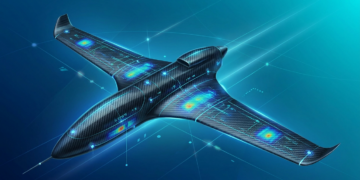













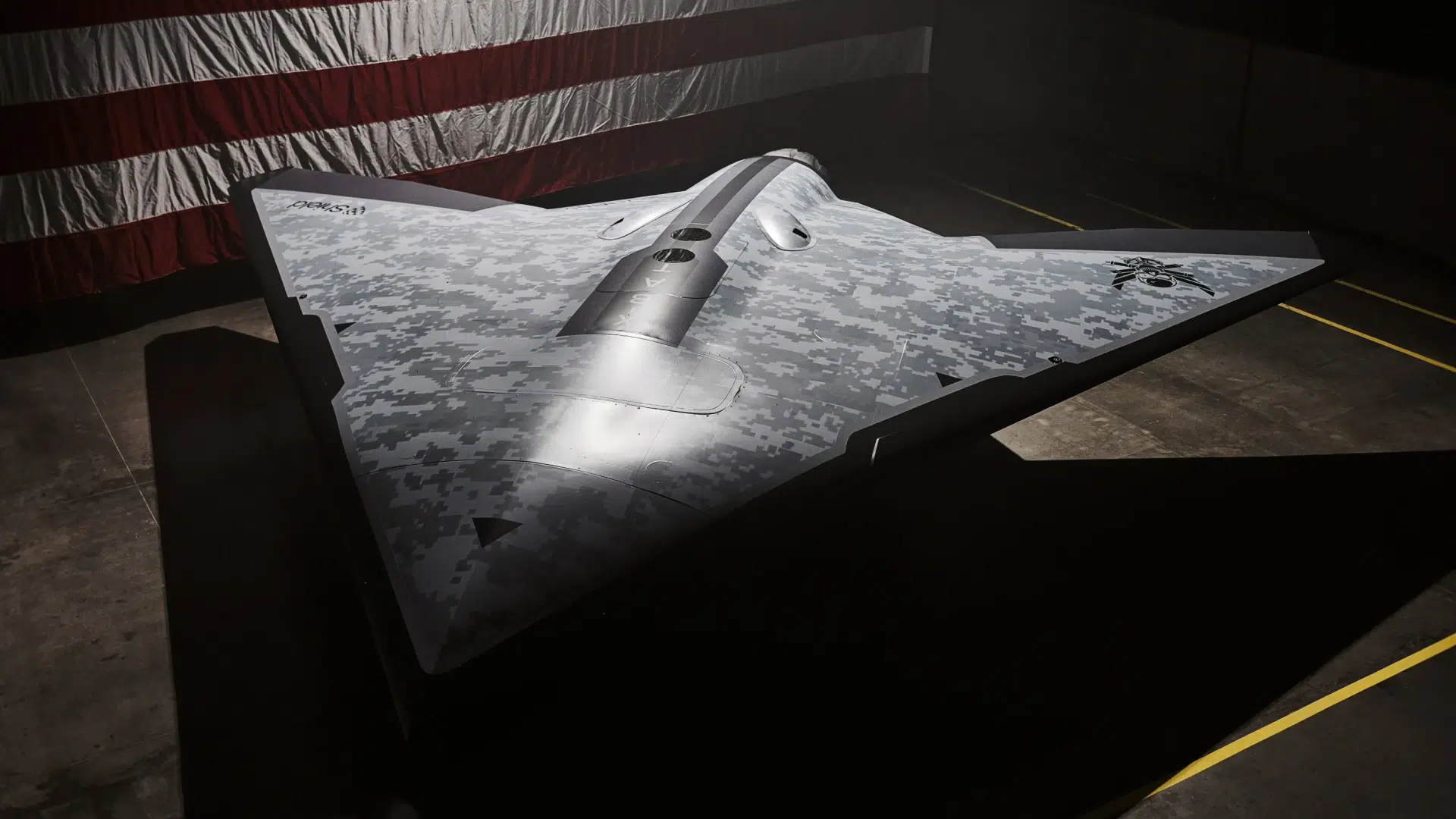
The first full-scale prototype of Shield AI’s X-BAT has been completed and is being transported to a flight test facility in Kansas for vertical takeoff and landing tests. According to the company, X-BAT is a multirole autonomous strike fighter aircraft twice the size of Increment 1 CCAs.
Shield AI is transporting its autonomous vertical takeoff and landing (VTOL) prototype, completed within one year, from its development facility in Frisco, Texas, to Newton, Kansas. Following a year of design and manufacturing efforts, the company stated that X-BAT’s development is ongoing and that several stages remain to be completed.
X-BAT’s Multirole Mission Capabilities
Shield AI is working with the U.S. government on engineering efforts to ensure the timely delivery of the capabilities required during X-BAT’s development. Over the past year, wind tunnel, engine, and thermal tests have been conducted to address major technical risks. Developed as a multirole platform capable of meeting current operational needs and adapting to evolving mission requirements, X-BAT is designed to carry strike munitions both internally and externally. The aircraft will also be capable of conducting air-to-air combat, air-to-ground strike, and electronic warfare missions. According to the company, while the U.S. Air Force’s Increment 1 Collaborative Combat Aircraft (CCA) are being developed as significantly smaller platforms focused exclusively on air-to-air missions, X-BAT is twice their size and offers air-to-ground strike capabilities and a greater number of sensors. Shield AI expects X-BAT, powered by an F110 engine with thrust-vectoring capability, to deliver flight performance closer to that of fighter aircraft compared with these smaller platforms equipped with Williams-type engines.
X-BAT to Undertake Strike Missions
Developed to operate from different locations thanks to its vertical takeoff and landing capability, X-BAT is intended to expand deployment options while making the platform more difficult to detect and destroy. The company stated that the aircraft, designed to reduce dependence on traditional air bases vulnerable to long-range missiles, will be capable of operating from ships at sea, islands along the First Island Chain, and various operational areas. Shield AI noted that X-BAT’s ability to deploy across multiple locations could force adversaries to devote more time and resources to locating the platforms. This could create favorable conditions for other U.S. military assets to conduct strikes, while X-BAT itself could undertake direct strike missions when necessary. The company believes this capability could alter the balance of power across different theaters of operation, particularly in the Pacific.
Following the completion of the first full-scale X-BAT prototype, the company is moving into the testing phase to validate its vertical takeoff and landing technology. Testing will begin with the aircraft’s engine being started while the platform is positioned horizontally on its launch and recovery vehicle. The aircraft will then be raised into a vertical position for engine and platform testing. During these tests, X-BAT will be suspended by a crane as a safety precaution to prevent it from falling to the ground in the event of an engine stall or another malfunction. Untethered flights are planned following these tests. While continuing efforts to develop X-BAT’s takeoff and landing capabilities, Shield AI aims to fly the aircraft equipped with mission systems in 2028 and begin production in 2029. The company intends to bring the platform into operational service following the completion of its development.
🔍 You may also like
Source: C4Defence – Sheild AI