








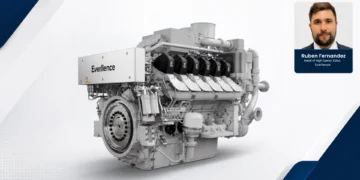








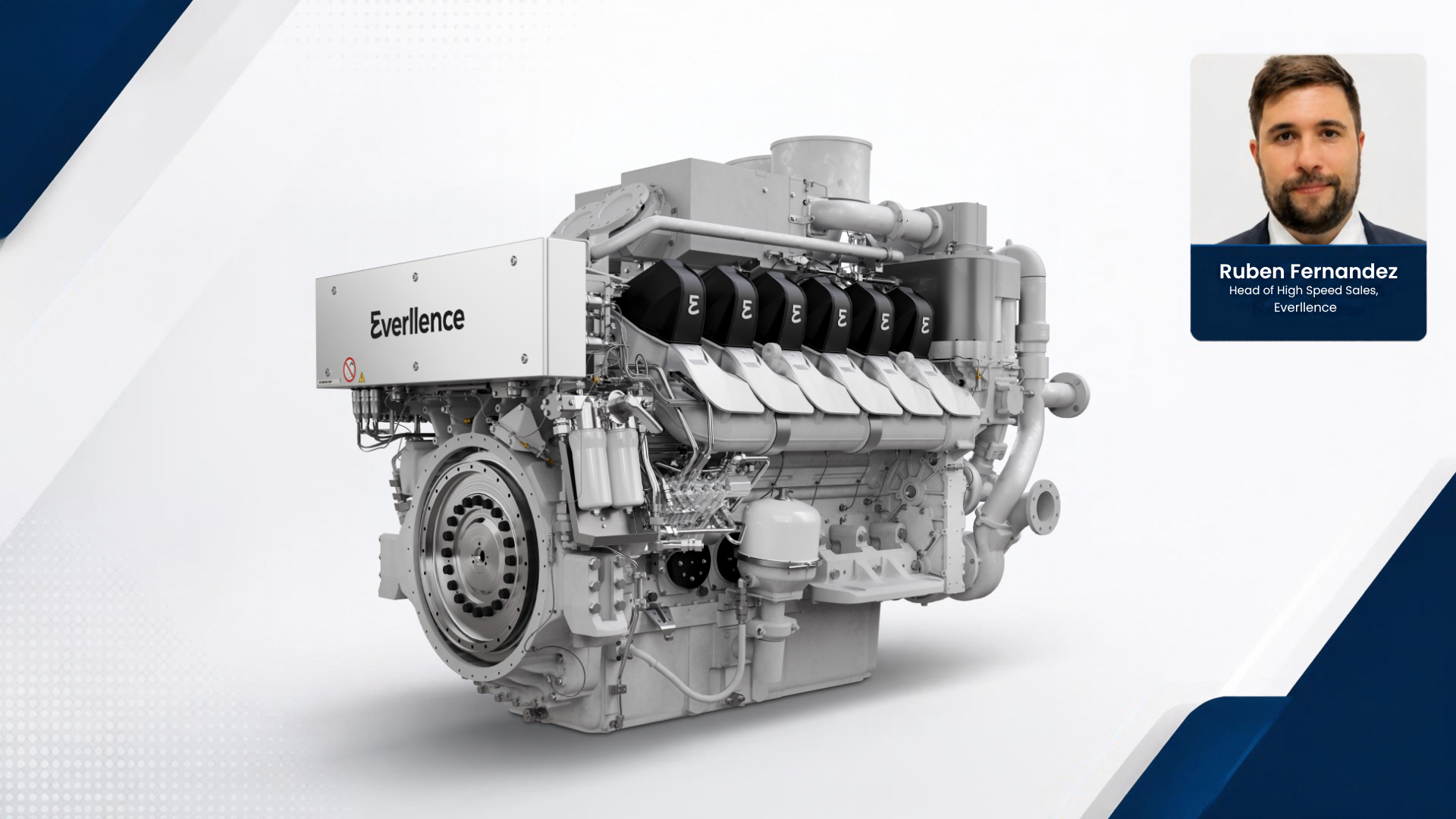
Operating under its corporate rebrand from MAN Energy Solutions, Everllence is meeting the growing power demands of modern warships with its 175D GenSet family. Ruben Fernandez, Head of High-Speed Sales at Everllence, discussed USV solutions and the potential for collaboration with Turkish shipyards and defense industry companies in an interview with C4Defence.

C4Defence: Following MAN Energy Solutions’ corporate rebranding as Everllence, how do the company’s next-generation GenSet solutions meet the growing power demands driven by AESA radars and advanced air-defence systems aboard modern warships?
Ruben Fernandez, Head of High Speed Sales, Everllence: When I look at the rebranding to Everllence, I would say it has been very successful. The new brand is now well established, but for me, the most important point is that our products, our people and our engineering capabilities have remained the same. We continue with the same pioneering spirit and the same focus on reliable, high-performance solutions for our customers.
In the naval sector, I see a shift in requirements. After a strong focus on anti-submarine warfare in recent years, I now see growing demand for anti-air warfare solutions, especially in NATO programmes. Modern surface combatants are being equipped with highly capable radar, sensor and weapon systems, and all of these systems need a lot of electric power. Ships that are designed today may still be in operation after 2060, so we cannot know exactly what the technology will look like then. But in my view, one thing is clear: a flexible, future-proof platform needs as much installed power as possible.
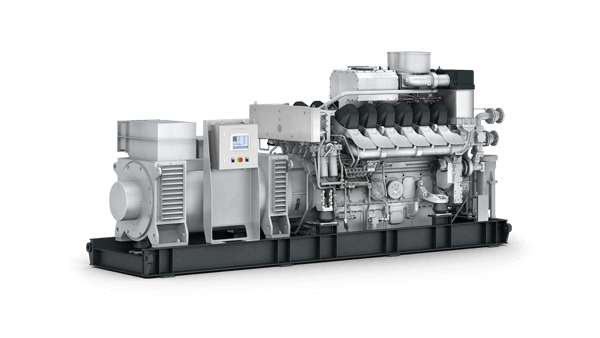
This is a challenge we have accepted at Everllence, and I believe we can support our customers with solutions that provide more power without making integration more difficult. As an extension of our existing high-speed and medium-speed portfolio, we recently introduced a new GenSet rating for the 175D. The 20V version is now available with 4.4 MW as a variable-speed GenSet, which is around 15 percent more than our previous highest rating.
This is enabled by modern DC ship architecture, which I consider state of the art for modern warships. With the new 175D GenSet rating, we can supply about 17.5 MW to the ship’s grid in a typical four-GenSet configuration, while keeping the same footprint and weight as before. At the same time, power level alone is not enough. Naval electrical systems also need to respond quickly when major consumers are connected. For me, this is where the 175D is especially strong: it combines high power density with fast load response. This gives naval architects a strong basis for today’s requirements and enough margin for future systems. In simple terms, it helps customers build warships that are powerful, flexible and ready for what comes next.
C4Defence: In terms of military standards such as acoustic and thermal signature management and shock resistance, what advantages do these GenSet systems offer to naval architects and ship designers?
Ruben Fernandez: Since the introduction of the 175D to the market over ten years ago, high-end naval projects have been a clear focus for us. These projects have very demanding requirements, especially when it comes to acoustic performance and shock resistance. For naval architects and ship designers, it is important to have a solution that can be adapted to the specific vessel.
One advantage we offer is our experience. We have a highly capable in-house team for noise, shock and GenSet design, and this allows us to tailor our systems to meet the highest standards currently demanded in the market. It also means that we can support the customer early in the design phase and find practical solutions for space, weight, foundation design, vibration behaviour, noise and service access.
This approach has been highly appreciated in several high-end naval programmes, especially in NATO-related projects. Examples include the Squadron 2020 project for the Finnish Navy, the ASWF programme with the Dutch and Belgian navies, and the fleet renewal of the Portuguese Navy with new OPVs and a drone carrier. Put simply, our GenSet systems give naval architects a reliable and flexible basis to meet demanding military standards while still keeping the overall ship design practical and efficient.
C4Defence: What does the 175D engine family’s high power-to-weight ratio and compact design bring to Unmanned Surface Vessels in terms of performance and space efficiency?
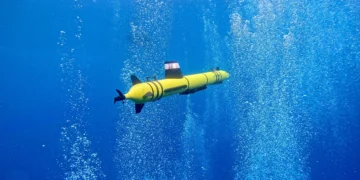
Ruben Fernandez: I see unmanned surface vessels as a very important trend, and in my view, we are only at the beginning of this development. The 175D is well suited for this because it combines very high power with the compact design you mentioned. This gives ship designers more freedom: they can use the available space efficiently, keep weight under control, and still have enough power for propulsion, sensors and mission systems.
At the same time, for USVs I believe reliability and robustness are the real cornerstone. Weight and compact design are important, but if there is no crew on board, the engine must first of all be dependable. Even a small failure, for example with an engine sensor, can put the mission at risk. That is why the engine must be able to support long periods of operation without direct human intervention.
This is also why we are adapting the 175D for USV applications. We have reviewed the maintenance strategy and intervals and made further improvements to the engine and its auxiliary systems. Together with our digital remote solutions, our target is to enable considerably more than 720 hours of unmanned engine operation. That is more than one month of continuous operation, and it strongly supports the growing use of unmanned surface vessels. Overall, the 175D gives USV designers the power, reliability and endurance they need to make these platforms practical, capable and mission-ready.
C4Defence:Reliability is a critical factor for these platforms during long-endurance missions. How do the 175D system’s maintenance intervals, durability, and remote condition-monitoring capabilities, such as digital twin technology, support operational continuity?
Ruben Fernandez: For me, reliability is the basis for everything. If reliability is not there, no other feature or performance value really matters. That is why we at Everllence take this topic extremely seriously and are constantly working to improve the reliability and stability of our engines.
Based on this foundation, we look at further features that bring value to the customer. One example is maintenance intervals. The 175D offers a strong benchmark for a long time between overhauls, which helps customers keep the vessel available for longer periods. At the same time, our background comes from large four-stroke and two-stroke engines, and this strongly influences the design philosophy of the 175D.
For maintenance and repair, the 175D is designed so that all work can be done directly in the engine room. We call this in-situ maintenance. Compared with maintenance concepts that require the engine to be removed from the vessel for a land-based overhaul, the 175D can be brought back into service in a fraction of that time. This is a major advantage for operational continuity.
You also mentioned remote condition monitoring. This is something we know well from commercial shipping, where it is already broadly established. With PrimeServ Assist, we can support customers by using operating data for remote expert support and trend analysis. For naval applications, this is more challenging because of cyber-security and data-handling requirements, but it is something we can manage, especially for USVs and also for conventional platforms.
To sum up, the 175D supports operational continuity by combining a reliable engine platform, long maintenance intervals, practical in-situ maintenance and digital support tools.
C4Defence:Given the growing prominence of Turkish shipyards in the global naval shipbuilding market, how do you view the potential for collaboration with Turkish defence industry companies on frigate, fast attack craft, and USV projects, and is there any such initiative currently underway?
Ruben Fernandez:Türkiye is a very important market for us, especially in the naval sector. We support both Turkish Navy programmes and projects that are built in Türkiye for export customers. In my view, Turkish shipyards and defence industry companies have become very strong international players, and they are often very open to innovation and practical technical solutions. This can be seen in several recent export projects, for example for the Portuguese and Malaysian navies.
For us, collaboration starts early. We work closely with shipyards, naval designers and system integrators to understand the vessel concept and to find the best technical solution. This is important for frigates, fast attack craft and future USV projects.
Another major advantage is our local organization in Türkiye. We have people close to the customers, strong service capabilities and our own workshops. This helps us not only during the project phase, but also throughout the life of the vessel. For naval customers, this local presence and close daily relationship are very important.
So yes, I see strong potential for further collaboration with Turkish defence industry companies. Türkiye is a naval market that combines ambition, speed and technical capability, and we are ready to support this with our experience, our product portfolio and our local team. At the end of the day, we want to be a reliable long-term partner for Turkish naval projects, from the first design discussion through to operation and service support.
C4Defence:Finally, is there any additional message you would like to share with our readers and the global maritime and defence sector, or a particular point you would like to emphasize?
Ruben Fernandez:I think we are living in a time when speed and readiness are more important than ever. Global tensions are rising, and navies need solutions that can be delivered and supported quickly. At the same time, the technical requirements are becoming more demanding, especially when we look at power generation, sensors, air-defence systems and unmanned platforms.
For me, this means that industry and governments need to work together even more closely. The best results come when navies, shipyards, designers and suppliers cooperate from the beginning. This helps to create solutions that are not only technically strong, but also practical, reliable and ready for operation.
At Everllence, we strongly believe in relationships and long-term partnerships. We want to support our customers not only with engines and propulsion systems, but also with experience, local presence, service and a clear understanding of naval requirements. In simple terms, we are ready to serve this market and to help our partners build naval platforms that are powerful, dependable and prepared for the future.

This interview was originally published in Turkish in [Issue 161] of C4Defence Magazine.