


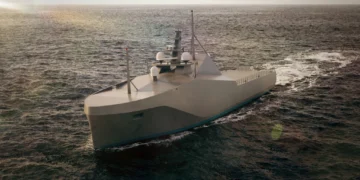



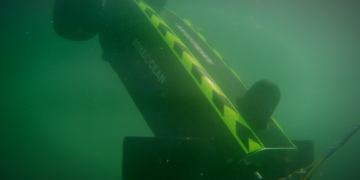





















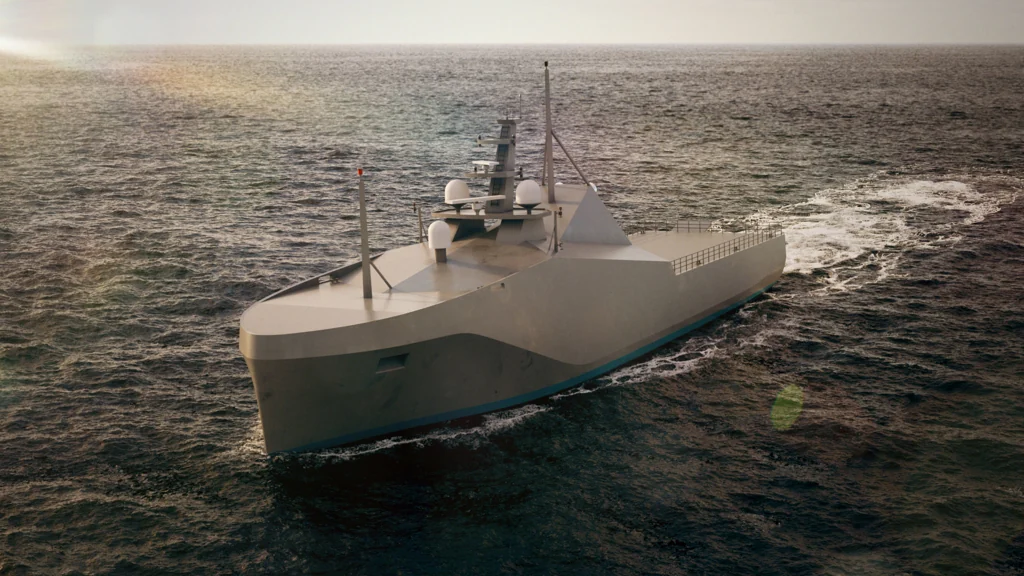
Kongsberg Maritime’s Arctic Hunter USV, developed to meet the Royal Navy’s hybrid fleet requirements, is intended to provide continuous sensing support for submarine detection missions in the Arctic.
Norwegian maritime technology company Kongsberg Maritime has unveiled the Arctic Hunter unmanned surface vessel (USV), developed for hybrid fleets in which manned and unmanned naval platforms operate together. Designed for anti-submarine warfare (ASW) missions in the Arctic region, the platform was developed to support the UK Royal Navy’s hybrid fleet initiatives. Combining its expertise in commercial vessel design with remote-control and autonomous systems technologies, Kongsberg Maritime has adapted one of its proven commercial vessel designs, previously developed and capable of operating in harsh Arctic conditions, to meet the Royal Navy’s Type 92 anti-submarine warfare requirements.
Technical Specifications of the Arctic Hunter
Kongsberg Maritime’s unmanned vessel technologies have been approved by the classification society DNV and the Norwegian Maritime Authority. The company stated that these approvals demonstrate its ability to meet the complex marine engineering and platform control requirements associated with operating large unmanned offshore vessels. The Arctic Hunter, which is planned to be rapidly constructed at commercial shipyards with military systems integrated by the defence industry, is expected to operate from a forward support base within the Arctic Circle. The platform is equipped with Thales UK’s sovereign submarine detection sonar and secure military communications systems, while its extensive payload capacity and deck space allow for the integration of various mission systems. The Arctic Hunter is also intended to strengthen the region’s existing multi-layered anti-submarine warfare infrastructure by providing continuous sensing capability.
Emphasising that Atlantic security is a key priority and describing the Arctic Hunter as a solution to growing submarine detection requirements, Kongsberg Maritime Chief Executive Officer (CEO) Lisa Edvardsen Haugan stated that the company has been designing vessels capable of operating in Arctic waters for more than 50 years. She noted that combining this experience with dynamic positioning, remote-control and autonomous systems technologies would contribute to the Type 92 programme. Working with its longstanding partner Balaena Maritime to accelerate the delivery process, Kongsberg Maritime plans to deliver the new vessels from the Birkenhead shipyard, with the aim of having them ready for military systems integration and operational deployment by the end of this decade.
International Cooperation for the Arctic Hunter
The company announced that the Arctic Hunter has the potential to be used not only by the UK Royal Navy but also by NATO and Joint Expeditionary Force (JEF) member nations. The Type 92 programme, based on the Arctic Hunter, supports the Lunna House Agreement, which aims to position the UK and Norway as leaders in the use of autonomous systems in the Arctic region within NATO. Kongsberg Maritime plans to sign technology cooperation agreements with Thales UK and Balaena Maritime during the Atlantic Future Forum in Oslo. The agreements are expected to strengthen defence industry cooperation between the two countries and support skilled employment.
🔍You may also like
Source: C4Defence–Kongsberg Maritime