

























A Lifecycle-Based Approach for Service Life, Condition-Based Maintenance, and Time-Critical Component Logistics
📌 Key Takeaways
- The extensive use of composite materials in UAVs/UCAVs highlights the growing necessity for advanced damage detection and tailored maintenance strategies.
- Structural Health Monitoring (SHM) data should extend beyond damage detection to serve as a vital input for lifecycle management and Integrated Logistics Support (ILS).
- Sensor data directly supports critical decision-making workflows, including damage severity assessment and maintenance task prioritization.
- Time-critical transportation models play an essential role in delivering mission-critical maintenance equipment to operational bases.
- Logistics performance must be evaluated not merely by transit time, but by its net impact on operational availability and maintenance efficiency.
Unmanned aerial vehicles (UAVs / UCAVs) extensively leverage composite materials due to their superior specific strength and rigidity. However, internal damage mechanisms—such as delamination, matrix cracking, fibre breakage, and debonding—resulting from impact, fatigue, environmental exposure, or operational loads are rarely detectable through visual surface inspection alone. This reality underlines the limitations of traditional calendar-based maintenance and elevates the necessity of Structural Health Monitoring (SHM), damage tolerance principles, and Condition-Based Maintenance (CBM) strategies.

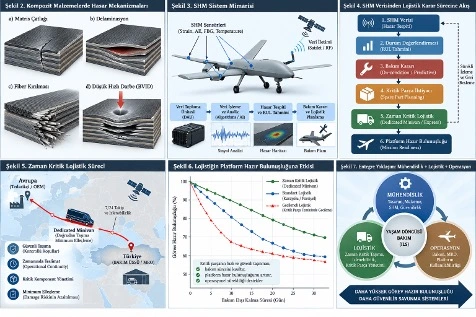
This study advocates treating SHM data not as an isolated damage detection signal, but as a core input for Integrated Logistics Support (ILS) and system lifecycle management. Within this framework, sensor data drives an end-to-end decision chain: mapping damage location and severity, predicting Remaining Useful Life (RUL), prioritizing maintenance tasks, generating spare part or repair kit demands, and triggering time-critical logistics actions.
Furthermore, this paper evaluates the engineering impact of dedicated express transportation models (such as dedicated minivans) in delivering mission-critical components, sensors, avionics modules, composite repair kits, and specialized tooling directly to field maintenance locations. The core premise is that logistics performance must be measured not solely by transit time, but by its overall impact on fleet availability, maintenance latency, handling exposure, transport conditions, and operational readiness.
Introduction
Range, endurance, payload capacity, and fuel/energy efficiency represent core performance metrics in UAV and UCAV design. Advanced composite materials enable these targets through high specific mechanical properties and tailorable anisotropic behavior. However, the failure mechanics of composites differ fundamentally from metallic structures; subsurface impact damage, delamination, and disbonding cannot be reliably assessed through visual inspection. FAA guidance on composite aircraft structures highlights that impact threats must be evaluated alongside damage severity and detectability (FAA, AC 20-107B).
Consequently, modern maintenance strategies cannot rely strictly on flight-hour intervals. A robust approach must simultaneously answer: What is the current structural state? How fast is damage propagating? When is intervention required? Where must supporting resources be staged? SHM delivers the data layer for this transition, while ILS integrates maintenance planning, spare parts management, technical documentation, support equipment, manpower, and procurement at a system level.
The central research question of this study is: How can structural health data gathered via SHM be transformed into actionable ILS inputs that drive near-real-time maintenance and logistics decisions for UAV fleets?
This paper presents a conceptual, systems-engineering framework connecting composite damage physics, SHM, residual life estimation, maintenance decision-making, and time-critical logistics across the platform lifecycle.
Damage Mechanisms and Service Life in Composite UAV Structures
Composite structures across UAV platforms—including wing skins, fuselage panels, empennage assemblies, control surfaces, radomes, sandwich panels, and bonded joints—are subjected to aerodynamic loads, vibration, thermal cycling, moisture ingress, ground handling impacts, foreign object debris (FOD), and landing forces during service.
Damage in composites rarely manifests as a single isolated fault. Matrix microcracking, fibre-matrix debonding, delamination, fibre rupture, core crushing in sandwich structures, and adhesive joint separation frequently interact and propagate. Therefore, “no visible damage” does not equate to structural integrity. Literature demonstrates that SHM holds strong potential in identifying subsurface or structurally inaccessible defects early.
From a service-life perspective, identifying damage existence is insufficient; determining its precise location, geometric progression, and impact on load-bearing capacity is paramount. This aligns directly with damage tolerance philosophy: the structure operates safely with acceptable damage levels while continuous monitoring triggers maintenance at predetermined thresholds.
Structural Health Monitoring (SHM): From Sensor Output to Engineering Decisions
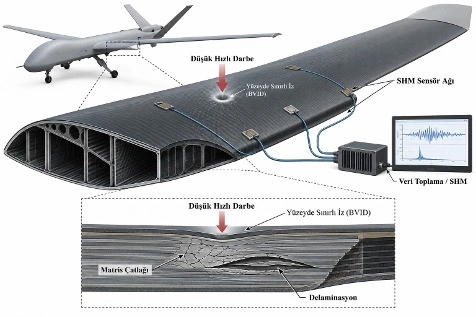
SHM operates as an integrated architecture comprising sensors, data acquisition hardware, signal processing algorithms, damage identification routines, and decision-support layers. In aerospace composites, common modalities include piezoelectric sensor arrays with guided waves, Fiber Bragg Grating (FBG) optical networks, acoustic emission monitoring, and strain-based embedded sensing. Sensor selection depends on structural geometry, target failure modes, environmental conditions, power/weight budgets, and processing constraints.
The operational value of SHM resides in translating raw sensor signals into actionable engineering and maintenance decisions. The data pipeline follows a structured progression: Measurement $\rightarrow$ Feature Extraction $\rightarrow$ Damage Detection $\rightarrow$ Localization $\rightarrow$ Severity Assessment $\rightarrow$ Prognostic Prediction $\rightarrow$ Maintenance Threshold Verification. Generating anomaly alerts without integrating them into logistics and maintenance systems yields minimal gain in platform availability.
Integrating SHM Data into Integrated Logistics Support (ILS)
The goal of ILS is to guarantee system supportability and operational availability throughout its lifecycle from early design stages. In UAV operations, linking SHM data into ILS workflows aligns maintenance planning, inventory management, technical publications, support equipment, training, and configuration control directly with real-time structural health.
For example, when a damage index on a wing panel nears a maintenance threshold, the system should not merely log a technical alert—it should automatically trigger a logistics query: Is a replacement panel or composite repair kit in stock? Where is it located? Are certified technicians and non-destructive testing (NDT) tools available on site? What is the estimated arrival time for the required material? Resolving these questions within a unified decision model represents true Condition-Based Maintenance.
In the proposed framework, SHM outputs are logged as “condition events” within the Maintenance Management System (MMS). The damage classification and estimated Remaining Useful Life (RUL) are evaluated against upcoming mission profiles. If projected RUL falls below the planned mission cycle or safety margins, maintenance work orders and material transport are automatically prioritized.
Condition-Based Maintenance, RUL, and Operational Readiness
The primary benefit of CBM is transitioning from fixed-calendar or flight-hour intervals to actual physical condition monitoring. This minimizes unnecessary teardowns and inspections while ensuring critical damage is addressed before reaching dangerous thresholds. Literature confirms that mature SHM implementations enhance maintenance efficiency and lower overall lifecycle costs
In UAV operations, fleet readiness depends as much on logistics delays as it does on hands-on wrench time. Total downtime encompasses fault verification, engineering assessment, maintenance scheduling, spare parts lead time, transportation duration, customs/clearance procedures, and physical repair. Among these, spare parts availability and transportation bottlenecks often dominate international supply chains.
Consequently, RUL estimates must be evaluated alongside logistics lead times. If safe remaining operational time is shorter than standard supply chain lead times, the requirement automatically shifts to “time-critical” status. Structural health metrics thus directly dictate logistics service levels.
Time-Critical Logistics and the Engineering Role of Dedicated Express Models
In defence and aerospace supply chains, time-critical logistics signifies more than speed. It requires delivering mission-critical components in correct configurations through controlled, low-handling processes with end-to-end visibility. Across European–Turkish corridors, dedicated express/minivan models offer direct point-to-point transit, minimal handling, and operational flexibility for high-value, time-sensitive payloads
From an engineering perspective, the benefits focus on three main areas:
- Downtime Reduction: Direct routing drastically shortens transit times, reducing platform downtime.
- Risk Mitigation: Minimizing transshipment points reduces handling hazards for delicate, high-value components.
- Predictability: Vehicle-level real-time tracking provides accurate arrival estimates, streamlining maintenance scheduling.
These benefits must be validated against technical specifications, including temperature, humidity, shock/vibration limits, ESD protection, dangerous goods regulations, and security clearance requirements.
Candidates for time-critical transport include composite repair kits, portable curing units, sensors, data acquisition modules, precision-machined structural parts, line-replaceable units (LRUs), and specialized NDT gear. Decision criteria extend beyond monetary part value to include the platform downtime cost and mission impact caused by part absence.
Key Performance Indicators (KPIs)
Evaluating SHM–ILS–logistics integration solely on freight costs or transit hours is insufficient. Performance metrics must directly reflect system availability. Recommended KPIs include:
- Detection-to-Decision Time: Elapsed time from damage detection to engineering maintenance approval.
- Order Trigger Latency: Time from maintenance decision to logistics dispatch.
- Critical Part Lead Time: Combined procurement and transit duration.
- ETA Accuracy: On-time arrival performance against scheduled maintenance windows.
- Handling Operations: Total transshipment and transfer steps per leg.
- Environmental Limit Compliance: Excursion counts for shock, vibration, temperature, and humidity.
- Awaiting-Parts Downtime: Maintenance delays attributed to parts unavailability.
- Mean Logistics Delay Time (MLDT): Overall logistics delay contribution to downtime.
- Fleet Availability / Mission Capable Rate: Net operational impact on fleet readiness.
- First-Pass Acceptance Rate: Post-maintenance functional verification success on the first attempt.
These metrics evaluate logistics providers based on their contribution to platform mission readiness rather than as isolated transport functions.
Digital Twins and the Future SHM–ILS Architecture
Merging SHM stream data with Digital Twin frameworks enables dynamic structural health tracking for individual airframes. By accumulating flight load histories, environmental exposure logs, sensor streams, maintenance records, and configuration changes within a single digital model, RUL predictions become highly contextualized.
Within this setup, logistics operates inside the digital twin environment rather than as an external task. Integrating stock locations, shipping lead times, customs steps, transport modes, and maintenance berth capacities into the digital model allows the system to determine not only when maintenance is needed, but how and when replacement components must move to meet the window.
This shifts defence logistics from reactive emergency transport to predictive, data-driven dispatch. Time-critical logistics transforms from an unexpected crisis fix into a controlled operational tool triggered directly by prognostic algorithms.
Discussion
Integrating SHM into UAV fleets presents notable opportunities alongside technical and operational challenges. Sensor weight, power draw, environmental signal noise, false alarm rates, cyber security, algorithm verification, airworthiness certification, and human-in-the-loop workflows remain key integration factors. Furthermore, moving from raw SHM signals to reliable RUL estimates requires validated fracture mechanics models and extensive field data.
Similarly, time-critical logistics is not a one-size-fits-all default. Deploying dedicated express models requires balancing part criticality, RUL, standard lead times, operational schedules, dimensions, security protocols, and cost-benefit ratios. The objective is dynamic logistics service allocation based on engineering criticality rather than rushing every shipment.
The primary contribution of this research lies in treating SHM, maintenance execution, ILS, and time-critical transport as a single lifecycle optimization challenge. While existing literature often separates structural health monitoring from supply chain management, linking them via RUL metrics and mission capability offers a clearer path toward optimized fleet availability.
Conclusion
Maintaining structural integrity and operational readiness in composite UAV/UCAV fleets requires more than high-performance materials and advanced design. Early damage detection, accurate structural health interpretation, timely maintenance decisions, and precise, scheduled component logistics are interconnected elements of a single operational ecosystem.
This study demonstrates the necessity of integrating SHM data directly into ILS workflows and evaluating RUL alongside logistics lead times. The proposed decision chain—Damage Detection $\rightarrow$ Health Assessment $\rightarrow$ RUL Estimation $\rightarrow$ Maintenance Decision $\rightarrow$ Logistics Triggering $\rightarrow$ Time-Critical Transport $\rightarrow$ Maintenance Execution $\rightarrow$ Return to Service—aligns maintenance and logistics workflows toward maximizing platform availability.
When selected through rigorous criticality analysis, direct, minimal-handling transport solutions like dedicated express minivans serve as effective operational tools for international, time-sensitive supply needs. Future research should focus on combining flight SHM datasets, maintenance logs, logistics transit metrics, and operational availability figures to further quantify the lifecycle cost impact of prognostic maintenance and logistics integration.
References
1. Diamanti, K., & Soutis, C. (2010). Structural health monitoring techniques for aircraft composite structures. Progress in Aerospace Sciences, 46(8), 342–352.
2. Federal Aviation Administration (FAA). (2009, Change 1). AC 20-107B: Composite Aircraft Structure.
3. Federal Aviation Administration (FAA). (2010). AC 21-26A: Quality Control for the Manufacture of Composite Structures.
4. INCOSE. (2023). Systems Engineering Handbook: A Guide for System Life Cycle Processes and Activities (5th ed.). Wiley.
5. MIL-STD-810H. (2019). Environmental Engineering Considerations and Laboratory Tests. U.S. Department of Defense.
6. NATO. (2018). Allied Joint Doctrine for Logistics (AJP-4, Edition B Version 1).
7. NATO. (2020). AAP-48: NATO System Life Cycle Stages and Processes.
8. Ogunleye, R. O., Rusnáková, S., Javořík, J., Žaludek, M., & Kotlánová, B. (2024). Advanced Sensors and Sensing Systems for Structural Health Monitoring in Aerospace Composites. Advanced Engineering Materials, 26, 2401745.
9. Ricci, F., Monaco, E., Boffa, N. D., Maio, L., & Memmolo, V. (2022). Guided waves for structural health monitoring in composites: A review and implementation strategies. Progress in Aerospace Sciences, 129, 100790.
10. SX000i Working Group. (2020). International Guide for the Use of the S-Series Integrated Logistic Support (ILS) Specifications.
11. Tuloup, C., Harizi, W., Aboura, Z., Meyer, Y., Khellil, K., & Lachat, R. (2021). Sensors for process and structural health monitoring of aerospace composites: A review. Engineering Structures, 237, 112231.
12. U.S. Department of Defense. (2022). Integrated Product Support (IPS) Element Guidebook. 13. U.S. Department of Defense. (2023). Performance Based Logistics (PBL) Guidebook.
Ceyla Akın – Mechanical Engineer (M.Sc.). / This analysis was originally published in C4Defence Magazine.