


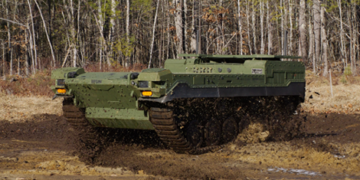














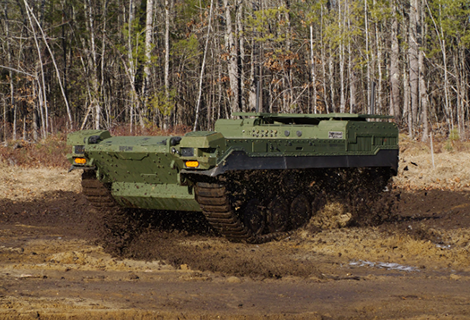
The US Marine Corps will use the RIPSAW M3, which has a payload capacity exceeding 2,268 kilograms and a modular open systems architecture, in experimental testing.
Textron Systems and its subsidiary Howe & Howe announced that they will supply two RIPSAW M3 robotic ground vehicles to the US Marine Corps. The vehicles will be used as test platforms for experimental activities and systems integration testing at the Marine Corps Warfighting Laboratory (MCWL) in Quantico, Virginia. The US Marine Corps will be able to integrate different mission payloads and sensors into the vehicles to test various mission scenarios. The work is also expected to help define requirements for future robotic systems.
Technical Specifications of the RIPSAW M3
Developed by drawing on more than 60 years of experience in unmanned technologies across the air, land and maritime domains, the RIPSAW M3 uses a Modular Open Systems Architecture (MOSA) that supports the integration of different sensors and mission equipment. This architecture enhances the vehicle’s agility and functionality in complex combat environments, allowing it to be adapted to different mission requirements. With a payload capacity exceeding 5,000 pounds (approximately 2,268 kilograms), the vehicle can reach speeds of more than 30 mph (approximately 48 km/h). Its flat top deck allows different mission payloads to be carried. These features are intended to enable the vehicle to support various missions in challenging terrain conditions across different geographical regions.
Textron Systems Vice President of Programmes Sara Willett highlighted the RIPSAW M3’s speed, agility and multi-mission capabilities, stating that combining the vehicle’s existing capabilities and reliability with MCWL’s work on developing future operational concepts would advance the US Marine Corps’ unmanned force structure and the use of these systems on the battlefield. Howe & Howe Senior Vice President Michael Howe stated that the company has spent more than 20 years developing advanced, multi-domain robotic platforms designed with durability in mind for use in challenging terrain conditions.
Cooperation on Autonomous Systems
Howe stated that the RIPSAW M3 is well suited to meeting the US Marine Corps’ requirements for challenging environmental conditions and that the company would work closely with the Marines to develop technologies addressing future requirements. Textron Systems reported that it has accumulated more than three million operational hours with unmanned systems across the air, land and maritime domains, adding that it continues to develop its autonomous technologies to support current and future mission requirements. The company stated that the work is being carried out under an Other Transaction (OT) agreement with the National Advanced Mobility Consortium, with support from the US government.
🔍 You may also like
Source: C4Defence – Textron