














InnotalentPlus Founder and Innovation Strategist, Independent Board Member at Altınay Defence Technologies, Güven Karaöz, told C4Defence about Dual-Use as the natural architecture of the new era of security and technology.

C4Defence: As InnotalentPlus, you have announced a new structure called “Dual-Use Studio” to the public. Let’s start here: What does Dual-Use mean to you?
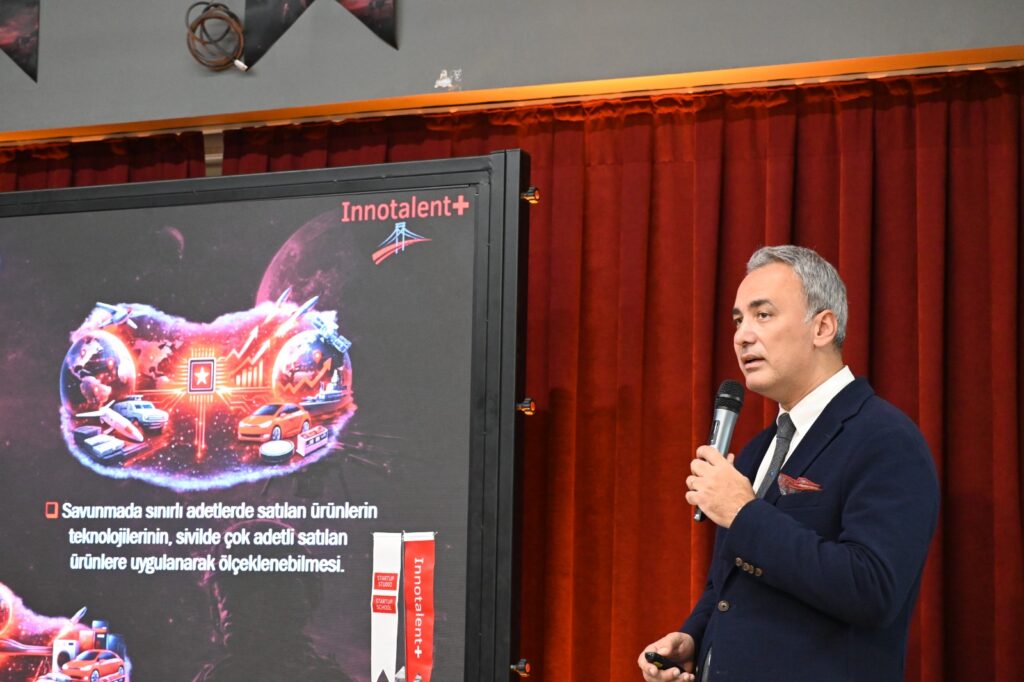
InnotalentPlus Founder & Innovation Strategist Güven Karaöz: Dual-Use is not simply “selling products to both civilian and defense markets,” as many startups assume. From our perspective, dual-use is not a category; it is a strategy. As we specifically emphasized in our launch presentation, the issue is not merely accessing two markets at once; it is about developing an institutional reflex capable of managing two different dynamics simultaneously while designing, scaling, and positioning technology.
In defense, aviation, and space, products typically progress in limited quantities, with high technical standards and long procurement cycles. On the civilian side, however, high-volume sales, rapid iteration, and price competition dominate. A Dual-Use strategy means scaling the technical depth of defense into civilian markets; and transferring the speed, feedback, and cost advantages from civilian markets into defense. The best aspects of these two worlds need to be brought together systematically. The structure we have established exists precisely for this purpose.
C4Defence: Why now? What role does the global conjuncture play in this move?
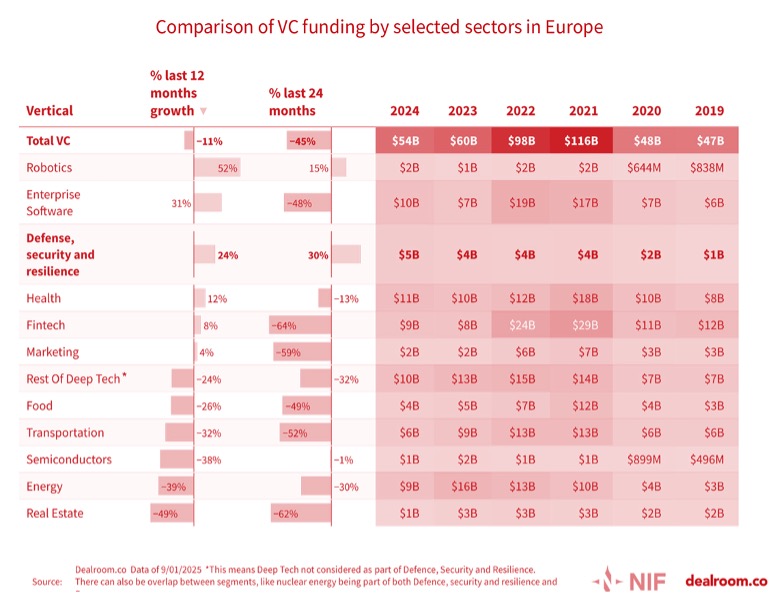
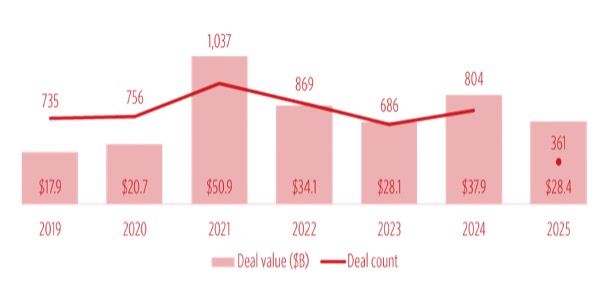
Güven Karaöz: The timing is not coincidental. In the 2024–2025 period, there has been a significant capital shift globally. While total VC investment in Europe has contracted by 45 percent over the past two years, we observe that the “defense” and “security & resilience” vertical has increased fivefold, rising steadily from the $1 billion level in 2019 to $5 billion by 2024. When we look at the overall picture, we see that it is the only vertical showing consistent growth.
As of 2025, investments in defense technologies have exceeded $28 billion; in the second quarter alone, more than $19 billion in VC investment was realized.
Mechanisms such as the NATO DIANA program, the NATO Innovation Fund, the European Defence Fund (EDF), and EUDIS are now placing defense innovation within an institutional and permanent framework. More importantly, with trends such as “friendshoring” and “onshoring,” supply chains are being geopolitically reshaped.
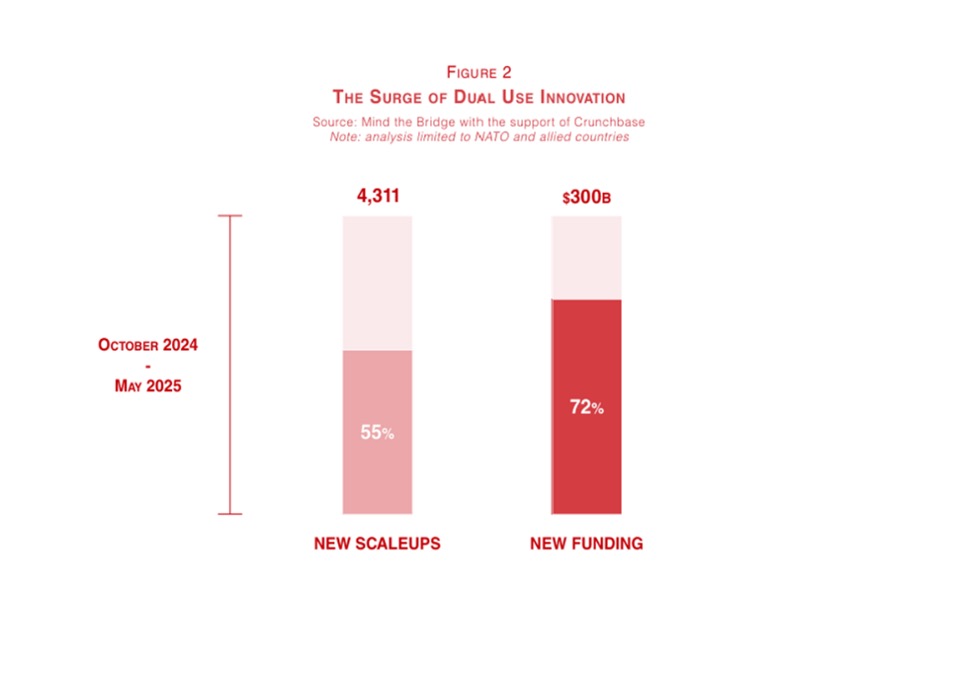
The data is even more striking: according to October 2024 – May 2025 data from Mind the Bridge and Crunchbasecovering NATO and Allied Countries, 55 percent of the total 4,311 newly scalable startups (scaleups) operate in the dual-use domain. During the period examined, total new investments amounted to $300 billion, of which 72 percent went to dual-use ventures. This picture demonstrates that the increase in investment in the dual-use field in 2025 is not merely a temporary wave, but a structural capital shift.
Türkiye cannot afford to remain outside this picture. However, this opportunity cannot be captured with a fragmented and reactive approach. Dual-Use Studio was designed to fill this gap.
C4Defence: At the launch, you specifically addressed the question “Why Dual-Use Studio?” under the heading of “pain points.” Where exactly is the problem in Türkiye?
Güven Karaöz: There are three fundamental fractures.
First, startups misunderstand the concept of Dual-Use. Most startups either romanticize the defense side or ignore it entirely. Saying “we can also sell to defense” without taking into account dynamics such as regulation, certification, security bureaucracy, and long sales cycles is not realistic.
Second, there is a lack of interface between the public sector and startups. The security bureaucracy and the startup ecosystem speak different languages. One side is focused on risk minimization; the other operates with a rapid trial-and-error culture. There is almost no structure that can act as a translator between these two cultures, understanding the dynamics of both sides.
Third, the number of structures in Türkiye that truly own the Dual-Use concept end-to-end is almost negligible.
Fourth, regulatory uncertainty makes startups uneasy. Topics such as Legal Readiness Level, risk and compliance strategy design are almost never discussed.
Dual-Use Studio was designed to systematically close these gaps.
C4Defence: You held launch events on February 9 at Ankara Bilkent TEKMER and on February 16 at Istanbul ITU ARI Teknokent. Was there a strategic meaning behind organizing two launches in two different cities one week apart?
Güven Karaöz: Absolutely. Ankara is the heart of the defense, aviation, space, and intelligence ecosystem. The public sector, prime contractors, and the security bureaucracy are based there. Istanbul, on the other hand, is the center of entrepreneurship, investment, and university–industry collaboration. Of course, this does not mean that there are no significant companies in Istanbul working with the defense industry. However, Ankara’s technology climate and mindset are somewhat closer to the fields I just mentioned.
For us, Bilkent TEKMER and İTÜ ARI Teknokent are not merely hosts, but strategic partners. On this occasion, I would like to sincerely thank Mr. Ali Serkan Dündarlı, Chairman of the Board of Bilkent TEKMER & HANE, and Prof. Dr. Attila Dikbaş, General Manager of İTÜ ARI Teknokent, for the valuable climate of collaboration they have created. The Dual-Use ecosystem cannot be a single-city structure. Defense is predominantly centered in Ankara, while capital and scale are concentrated in Istanbul; however, we aim to reach valuable stakeholders across every province of our country—from east to west, north to south. We aspire to serve as a bridge between Ankara and Istanbul and other cities and countries.
In Istanbul, we also officially launched our Dual-Use Acceleration Program, which we will implement together with İTÜ ARI Teknokent and İTÜ Çekirdek. Startups selected for this program will gain the opportunity to take the stage at the Dual-Use platform, which will appear for the first time at one of the ecosystem’s most prominent arenas, the İTÜ Çekirdek Big Bang.
At the Ankara launch, there was strong interest from representatives of the public sector and the defense industry. In Istanbul, we were joined by representatives of public institutions and defense companies, distinguished commanders who have proudly worn the uniform of the Turkish Armed Forces, investors, startups, and scaleups. Seeing diverse ecosystem stakeholders gather around Dual-Use Studio is extremely valuable for us. In this context, I would like to thank Mr. R. Ruşen Kömürcü, General Manager of ULAK A.Ş., and Dr. Oğuz Hamşioğlu, Secretary General of SASAD, for standing with us as ecosystem partners.
C4Defence: At the launch, you presented a comprehensive value proposition set. Could you elaborate on all the headings?
Güven Karaöz: Certainly. Dual-Use Studio has currently been structured around twenty-three main value propositions, and each of these headings represents not isolated services but components of an integrated system.
At the first stage, we prepare companies for Dual-Use. We design Dual-Use innovation strategies aligned with their core strategies, develop Dual-Use-focused innovation and entrepreneurship programs, and analyze the Dual-Use adaptability of existing technologies. In doing so, we present concrete data to reveal the gap between a company’s current position and the defense or civilian industry it aims to enter.
Within this framework, we measure the Dual-Use and innovation readiness levels of startups and technology-intensive SMEs, clearly identifying where they stand. This readiness assessment covers not only technical maturity but also legal, operational, and strategic alignment.
When necessary, through a Dual-Use-focused venture building approach, we co-build startups together with established companies seeking entry into the defense industry. In other words, we do not merely provide guidance; we sit at the table and establish companies together.
Subsequently, we develop accurate positioning strategies in both civilian and defense markets and provide internationalization services to portfolio companies. We integrate the long sales cycles of the defense side with the speed expectations of the civilian market within a unified plan.
On the visibility side, we provide media support through partnerships with defense industry magazines.
On the investment side, we will offer access to the portfolio of a Dual-Use-focused venture capital fund in which Dual-Use Studio will act as the GP.
Our interface role is a critical pillar. We professionally manage investor relations while also ensuring the establishment of healthy and sustainable relationships with the security bureaucracy.
In terms of model design, we work on both “Inside-Out” and “Outside-In” frameworks, constructing models that enable innovation to flow from defense to civilian markets and from civilian markets back to the field.
Within the scope of preparation for international programs, we manage application and positioning processes for mechanisms such as NATO DIANA.
Regarding access to finance, we provide training and consultancy on national and international funds, grants, and incentive mechanisms.
In terms of mentorship support, we offer both technical and business model mentoring, and through the platform of the startup FlexVision, we match ventures with professionals of public-sector origin.
On the legal, risk, and compliance front, we conduct SLRL (Startup Legal Readiness Level) assessments and design the necessary legal infrastructure.
For ecosystem activation, we organize integrated Ideathon, Hackathon, and Demo Day events with armed forces units and companies, and we run sponsored Dual-Use incubation and acceleration programs.
We are also launching the Defence Innovation Leaders (D.I.L.) Program.
Together with our ecosystem partner companies, we create opportunities for PoC, R&D/Product Development, commercialization/internationalization, and technical mentorship for startups.
In addition to our “Dual-Use Innovation Talks” branded events, we will organize an annual Dual-Use Summit.
Each year, we will publish the “Dual-Use Entrepreneurship Ecosystem Report” to strengthen the intellectual foundation of the field.
Finally, through the “Mission: Next” program, we offer an innovation- and entrepreneurship-based repositioning model for veterans.
Each of these headings is not an independent service item; rather, they are holistic components of a strategy to build a sustainable, measurable, and scalable ecosystem in the Dual-Use domain.
C4Defence: You mention the “Inside-Out” and “Outside-In” models. Could you elaborate on this model?
Güven Karaöz: In the “Inside-Out” model, innovation is generated internally—within the security bureaucracy and the military—and then diffuses into the civilian sphere. Defense companies possess technical excellence, mission focus, and a culture of discipline. When this mindset is properly transferred into the startup ecosystem, highly powerful structures emerge.
In the “Outside-In” model, knowledge and speed are transferred from the civilian sphere to the field. Rapid iteration, user feedback, and cost optimization from civilian markets create value on the defense side.
A Dual-Use strategy means institutionalizing this bidirectional flow. Our model systematizes this two-way transition.
C4Defence: The “Mission: Next” program particularly drew attention. What is the motivation behind this approach aimed at veterans?
Güven Karaöz: Individuals who have served for years in the Turkish Armed Forces and security bureaucracy institutions and who became veterans without hesitation—even for a moment—for people they had never met possess immense mental discipline, field experience, and a strong sense of duty. Yet the system does not sufficiently utilize this potential. Through this program, we aim to enable them to share their experience in the fields they know best, while also supporting their psychological rehabilitation.
Within the scope of the “Mission: Next” program, we will provide our veterans with training in innovation, entrepreneurship, and Dual-Use competencies; at the same time, we will offer startup mentorship training. Veterans who complete this formation may serve as mentors within a startup or technology-intensive SME, or integrate into the new economy in roles such as Board Advisor, salaried employee, or equity-based contributor—operating in areas they know best.
This strategic approach of Dual-Use Studio will bring together security culture and entrepreneurial culture. Our veterans can naturally become key actors of this bridge. In the second phase, we plan to implement this model for personnel who are close to retirement, designing a post-retirement path integrated into the new economy.
C4Defence: What are your strongest capabilities? What differentiates you from other structures?
Güven Karaöz: First, we are not alone. Our studio brands—Strategy Studio, Legal Lab Studio, Innovation Studio, Digital Transformation Studio, AI Studio, Finance Studio—along with our Startup School brand, stand alongside us. Receiving support particularly in legal, financial, and strategic matters when needed is highly important.
Our strategic partnerships with İTÜ ARI Teknokent and Bilkent TEKMER; our public-sector experience, particularly with the Presidency of Defence Industries; our experience in designing corporate entrepreneurship and open innovation systems; our business NGO network; our participation in the Dual-Use consortium under HANGAR BİGG together with TUSAŞ and TEKNOPARK ANKARA; our board-level experience in defense companies; our plan to establish a Dual-Use-focused venture capital fund; our proximity to the investment ecosystem; and the international network we have begun to build through our country representatives—these constitute our core strengths.
C4Defence: Who is your target audience?
Güven Karaöz: Universities, technoparks, large-scale prime contractors in the defense industry, public institutions, startups with dual-use potential, technology-intensive SMEs / mid-sized enterprises, companies seeking to take action in line with a dual-use strategy—particularly those aiming to establish a CVC (Corporate Venture Capital) structure—and investors.
Our main objective is not to position these actors individually, but collectively. Dual-Use is not a game played alone. It requires ecosystem design. As InnotalentPlus, we have been striving to build this from day one.
C4Defence: Finally, let’s get to know you a bit. What motivated you to establish this structure?
Güven Karaöz: I have been working in the field of innovation strategy for many years. I have engaged with both defense and civilian industry companies in corporate entrepreneurship, open innovation, and strategic-level organizational agility transformation projects. I clearly observed one thing: although there are exceptions, the two worlds generally either misunderstand each other or do not understand each other at all.
The defense side perceives startups as risky; startups see defense as slow and bureaucratic. Yet the reality is this: the technologies of the future—artificial intelligence, robotics, advanced materials, cybersecurity, and similar fields—are inherently dual-use by nature.
Seeing this gap and not taking action was not an option for me. Dual-Use Studio is not the product of a personal vision; it is an outcome of the problems and pain points we have identified. Instead of continuously diagnosing the situation, complaining, and merely talking about these issues, we chose to take action.
C4Defence: What is your goal for the next 3–5 years?
Güven Karaöz: For the Dual-Use concept in Türkiye to evolve into a substantive, measurable, and sustainable model. For Turkish startups to become more visible in programs such as NATO DIANA. Our aim is also to take action in verticals aligned with our own core needs and warfare concepts. We want the Dual-Use-focused venture capital fund to become an active investment player, and most importantly, for the bridge established between defense and civilian sectors to become permanent.
Dual-Use is not a trend. It is the natural architecture of the new era of security and technology. We are here to take an active role in building that architecture.
SOURCE: C4Defence