














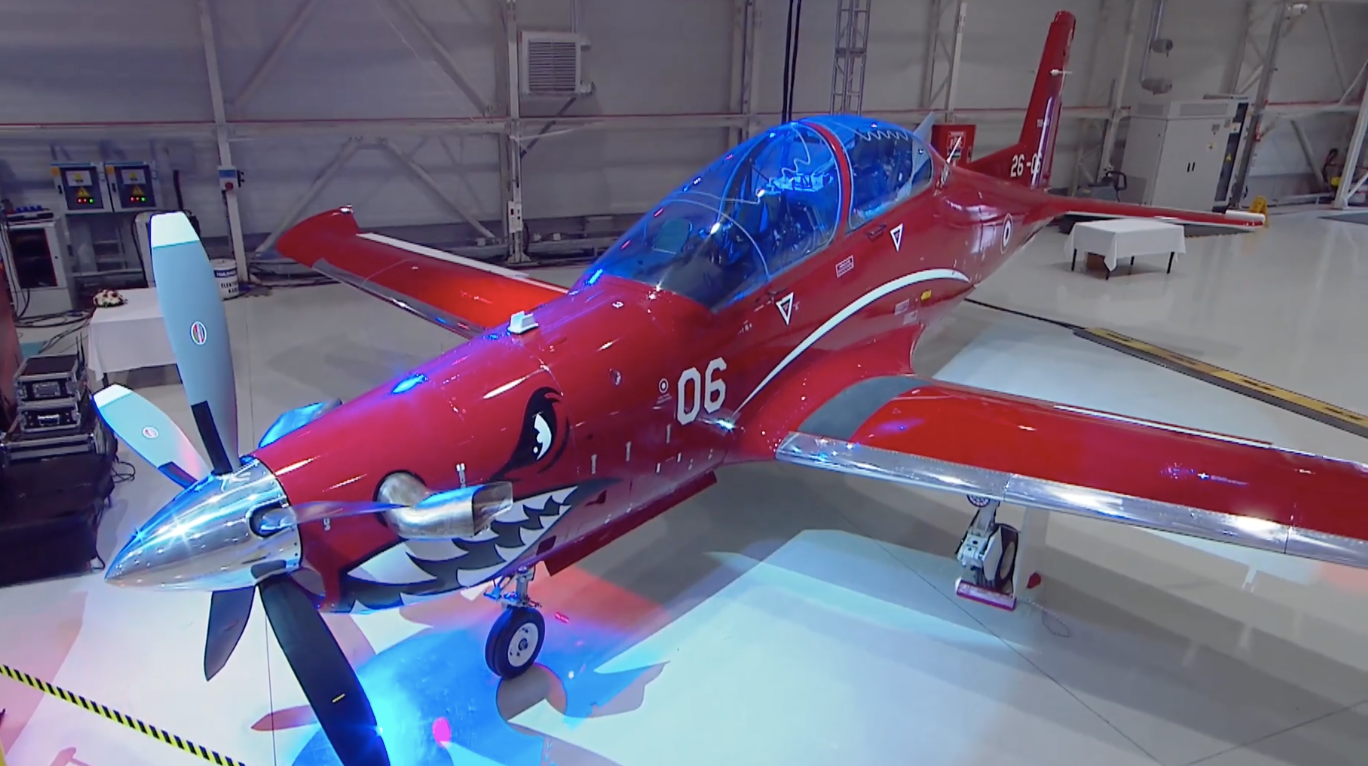
Developed nationally by TUSAŞ, the New Generation Basic Training Aircraft HÜRKUŞ-II has entered the inventory of the Turkish Air Force Command following its military-type certification. While the first two aircraft have been delivered, the delivery of 12 more aircraft is planned within 2026.
Acceptance tests for HÜRKUŞ-II, developed nationally by Turkish Aerospace Industries (TUSAŞ), have been completed. Following approximately three weeks of testing and inspections, two aircraft were incorporated into the inventory of the Turkish Air Force Command. During the acceptance process, evaluations were carried out in various areas, primarily flight performance, avionics systems, and structural integration.

Speaking at the delivery ceremony, Turkish Aerospace Industries General Manager Dr. Mehmet Demiroğlu stated that HÜRKUŞ-II is a milestone in TUSAŞ’s fixed-wing journey, and noted that the engineering knowledge and expertise accumulated along the process ranging from HÜRKUŞ-II to HÜRJET, and from HÜRJET to KAAN and beyond, have made Türkiye one of the four countries in this field. Stating that HÜRKUŞ-II has added a new success to the ones it has achieved since its maiden flight, Demiroğlu said that HÜRKUŞ-II, which gained a new capability with the military-type certification obtained very recently, has been introduced into the inventory. Demiroğlu wished that the first delivery carried out with the Air Force Command would be beneficial to Türkiye, the nation, the Turkish Armed Forces, and the Air Force.
Training and Mission Capabilities of HÜRKUŞ-II
Design studies for the current configuration of HÜRKUŞ-II, developed for delivery to the Air Force Command, began on May 3, 2021. Following design, production, and ground tests, the first aircraft in the new configuration performed its maiden flight at the end of 2024. As part of the development activities, improvements were made to reduce the structural weight of the aircraft and increase its aerodynamic performance. HÜRKUŞ-II was designed to support basic and advanced primary pilot training on the same platform.
Equipped with new-generation avionics, advanced safety systems, and a digital training infrastructure, HÜRKUŞ-II facilitates pilot candidates’ transition from basic training to advanced jet training. Serving as a part of the pilot training continuum extending from HÜRKUŞ-II to HÜRJET and subsequently to the 5th-generation National Combat Aircraft KAAN, the platform can reach an altitude of 30,000 feet and a maximum speed of 320 KCAS with its 1,600-horsepower Pratt & Whitney Canada turboprop engine.
Commander of the Air Force General Rafet Dalkıran stated that HÜRKUŞ-II will undertake an important role in the pilotage training of the Turkish Air Force. Dalkıran expressed the following: ‘With its modern avionics systems, high performance, and maneuverability, it will greatly contribute to our pilot candidates in developing their flight skills and growing within an infrastructure suited to contemporary training needs. By integrating with our indigenous and national aircraft that will enter our inventory, notably HÜRJET and KAAN, it will constitute an important foundation for training and operational processes.
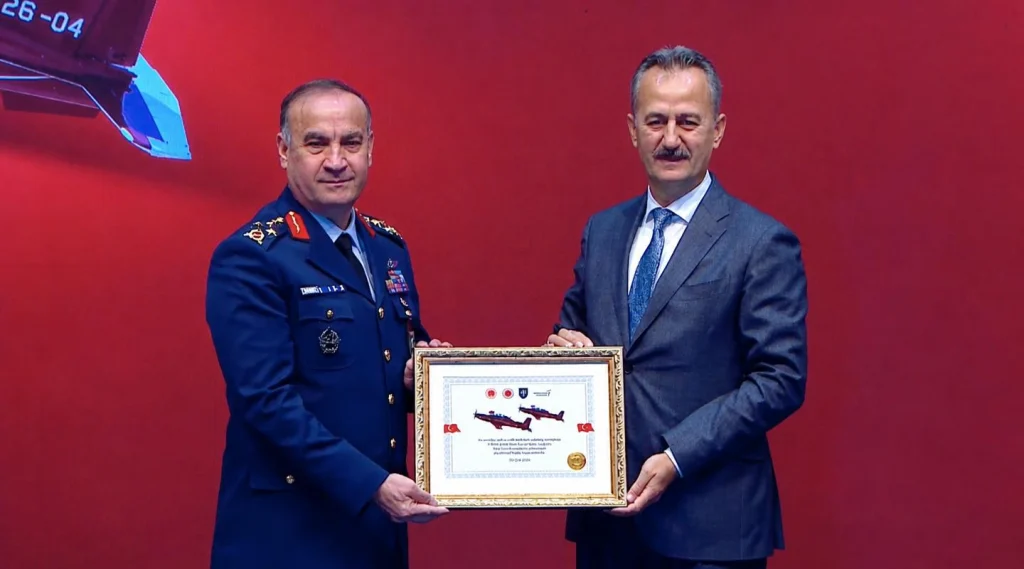
Speaking at the ceremony, Presidency of Defense Industries (SSB) President Prof. Dr. Haluk Görgün announced that approximately 23,000 hours of testing activities were carried out within the scope of ground, laboratory, and system integration studies during the development process of HÜRKUŞ-II. Stating that the aircraft was granted military-type certification in accordance with international standards on September 9, Görgün expressed that Türkiye has reached the capability not only to design and manufacture its own aircraft, but also to test and certify them.
Noting that the design, development, testing, and integration experience gained in the HÜRKUŞ-II project is being transferred to the HÜRJET and KAAN projects, Görgün stated that the cockpit and avionics architecture of the aircraft was designed in integrity with other air platforms. Görgün also mentioned that HÜRKUŞ-II is produced with a domesticity rate of over 70%, and that the domestic nature of its subsystems and software facilitates the integration of national ammunition.
55 Aircraft will be Delivered by 2028
Within the scope of the contract signed between the Presidency of Defense Industries and TUSAŞ, the procurement program, initially set at 15 aircraft, was increased to a total of 55 with 40 additional aircraft. In the September–December period of 2026, 12 more HÜRKUŞ-II aircraft are planned to be delivered to the Air Force Command. As of 2027, HÜRKUŞ-II squadrons are targeted to be seen in the Turkish Air Force, and the 55-aircraft procurement program is aimed to be completed by the end of 2028.
🔍 You may also like
Source: C4Defence