
















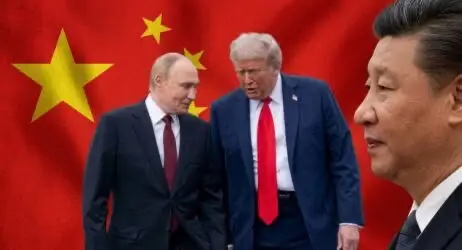
Beijing’s Rise as Primus Inter Pares—First Among Equals—or the Opening of a New Era of Rivalry?
Table of Contents
- Beijing’s Rise as Primus Inter Pares—First Among Equals—or the Opening of a New Era of Rivalry?
- Diverging Interests and Expectations of the Three Major Powers
- Key Political and Military Dimensions of the Trilateral Meeting
- The Challenge of Nuclear Non-Proliferation
- Key Messages from the Joint Statement
- Conclusion
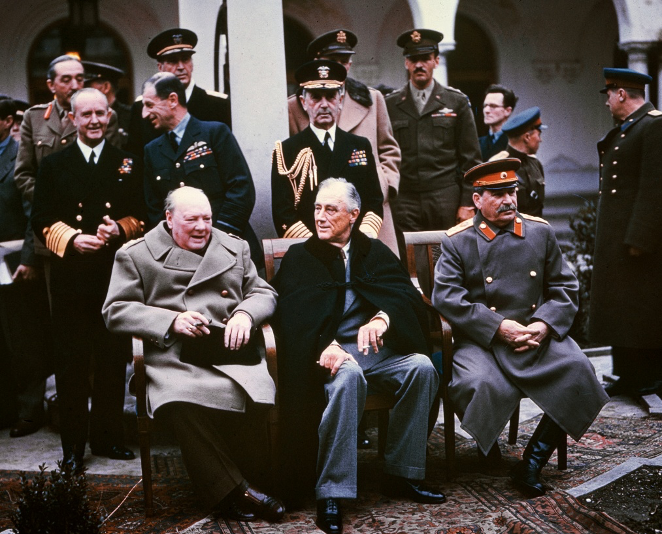
The Three Victorious Allied Leaders of World War II at the 1945 Yalta Conference: Winston Churchill, Franklin D. Roosevelt, and Joseph Stalin.
Xi Jinping: Promised that the Shenzhen meeting would be “groundbreaking.”
Trump: Stated, “We are truly making history.” He also remarked, “No peace can be achieved by rejecting opportunities for dialogue.”
Putin: Stated that they had “opened a new chapter in the history of diplomacy.”
On November 19, 2026, the leaders of the United States, China, and Russia, the world’s three largest nuclear powers, held their first-ever trilateral summit on the sidelines of the Asia-Pacific Economic Cooperation (APEC) Summit in Shenzhen, China’s high-tech innovation hub. The summit took place amid escalating international tensions and growing uncertainty surrounding the future of global security.
In our assessment, the summit was largely lacking in substantive outcomes; nevertheless, it can be considered significant in terms of diplomatic prestige and symbolic importance.
The historic agreement reached among Winston Churchill, Franklin D. Roosevelt, and Joseph Stalin at Yalta on the Black Sea coast in 1945, following World War II, shaped the balance of power in Europe during the Cold War and defined the spheres of influence between East and West.
Seventy-one years later, London and the European Union are absent from the newly established global negotiating table. The US-mediated peace talks held in Abu Dhabi, followed by meetings between US envoys and European and Russian leaders, revealed a fundamental paradox in the geopolitics of the Russia-Ukraine war: Washington seeks to end the conflict while transferring part of its security responsibilities to its European allies.
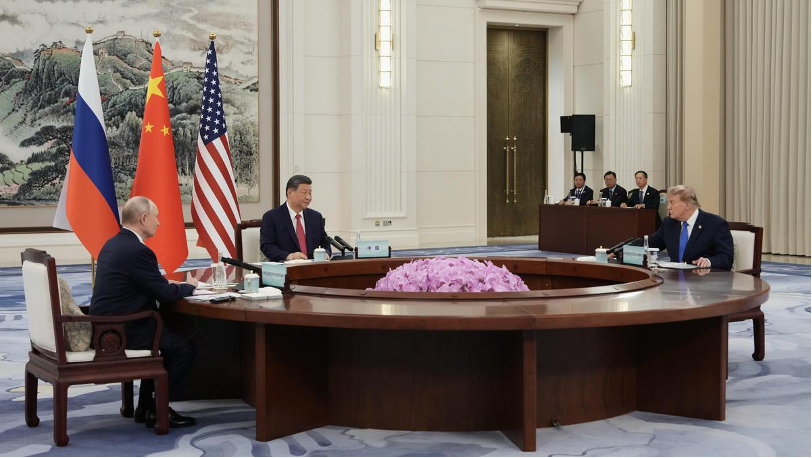
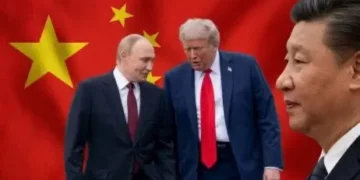
U.S. President Donald Trump (right) met with Chinese President Xi Jinping and Russian President Vladimir Putin at Kylin Villa in Shenzhen, Guangdong Province, southern China, on Thursday, November 19, 2026.
With the prospect of major regional agreements fading, the primary focus of the Shenzhen Summit is shifting toward functional, compartmentalized crisis management along two parallel tracks. The first—covering technology and security—involves exploring “algorithmic safeguards” to regulate the use of artificial intelligence in nuclear command and control systems following the expiration of the New START Treaty, alongside tighter US restrictions on advanced semiconductors. The second—operational and economic in nature—focuses on the Strait of Hormuz. The third issue is the war in Ukraine.
- Can the trilateral meeting involving Putin and Trump help preserve the legacy of victory in World War II and the postwar international order?
- Could the Shenzhen Summit acquire greater historical and political significance by establishing a framework of shared responsibility for maintaining international peace and stability? Can the three leaders assume responsibility for a turning point in international relations?
- Can the summit produce peaceful solutions to the ongoing armed conflicts in Europe and the Middle East?
- How might concerns in Europe, East Asia, Canada, Brazil, Türkiye, the United Kingdom, France, Germany, Italy, Spain, and Middle Eastern capitals such as Riyadh and Cairo be addressed regarding potential behind-the-scenes agreements that could disadvantage countries excluded from the negotiating table?
- At a time of global conflict and turbulence, could the trilateral summit bringing together the leaders of China, Russia, and the United States represent a promising sign of détente?
Diverging Interests and Expectations of the Three Major Powers
Russia remains at an impasse in eastern Ukraine. Ukraine has inflicted severe damage on major sections of the Kerch Bridge, Putin’s personal prestige project connecting Russia to the Crimean Peninsula. While Moscow aims to use the meeting to break its international isolation and reshape Europe’s security architecture, it continues to grapple with structural economic pressures and underlying disagreements with Beijing over energy market calculations. For the Kremlin, which has long advocated the concept of a “multipolar world” in which all nations have an equal voice, an opportunity has emerged. The United States continues its blockade in the Strait of Hormuz amid a situation oscillating between war and peace with Iran, while also alienating Canada. Questions surrounding the declining credibility of the United States as a guarantor of European security and Donald Trump’s unpredictability remain unresolved issues on NATO’s agenda.
Many observers have warned that Trump, approaching the end of his term, could be most dangerous in areas where he can act unilaterally, such as escalating tensions involving Iran or Cuba. Meanwhile, the US air traffic control system has been descending into chaos amid controversies surrounding the allocation of its modernization project to Israeli-backed companies, while the National Security Agency (NSA) has experienced power outages. The historic message delivered to Trump by American voters on November 3 indicates that Democrats and Republicans are preparing for a fierce political contest ahead of the 2028 elections. The Democratic Party is seeking to define its policy positions on major issues, including artificial intelligence (AI) safety, technological competition with China, US-Israel relations, and the United States’ role in the world.
Beijing, meanwhile, is positioning itself as a diplomatic “balancing power.” While leveraging its influence over critical mineral supply chains to safeguard its red lines concerning Taiwan, China is deliberately avoiding becoming part of a trilateral club that could undermine its standing in the Global South and Europe or impose premature limitations on its nuclear arsenal. For Beijing, however, the summit’s symbolic significance is paramount: Washington is finally treating its geopolitical and ideological rivals as equals in matters of global governance. Beijing has used the summit to highlight its pivotal role in bringing together rival powers embroiled in prolonged conflicts and to reinforce China’s image as a capable and indispensable global leader. Shenzhen’s hosting of the APEC Summit has positioned Beijing…
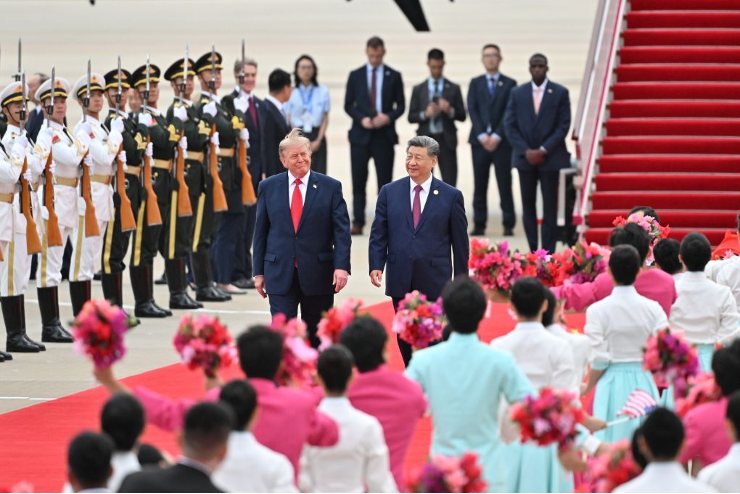
The summit showcases Shenzhen, a city that China has transformed over the past four decades from a fishing village into a skyscraper-filled hub for export-oriented manufacturing and technology. China’s rise as the world’s second-largest economy depended on access to global investment and international markets, as multinational manufacturers relocated their factories overseas to benefit from cheaper labor and faster-growing markets.
“While pursuing its own development, China has shared opportunities with other countries and worked toward common development,” Xi said. “China has consistently contributed to international trade and economic cooperation, bringing stability and predictability to global economic growth,” he added.
Key Political and Military Dimensions of the Trilateral Meeting
In his opening remarks, Trump stated, “The three of us have a lot to discuss, and we have already discussed many of these issues.”Russian President Vladimir Putin said he expected “substantial potential benefits” from his trilateral meeting with US President Donald Trump and Chinese leader Xi Jinping this week.
Putin also emphasized that the three leaders should work together to address contemporary challenges, including food security, energy security, counterterrorism, and the fight against international crime. “I believe that if we cooperate constructively on the basis of mutual respect, equality, and a balance of interests, the peoples of Russia, the United States, and China can make significant contributions to strengthening peace and security around the world,” Putin said.
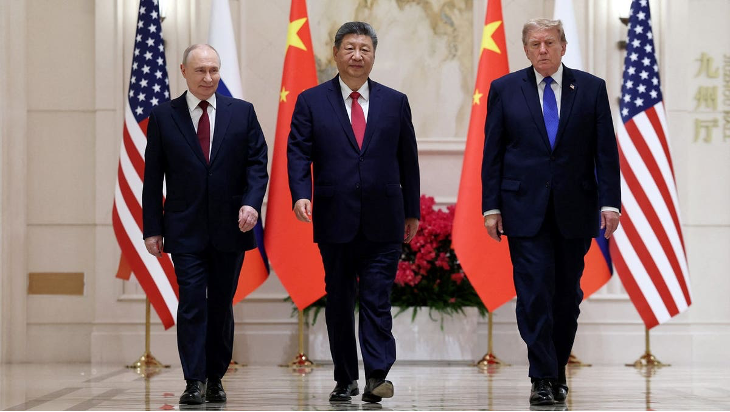
The three leaders met on the sidelines of the 33rd Asia-Pacific Economic Cooperation (APEC) Economic Leaders’ Meeting, hosted by China on November 18–19.
Putin emphasized that the countries share responsibility for international security, pointing to their status as permanent members of the United Nations Security Council. He then addressed one of the summit’s most pressing issues: the war in Ukraine. Putin stated that the three countries have “many common interests in resolving regional conflicts, including the conflict in Ukraine.” Putin described the talks in China as “undoubtedly a new chapter in the history of diplomacy.” Speaking at a press conference in Shenzhen, China, Putin said, “I would very much like this to continue. At the very least, we exchanged views on some important issues, and I believe that although we did not necessarily reach agreements, we achieved mutual understanding.”
Noting that no such meeting had ever taken place before, Putin characterized the gathering as a significant moment in diplomatic history. As the host, Xi welcomed both leaders and emphasized that the talks were crucial for “peaceful coexistence and overall stability,” arguing that they would “benefit one another and the entire world.” Xi described the meeting as a “groundbreaking step” and underscored the responsibility of all three powers to maintain global stability.
The Challenge of Nuclear Non-Proliferation
The discussions were expected to focus on issues such as nuclear non-proliferation, the war in the Middle East, trade policies, and potentially the war in Ukraine. Experts have tempered expectations of major breakthroughs. The timing could hardly have been more significant. The New START Treaty expired in February, leaving the world’s largest nuclear arsenals without binding limitations for the first time in half a century.
China’s nuclear arsenal has more than doubled since 2019, reaching approximately 620 warheads, while the Pentagon expects the figure to exceed 1,000 by 2030. The United States is developing Golden Dome, a multilayered missile defense system incorporating space-based interceptors. Without limitations, all three countries are moving toward a three-way arms race that none of them desires. Trump presented this first trilateral meeting with Xi and Putin, two of America’s principal rivals, as an opportunity to establish rules governing nuclear arms control and begin addressing the wars in Ukraine and Iran. “Frankly, this is a very difficult issue because once you have nuclear weapons, it is very difficult to give them up. As the leader of a country, it is very difficult to relinquish them,” Trump stated.
China is intensifying its efforts to catch up with the two nuclear powers. Beijing has long been reluctant to participate in such nuclear non-proliferation or arms control negotiations. According to the Stockholm International Peace Research Institute (SIPRI), China possessed an estimated 620 nuclear warheads as of January 2026, compared with 5,042 for the United States and 5,420 for Russia. Chinese diplomats have repeatedly argued that the primary responsibility for nuclear disarmament lies with the United States, citing China’s relatively small nuclear arsenal. In October 2026, commenting on potential negotiations with China and Russia, Trump stated, “All of this is a shame because, if possible, I would very much like nuclear disarmament. In fact, we are discussing nuclear disarmament with Russia and China.”
Trump also remarked that “past leaders often avoided talking to countries with which they had disagreements,” adding, “No problem can be solved by refusing to talk. “Trump said that the United States, Russia, and China were in a “unique position” to reduce the world’s nuclear weapons stockpiles. Echoing Trump’s remarks on nuclear weapons, the Chinese president called for their complete prohibition and elimination, adding that a nuclear war cannot be won and must never be fought. Xi Jinping stated that nuclear weapons should be comprehensively prohibited and completely eliminated, with the ultimate objective of building a world free of nuclear weapons. Putin emphasized that Russia, China, and the United States could strengthen global stability through constructive cooperation. He called on the three leaders to discuss global and regional issues, including energy security and the war in Ukraine.
Key Messages from the Joint Statement
As is known, Xi has met with Trump three times since October last year and with Putin more than 40 times since becoming president in 2013. Trump and Putin have also met in person on several occasions, including the Russian leader’s visit to Alaska in August 2025.
At the APEC meeting, the three leaders addressed nuclear disarmament, global security, and the Russia-Ukraine war, among other issues, in their public statements. Donald Trump, Vladimir Putin, and Xi Jinping issued a “joint statement on peace” following 90 minutes of talks in China. The statement declared that “a nuclear war cannot be won and must never be fought. “Host Xi emphasized the responsibilities of the three countries as major global powers, stating that “positive interactions” among China, the United States, and Russia were “not an option, but a necessity. “Xi called on the three countries to set an example by working together to address global challenges and safeguard international peace and stability. Trump stated, “I am very pleased that this trip has given us the opportunity to hold the first-ever trilateral meeting among the leaders of the United States, Russia, and China.”
Putin remarked, “Our countries have many common interests when it comes to resolving regional conflicts, including, of course, the conflict in Ukraine.” He added that they share “responsibility for maintaining international peace and security. “Finally, the three countries emphasized the importance of stable energy flows and stated that they “plan to increase the production and supply of refined petroleum products for the benefit of all nations.”Although China, Russia, and the United States announced that they had agreed on a peace statement following the unprecedented trilateral summit, the statement made no mention of the wars in Ukraine and Iran, which involved two of the participating countries. Xi described US-China relations as “generally stable and positive. “However, he warned Washington over Taiwan, stating that the United States “must continue to do the right thing to avoid major disruptions in US-China relations.”
Conclusion
- The ability to bring Putin and Trump to the negotiating table—that is, the scenario of becoming primus inter pares, or first among equals—would bring significant political benefits to Beijing.
- In a report summarizing “flexible” takeaways from the “first-ever” meeting of the leaders of China, Russia, and the United States, TASS states: “Putin was seated to Xi’s right, the place of highest honor according to diplomatic protocol, while Trump was seated to his left.”
- Although the summit failed to produce concrete results regarding the war in Ukraine, the crisis in Iran, or other pressing global issues, it created a remarkable image.
- The Shenzhen Summit could serve as a model demonstrating that competition among the United States, Russia, and China can continue without escalating into nuclear war, while also showing that greater flexibility and a more positive atmosphere of dialogue in international conflict zones may help overcome mutual distrust, unlike the Yalta framework. Over the past century, America, protected by two oceans, has been forced to learn the hard way that its interests are fundamentally linked to the security of Europe and East Asia.
- However, from a realpolitik perspective, the Shenzhen meeting represents a test of structural incentives rather than a step toward binding multilateral agreements. The fundamental tension lies between transactional diplomacy and asymmetric balances of power. The primary structural obstacle is the arithmetic of arms control. A trilateral arms control framework requires a common balance or verification baseline. China’s arsenal of approximately 500 nuclear warheads represents roughly one-tenth of the more than 5,000 deployed warheads possessed by Washington and Moscow, respectively. Under current conditions, agreeing on trilateral limitations would either lock China into a permanent numerical disadvantage or require the two largest nuclear powers to reduce their active stockpiles by 90% to achieve structural parity. Since neither of the historical superpowers intends to reduce its arsenal to China’s level, Beijing views trilateral nuclear negotiations as an instrument designed to restrict its modernization before it achieves parity.
- In the final analysis, Trump and Putin are pursuing their own distinct and unsuccessful wars of choice, serving as aging embodiments of their nations’ declining power. Xi has spearheaded the relentless, remarkably efficient, and rapid rise of a global technological superpower, yet he continues to avoid confrontation in his own potential war of choice—the invasion of Taiwan. Following World War II, history had little choice but to listen to Truman, Stalin, and Churchill. It may, however, choose to ignore Shenzhen. For Russian President Vladimir Putin, the summit offered a highly sought-after opportunity to demonstrate that the Kremlin leader stands at the helm of a superpower on equal footing with the United States and China. This move dealt another blow to Western efforts to isolate Putin, while also providing an opportunity to persuade Trump to accommodate Moscow’s demands for a settlement in Ukraine at a time when Washington seeks to broker a peace agreement.
- Trilateral arms control faces a simple problem. The three countries are like a three-legged stool with legs of unequal length. While the United States and Russia each possess thousands of nuclear warheads, China has approximately 620. Beijing will not accept an agreement that legally enshrines its inferior position. Washington, meanwhile, will not accept a freeze agreement that allows China to expand its arsenal freely while US and Russian forces remain constrained.
- According to some commentators, the real test will be whether the three countries fulfill their commitments to nuclear risk reduction and nuclear non-proliferation.
REFERENCES
1. The Guardian
2. AFP
3. Xi, etkinlik için arka plan olarak, Çin’in yüksek teknoloji devi haline gelmesindeki hızlı dönüşümü ve ABD’nin teknoloji ve ticaret sürtüşmeleri karşısındaki direnciyle özdeşleşmiş bir şehri seçti.Çin’in “mucize şehri” 18 milyonluk devasa metropol, Çin’in teknoloji devlerinin önde gelen isimlerine ev sahipliği yapıyor: donanım devi Huawei, drone üreticisi DJI ve Tesla’yı geride bırakan elektrikli araç satıcısı BYD; hepsi de ABD’nin ithalat yasaklarına veya kara listelerine rağmen gelişmeyi başarmış şirketler.
4. Washington Times
5. Çin Dışişleri Bakanlığı
6. Habtoor Research
7. The Diplomat
8. The Epoch Times
9. Washington Times
10. America’s role in European security, the APEC summit, and Democratic foreign policy
11. Habtoor Research
12. War on the Rocks
13. Shenzhen’in bu yılki APEC zirvesine ev sahipliği yapması, Pekin’in “Çin mucizesi” öyküsünü anlatma çabasının önemli bir parçasıdır.
14. AP
15. The Epoch Times
16. Reuters
17. Fox News
18. CNA
19. AA
20. Washington Times
21. CNBC
22. Belfer Center
23. AP
24. Washington Times
25. The Epoch Times
26. CSIS
27. AP
28. CNBC
29. The Hindu
30. CNBC
31. BBC
32. AA
33. The Hindu
34. CBC
35. The Guardian
36. The Hindu
37. Brookings
38. A47 News
39. CNN
40. AP
41. Belfer Center
42. The Guardian