















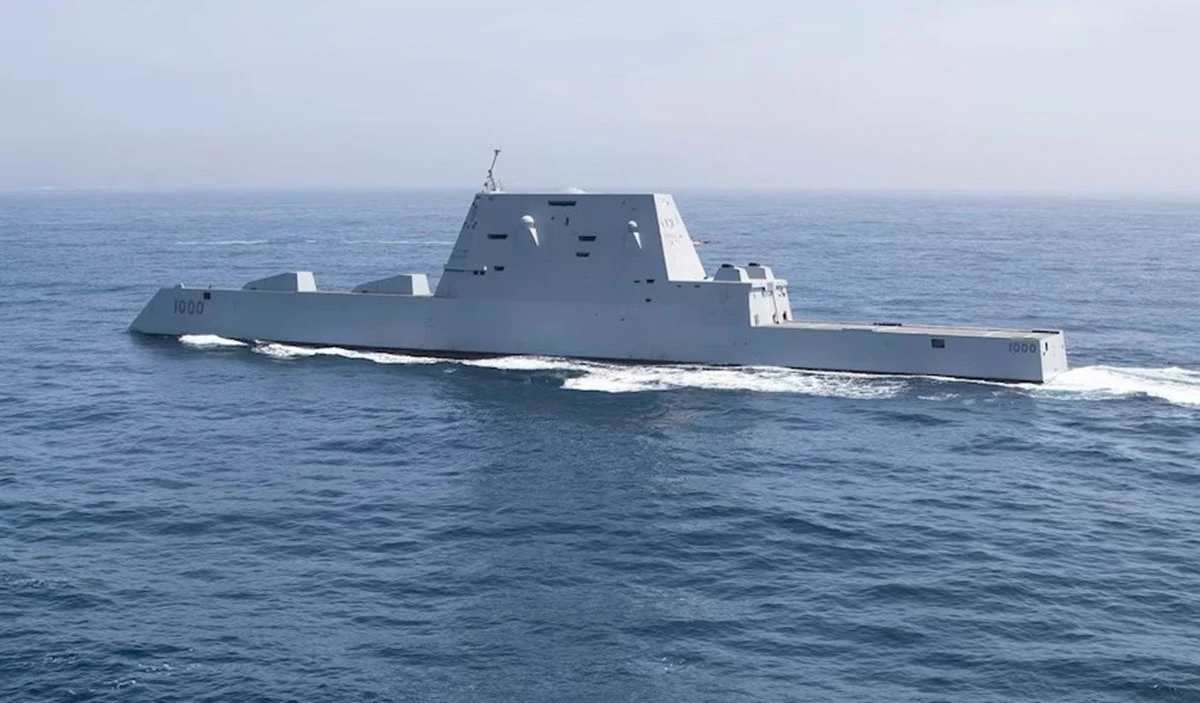
The US Navy’s plan to equip its Zumwalt-class destroyers with hypersonic missile systems has fallen a full 24 months behind schedule, owing to unforeseen technical setbacks and disjointed budget management. A recent report published by the Government Accountability Office (GAO) in July 2026 reveals that without a joint planning mechanism across the services, the Pentagon’s Conventional Prompt Strike (CPS) projects—with a budget of at least $50 billion—are likely to face further delays.

The US is attempting to unify platforms such as Virginia-class submarines, Zumwalt-class destroyers, and the Army’s Long-Range Hypersonic Weapon (LRHW) under a single striking force. However, the official audit report documents that, despite this massive multibillion-dollar investment, the services are managing their budgets and integration decisions independently of one another.
Tests Postponed and Production Well Below Target
According to the report, although modernisation work on USS Zumwalt—the first ship of its class—was 94 per cent complete as of January 2026, the process has yet to be finalised due to unplanned additional work. This slippage has had a knock-on effect, pushing back the date of the first planned hypersonic weapons flight test from the ship to 2027 from 2025, citing funding and test-related difficulties.
What’s more, quality and supply chain issues on the production lines mean that the current production rate remains well below the official target of 12 units per year. On top of all this, the unique architecture of the Zumwalt class—including its proprietary radar, combat, and network systems—has turned maintenance and sustainment costs into a significant financial burden for the Pentagon.
Shared Budget but Separate Service Efforts Breed Inefficiency
While Navy and Army officials have told the GAO that they are coordinating with one another, the report shows that investment decisions are largely being managed independently by each service. The Pentagon lacks an overarching master plan that encompasses all these programmes and ensures that investments serve common objectives. The absence of an official and binding planning framework not only prevents the timely resolution of production-line bottlenecks for the hypersonic missiles both services will share, but also complicates the cost-effective sustainment of the DDG 1000-class vessels.
Role-Sharing Across Services for $50 Million Missiles
A decision made in 2021 determined that the CPS missiles—each costing roughly $50 million—would be integrated into the DDG 1000-class destroyers. As part of the modernisation period carried out at the Huntington Ingalls Industries shipyard, the vessels are being fitted with large Vertical Launching System (VLS) tubes. The Navy also plans to integrate these missiles into Virginia-class submarines and, in the future, Trump-class battleships.
The Army also plays a key role in the project. Having resumed the deployment process for its wheeled-platform LRHW system following successful tests, the Army is also taking on production responsibility for the hypersonic glide body that will be shared by both services. The GAO has recommended that the Pentagon urgently develop an overarching management model to guide investments and overcome these logistical hurdles, in order to achieve the desired hypersonic missile capability on time—a recommendation the Department of Defence has stated it agrees with.
🔍 You may also like
Source: C4Defence–GAO