


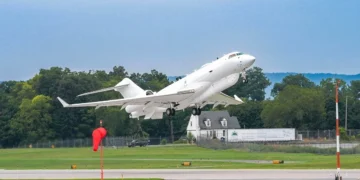






















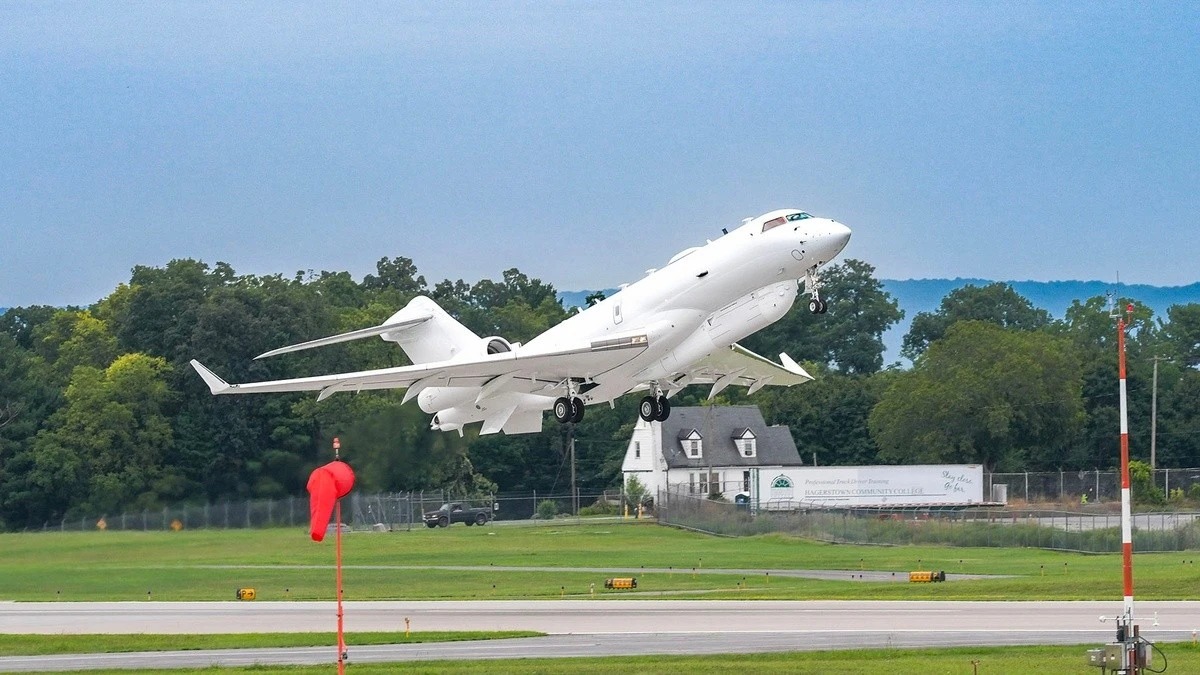
The US Army’s HADES Prototype 1 aircraft completed its maiden flight, featuring a commercial jet-based design intended to provide greater speed, range and altitude than previous-generation turboprop reconnaissance platforms.
The US Army reached a significant milestone in modernising its airborne intelligence capabilities with the first flight of the High Accuracy Detection and Exploitation System (HADES) Prototype 1 aircraft. The Fixed Wing Project Office and industry partner Sierra Nevada Corporation (SNC) carried out the work following the completion of the flight readiness review. With this development, HADES Prototype 1 entered the next phase, which will involve mission systems integration and developmental flight testing.
Airborne Intelligence and Reconnaissance Capability
HADES supports the US Army’s efforts to modernise its airborne intelligence, surveillance and reconnaissance (ISR) capabilities for large-scale, multidomain operations. The aircraft is based on an advanced commercial jet platform designed to provide greater speed, longer range, increased payload capacity and higher operating altitude compared with previous-generation turboprop ISR platforms. US Army officials expect these capabilities to extend commanders’ operational reach, enhance situational awareness and accelerate decision-making in contested environments. Fixed Wing Project Manager Lieutenant Colonel James Hickey stated that the first flight of HADES Prototype 1 had transformed the deep sensing vision from concept into reality. Hickey noted that this achievement reflected the dedication, technical precision and shared sense of mission of military personnel, civilian specialists and industry partners working to deliver new capabilities to the US Army and joint forces.
Technical Integration During Flight Testing
The first flight was conducted through collaboration between the Fixed Wing Project Office, the Sensors–Aerial Intelligence Project Director under the Command and Control/Counter-Command and Control Portfolio Acquisition Executive, and Sierra Nevada Corporation (SNC), the programme’s lead systems integrator. Engineers, test pilots and mission systems architects reportedly coordinated structural modifications, mission systems hardware integration and preliminary airworthiness validation activities to prepare the aircraft for flight. In the next phase, the US Army will integrate and evaluate HADES mission systems through developmental flight testing. This process will validate the effectiveness, integration and operational readiness of multidomain sensing and signals intelligence (SIGINT) capabilities. The results will be used to prepare for planned operational demonstrations. The HADES programme aims to provide the US Army with a modern airborne sensing capability that offers high survivability and rapid responsiveness to support joint force operations in contested operational environments.
🔍 You may also like
Source: C4Defence – U.S. Army