


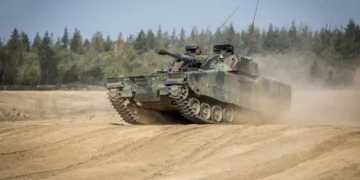















Four autonomous UGVs developed under DARPA’s RACER program completed their first end-to-end test at Fort Knox, from satellite imagery to field operations. The decision to open fire remained under human control.
On 15 October, 24 senior officials from military and government agencies attended a demonstration at the St. Vith Range at Fort Knox, Kentucky, USA. The vehicles developed by the Defense Advanced Research Projects Agency (DARPA) were prepared for their mission after technicians completed final cable and software preparations.

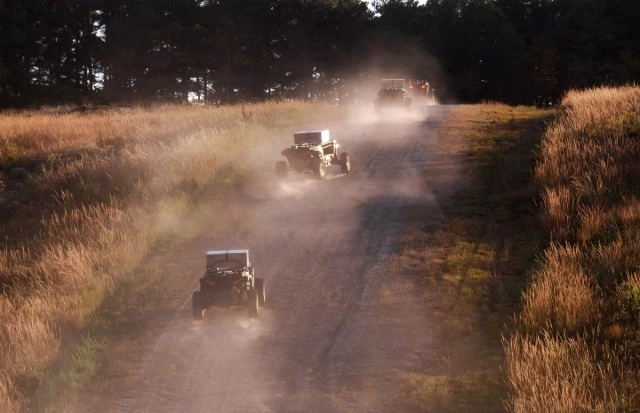
Four autonomous unmanned ground vehicles (UGVs) developed under DARPA’s Robotic Autonomy in Complex Environments with Resiliency (RACER) program were prepared for their mission after technicians completed the necessary cable and software preparations. The vehicles moved autonomously and in coordination with one another across rugged terrain to detect and monitor enemy elements. DARPA Technical Advisor Dr. Jason Gregory stated that they could designate 10-digit coordinates along the routes the vehicles would travel and that the vehicles could use their onboard sensors to perceive the terrain and reach designated locations in a manner similar to human drivers. Gregory also noted that Fort Knox was being used to evaluate how autonomous mobility technology could be combined with different mission payloads to provide military personnel with new capabilities.
Technological Foundation of the RACER Program
Operating as an independent research and development agency within the U.S. Department of Defense, DARPA aims to prevent the country from being caught unprepared by technological advances. RACER is one of 238 science and engineering programs conducted by DARPA to advance technology in the field of national security. Bringing together the expertise of three advanced technology companies, the RACER program involves work in various areas, ranging from the design of rugged off-road vehicles to algorithm technologies, advanced artificial intelligence and secure communications.

Jason Gregory announced the completion of an approximately five-year program focused on developing software that enables high-speed autonomous mobility in complex terrain. He explained that vehicles equipped with sensors and electronic drive-by-wire control systems could be fitted with autonomy software, allowing military personnel to assign them missions instead of driving them manually. Speed and resilience are among the primary objectives of the RACER program.
The program’s minimum objective is to achieve software performance that enables vehicles to travel across off-road terrain at speeds at least comparable to those of human drivers. The Fort Knox demonstration showcased not only autonomous mobility but also different mission capabilities that could be employed according to commanders’ needs. Kinetic and non-kinetic payloads were integrated into the autonomous vehicles, enabling target detection as well as close and deep target acquisition activities involving human decision-making. At the beginning of the demonstration, an operator was briefed on a simulated threat using satellite imagery.
Target Detection Using Autonomous Vehicles
After the operator tasked the team of robotic vehicles, the first vehicle, carrying an enclosed box, moved forward to search for targets. The other three vehicles remained at the starting point. When the first vehicle reached the middle of the hill, it detected a potential target, stopped and waited for further instructions. The enclosed box on the vehicle contained an unmanned aerial vehicle (UAV). It was reported that, in an actual mission, the UAV could be used to examine potential targets more closely or be equipped with munitions to conduct an aerial strike.
While the first vehicle remained stationary, two additional vehicles advanced along the route to provide support and protection. Once the vehicles reached their designated positions, a target on a neighboring hill approximately 300 yards (274 meters) away was struck in a simulated rocket attack. As the final vehicle began moving forward, the first vehicle reached the top of the hill.

Images and information related to all targets detected by the autonomous systems are transmitted to a human operator. While the vehicles autonomously perform movement, manoeuvring and target detection, the decision to open fire remains under human control. The demonstration at Fort Knox marked the first end-to-end test under the program, covering the entire process from satellite imagery to tactical ground operations. Previously, component and integration tests had been conducted at the facilities of the companies involved in the program. Fort Knox was selected as the location for the end-to-end test following a request from U.S. European Command (EUCOM).
Gregory stated that there had been a request to explore how robotic vehicles could be deployed beyond the forward line of troops, allowing military personnel to detect threats early and decide how to respond. The potential use of the program in the European theatre of operations had been considered from the outset. Relevant stakeholders proposed Fort Knox as an environment representative of the European theatre of operations. Fort Knox personnel also provided significant support in implementing the concept of operations, managing logistics and conducting field operations.
RACER’s Mission Capabilities
The vehicles’ capabilities can be expanded depending on the mission payloads integrated into them. In addition to kinetic attack missions, the vehicles can also be used for non-kinetic defensive operations. They are also being considered for logistical missions, including the transport of food, ammunition and other supplies. Thanks to their modular design, various systems, such as M240B machine guns, UAVs and rockets, can be integrated into the vehicles. The platforms, which have been compared to LEGO bricks, could also be used as casualty evacuation vehicles if needed.
The next test under the RACER program is expected to take place in December. DARPA officials plan to meet with a group of military personnel to gather their recommendations on how the vehicles could be deployed. Particular importance is placed on feedback from military personnel, who can provide direct and realistic assessments of the systems.
🔍You may also like
Source: C4Defence– U.S. Army