


















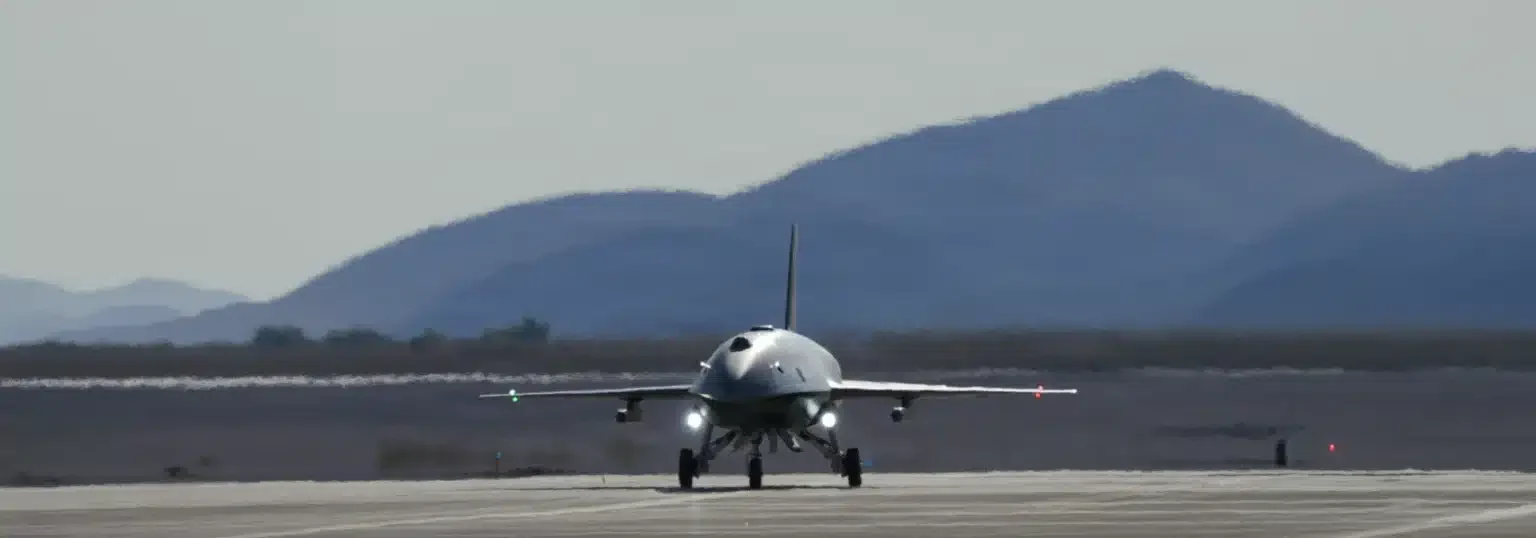
Shield AI’s Hivemind software enabled multiple autonomous combat aircraft to perform coordinated beyond-visual-range manoeuvres by executing instructions from an F-22 pilot.
Shield AI’s Hivemind software enabled multiple autonomous combat aircraft to perform coordinated beyond-visual-range manoeuvres by executing instructions from an F-22 pilot. Within three weeks, the Hivemind mission autonomy software achieved two firsts in the US Air Force’s Collaborative Combat Aircraft (CCA) programme. During the tests, the software executed instructions from an airborne F-22 pilot, enabling multiple CCAs to fly in formation and perform coordinated beyond-visual-range air combat manoeuvres.
The demonstrations tested the ability of multiple autonomous aircraft to operate as a coordinated team following the direction of an autonomous wingman by a fighter pilot. They demonstrated the applicability of cooperation between manned and unmanned aircraft, one of the CCA programme’s primary objectives, across different mission scenarios.
Coordinated CCA Flight Tests with Hivemind
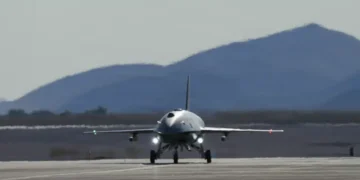
During the first test on 8 October, an F-22 pilot assumed the role of airborne mission commander and transmitted high-level tactical instructions to an FQ-44A. Hivemind interpreted and executed these instructions in real time, enabling the aircraft to perform dynamic manoeuvres and simulated combat missions under the pilot’s direction. In the second test, conducted on 26 October, Hivemind enabled multiple CCAs to fly in a multi-aircraft formation and perform coordinated tactical air combat manoeuvres beyond visual range. The test demonstrated that autonomous aircraft could conduct missions in a coordinated manner rather than merely operating independently within the same airspace.
The demonstrations, in which human pilots defined mission objectives and provided direction, support the development of an operational approach in which mission autonomy software translates these instructions into coordinated actions. This approach is intended to advance capabilities that enable human-led combat teams to direct multiple autonomous aircraft simultaneously and conduct more complex missions.
Hivemind Software Update Process
Shield AI Vice President of Hivemind Engineering Todd Wesley stated that the mission autonomy software running on each aircraft translates human-defined objectives into coordinated actions designed to achieve the desired mission outcome. He explained that these flights contributed to advancing the complex integration of sensors, data links and interfaces that enable mission autonomy. Wesley expressed satisfaction that aircraft and mission system integration had reached a level at which Hivemind’s capabilities could be demonstrated, noting that each flight provided data to support the development of the next software release. He added that efforts to update Hivemind and aircraft software together were approaching a stage at which the US Air Force could update software overnight following a sortie and fly again the next day. Wesley also thanked US Air Force operators, engineers and test teams for helping build confidence in the system with every flight.
The tests were also reported to have demonstrated the importance of the US Air Force’s Autonomy Government Reference Architecture (A-GRA). By separating mission autonomy from aircraft-specific functions through standardised interfaces, A-GRA enables mission software to be developed independently of the aircraft platform while preserving competition and reducing the workload associated with integrating new capabilities. Data collected from each flight test contributes to the development of subsequent software releases, improves the reliability of digital models and supports systematic decision-making throughout testing and operational deployment. Following a repeatable process of development, validation, flight, learning and updating across all aircraft applications, the company stated that new capabilities and behaviours developed on any aircraft in any operational theatre contribute to the maturation of Hivemind software used on other platforms, subject to data-handling restrictions.
Hivemind’s common software infrastructure has reportedly been integrated into more than 40 unmanned systems operating across the air, land, maritime and space domains. This infrastructure enables tools, interfaces, safety validations and integration methods to be transferred across different platforms, reducing the need to restart development from scratch for each new platform. CCA flights benefit from the common Hivemind software used on other platforms, while improvements gained through flight data and software updates can also be transferred to different systems. The company announced that it would continue testing, evaluation and refinement activities with the US Air Force, with data obtained from the flights guiding future development efforts.
🔍 You may also like
Source: C4Defence – Sheild Ai