












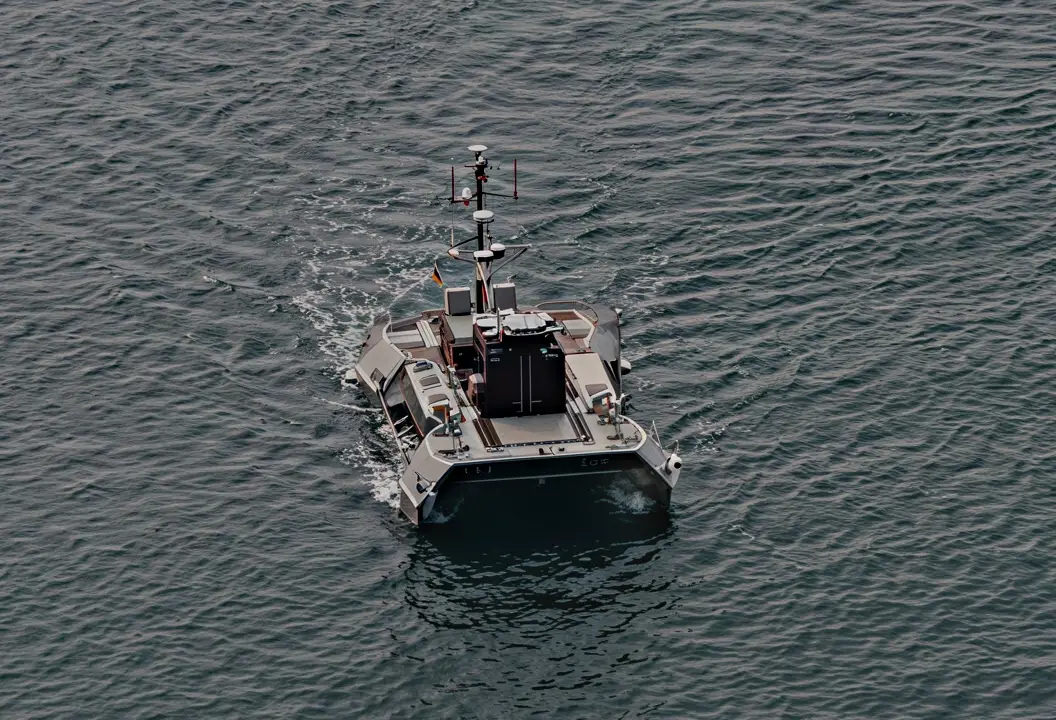
A drone’s flight time has always been tied to one thing: its battery. Now, in a first for the Royal Navy, that limitation has been engineered out entirely. ACUA Ocean’s uncrewed vessel, Pioneer USV, has demonstrated the ability to keep a drone airborne indefinitely not with a bigger battery, but by cutting the battery out of the equation altogether.

ACUA Ocean and Teledyne FLIR Defense completed two days of demonstrations for the UK Ministry of Defence and offshore industry stakeholders, backed by funding from UK Defence Innovation (UKDI). The trials tested how well an uncrewed aerial system and an uncrewed surface vessel could work together at sea.
How Pioneer USV and SkyCarrier Work Together
During the demonstration, Teledyne FLIR’s SkyCarrier platform autonomously launched a SkyRanger R70 drone, with the entire operation remotely commanded from ACUA Ocean’s Pioneer vessel.
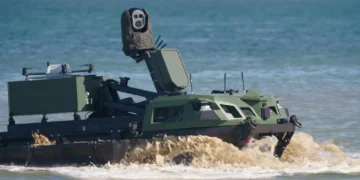
Pioneer holds the distinction of being the UK’s first Lloyd’s Register-certified, remotely operated uncrewed vessel, and it already delivers long-endurance maritime intelligence, surveillance and reconnaissance for the Royal Navy and allied customers. The trials confirmed something important: the tethered drone system integrates cleanly with Pioneer’s modular payload architecture, and it holds steady even in rough open-ocean conditions.
Tested in 4.25-Metre Waves
Pioneer USV has already completed several ISR and anti-submarine warfare demonstration contracts for the Royal Navy. In January 2026, it faced its toughest seakeeping test yet 4.25-metre wave heights and came out ahead of conventional monohull vessels by a wide margin: 60% less roll, and a peak roll rate four times lower. That stability is what makes it possible to fly a tethered drone safely off its deck in the first place.
Once launched from its SkyCarrier container, the SkyRanger R70 stayed connected to Pioneer via a dedicated power-and-data tether. With the battery no longer the limiting factor, the drone could keep watch from the air for as long as the vessel remained at sea.
What the Drone Can See
SkyCarrier isn’t limited to calm conditions or a fixed launch site — it can deploy a drone autonomously from a moving land vehicle, a ship underway, or a static installation. Closed, its rugged container shields the drone completely; opened, it unfolds into a mobile launch-and-landing pad.
The SkyRanger R70 itself runs real-time object detection and classification onboard, drawing on multiple embedded processors and four dedicated cameras to operate with minimal human input. Its long-range, high-resolution EO/IR sensor suite is what really stands out: despite being classified as a Group 1 UAS, it delivers surveillance performance typically associated with the far larger and costlier Group 2 systems.
Why the Royal Navy Cares
The combined system targets a problem the Royal Navy has flagged repeatedly — keeping personnel out of harm’s way during long, monotonous, or dangerous surveillance work. Paired together, Pioneer and the SkyRanger R70 extend the vessel’s field of view from sea level to altitude, giving commanders coordinated air-and-surface coverage that can hold for weeks at a time. That combination has direct applications in anti-submarine warfare, mine countermeasures, intelligence gathering, and protecting critical undersea infrastructure.
“Something Genuinely New”
ACUA Ocean CEO’su Neil Tinmouth, UKDI fonunu almanın hem şirketleri hem de Birleşik Krallık’ın denizcilik sektörü için önemli bir kilometre taşı olduğunu söyledi. Tinmouth’a göre SkyRanger R70’in Pioneer’la entegrasyonu, Kraliyet Donanması’nın bugün denize çıkarabileceği yeni bir kabiliyet anlamına geliyor. Teledyne FLIR Defense’in sahada kanıtlanmış bir sistemi, hazır ve sertifikalı bir platformla bir araya getirdiğini de ekledi.
ACUA Ocean CEO Neil Tinmouth called the UKDI funding a milestone both for the company and for the UK’s wider maritime autonomy ambitions. Integrating the SkyRanger R70 with Pioneer, he said, creates a persistent, multi-domain ISR capability the Royal Navy can deploy today — pairing a UAS that’s already proven itself in the field with a platform that’s built, certified, and ready to go.
Richard Cunha, Principal Product Director for Unmanned Aerial Systems at Teledyne FLIR Defense, echoed that view, noting that the SkyRanger R70 has already proven itself in some of the most demanding operational environments in the world. Combined with the Pioneer Mk2’s seakeeping and endurance, he said, it opens up a class of persistent maritime missions that simply wasn’t possible before.
🔍 You may also like
Source: C4Defence–ACUA Ocean