







C4 Defence
Friday, April 17, 2026
C4Defence
C4Defence 20. Yıl C4Defence 20th Anniversary
  • Home Page
  • NEWS
    • All
    • Interviews
    • Fairs / Events
    • Latest News
    Raytheon RAIVEN akıllı sensör sistemi uçuş testi konsept görseli

    Raytheon Completes First Flight Test of RAIVEN Sensor System

    MKE 76mm DENİZHAN Naval Gun on Turkish Navy ship during operation

    MKE Launches $1.5 Billion Strategic Investment Initiative

    Close-up view of the Ghost Shark XL-UUV, an extra-large autonomous underwater vehicle for the Royal Australian Navy.

    The Royal Australian Navy Officially Establishes the Maritime Autonomous Systems Unit

    Hill Hava Kuvvetleri Üssü'nde nakliye uçağı ile taşınabilirlik testi yapılan nükleer mikroreaktör.

    U.S. Air Force Confirms Deployment of Nuclear Microreactors at Two Bases

    Rheinmetall ve Destinus ortak girişimi tarafından geliştirilen yeni nesil füze sisteminin fırlatılma anı.

    Rheinmetall and Destinus Establish Europe’s New Missile Production Hub

    ROKETSAN showcases AKYA heavyweight and ORKA lightweight torpedoes at UDT 2026 in London.

    ROKETSAN Showcases Next-Generation Underwater Systems at UDT 2026

    A KC-135 Stratotanker from the 168th Wing refueling an F-22 Raptor over Alaska.

    Reinforcement of 4 New KC-135 Stratotankers to Alaska

    Technical maintenance and support agreement signed between Navantia and MSB Shipyards for TCG ANADOLU.

    Navantia Maintenance Support for TCG ANADOLU Systems

    Estonia signs contract for additional Lockheed Martin M142 HIMARS systems

    Estonia Signs Additional HIMARS Contract with Lockheed Martin

  • Defence Industry Systems
    • All
    • Power & Energy Systems
    • NAVAL VEHICLES
    • TURKISH DEFENCE INDUSTRY
    • LAND VEHICLES
    • AIRCRAFT
    • Space
    Raytheon RAIVEN akıllı sensör sistemi uçuş testi konsept görseli

    Raytheon Completes First Flight Test of RAIVEN Sensor System

    MKE 76mm DENİZHAN Naval Gun on Turkish Navy ship during operation

    MKE Launches $1.5 Billion Strategic Investment Initiative

    Close-up view of the Ghost Shark XL-UUV, an extra-large autonomous underwater vehicle for the Royal Australian Navy.

    The Royal Australian Navy Officially Establishes the Maritime Autonomous Systems Unit

    Hill Hava Kuvvetleri Üssü'nde nakliye uçağı ile taşınabilirlik testi yapılan nükleer mikroreaktör.

    U.S. Air Force Confirms Deployment of Nuclear Microreactors at Two Bases

    Rheinmetall ve Destinus ortak girişimi tarafından geliştirilen yeni nesil füze sisteminin fırlatılma anı.

    Rheinmetall and Destinus Establish Europe’s New Missile Production Hub

    ROKETSAN showcases AKYA heavyweight and ORKA lightweight torpedoes at UDT 2026 in London.

    ROKETSAN Showcases Next-Generation Underwater Systems at UDT 2026

    A KC-135 Stratotanker from the 168th Wing refueling an F-22 Raptor over Alaska.

    Reinforcement of 4 New KC-135 Stratotankers to Alaska

    Technical maintenance and support agreement signed between Navantia and MSB Shipyards for TCG ANADOLU.

    Navantia Maintenance Support for TCG ANADOLU Systems

    Estonia signs contract for additional Lockheed Martin M142 HIMARS systems

    Estonia Signs Additional HIMARS Contract with Lockheed Martin

  • Modernization Programs
    • All
    • TURKISH ARMED FORCES
    • Turkish SSB Projects
    • Turkish MoD Projects
    • ROBOTIC SYSTEMS
    Israeli Air Force CH-53K helicopter modernization by Elbit Systems

    Israel Shakes Hands with Elbit Systems for the Modernization of CH-53K Helicopters

    Turkish defense and aerospace industry 2025 export record of 10.054 billion dollars with a 48 percent increase - SSB

    Turkish Defense Industry 2025 Panorama

    Royal Air Force (RAF) Eurofighter Typhoon fighter jet on the runway, part of a £650 million radar upgrade and investment program.

    £650 Million Radar Modernization for the UK Typhoon Fleet

    Important Statements from Minister Güler Regarding the F-35 and Eurofighter Procurement Process

    Important Statements from Minister Güler Regarding the F-35 and Eurofighter Procurement Process

    A New Era in Underwater Warfare from Thales: Sonar 76Nano Unveiled

    A New Era in Underwater Warfare from Thales: Sonar 76Nano Unveiled

    KNDS Completes Delivery of 44 Leopard 2A7HU Main Battle Tanks to Hungary

    KNDS Completes Delivery of 44 Leopard 2A7HU Main Battle Tanks to Hungary

    BAE Systems to Modernize the U.S. Navy Destroyer USS Forrest Sherman

    BAE Systems to Modernize the U.S. Navy Destroyer USS Forrest Sherman

    U.S. Central Command Establishes One-Way Attack UAV Force in the Middle East

    U.S. Central Command Establishes One-Way Attack UAV Force in the Middle East

    MBDA Signs First Export Contract for Sky Warden C-UAS Solution

    MBDA Signs First Export Contract for Sky Warden C-UAS Solution

  • Articles
    • All
    • Country Reports
    • Sami Atalan
    • Prof. Dr. Mesut Hakkı Caşın
    • Prof. Dr. Mehmet Eryılmaz

    US-Iran Dangerous Turn in the Energy War: Legal Dimensions of Attacks on Critical Energy Infrastructure

    Malaysia’s Strategic Security Architecture and the Deepening Partnership with Türkiye in the Defense Industry

    Malaysia’s Strategic Security Architecture and the Deepening Partnership with Türkiye in the Defense Industry

    Analysis of Data Sovereignty and Aviation Data Infrastructure in Modern Military Operations by Mehmet Keyvan, CEO of KEYVAN HAVACILIK

    Data Sovereignty in Modern Military Operations: Why Countries Must Control Their Own Aviation and Geospatial Data Infrastructures

    Trump’s Five-Ring Strategy and Iran

    Trump’s Five-Ring Strategy and Iran

    The Geo-Economic Dimension of The War In The Persian Gulf: How A New Tanker War May Affect The Global Energy Crisis

    The Geo-Economic Dimension of The War In The Persian Gulf: How A New Tanker War May Affect The Global Energy Crisis

    Contradictory Defense Industry Relations on the United States–Türkiye Axis

    Contradictory Defense Industry Relations on the United States–Türkiye Axis

    Bölgede Devlerin Karşılaşması: ABD'nin en gelişmiş uçak gemisi USS Gerald R. Ford, 'Destansı Öfke Operasyonu' kapsamında Hayfa kıyılarına ulaşarak bölgedeki ateş gücünü en üst seviyeye çıkardı.

    The War Has Begun in the Persian Gulf: Could the “Epic Rage” Operation Be a Harbinger of a Global Energy Crisis?

    Two Egyptian Air Force Dassault Rafale fighter jets flying over the Great Pyramids of Giza.

    Egypt: A Suez-Centered Defense Strategy

  • ABOUT US
    • Masthead
    • Privacy Notice
  • Türkçe
  • English
No Result
View All Result
C4Defence
No Result
View All Result
Home Articles

Atom and Global Security

Sami Atalan by Sami Atalan
25 February 2026
in Articles, Sami Atalan
A A
Atom and Global Security

As the war ongoing in the Black Sea basin enters its fourth year, it continues unabated in its intensity. The concept of Nuclear Deterrence plays a key role in shaping such conflicts. Had Ukraine not returned the nuclear warheads it possessed to Russia, the situation on the ground would certainly have been very different.

Nearly every expert dealing with security issues in Munich agrees on this point and has expressed this view at least once. The process we are witnessing has once again proven that nuclear weapons constitute an absolute deterrent.

The Evolution of Nuclear Ambitions: From Iran to the NPT

If Iran is being targeted today, this should be interpreted not only in terms of energy resources but also through the lens of its proximity to acquiring an atomic bomb. Iran’s pursuit dates back to 1973. In the late 1960s and early 1970s, India’s and shortly thereafter Pakistan’s efforts to obtain the atomic bomb prompted the Shah of the time to act out of security concerns. Particularly during the Cold War years, having the Soviet Union as its northern neighbor made this decision unavoidable.

The CIA’s failed regime change attempts in 1977, followed by the weakening of the government and its overthrow in the 1979 revolution, gave rise to today’s geopolitical environment. Countries whose neighbors possess nuclear weapons have turned to such arms to safeguard their sovereignty. In the short term, they have preferred to remain under the umbrella of a country or pact that possesses these weapons.

This situation is often described as a mutual “win-win,” since the production and proliferation of this globally destructive power by additional countries could spell the end for all of us. For this reason, the Treaty on the Non-Proliferation of Nuclear Weapons (NPT), to which Türkiye is also a party, was opened for signature in July 1968, entered into force in March 1970 during the height of the Cold War, and remains in effect today. The primary countries that did not join the treaty—Israel, India, and Pakistan—eventually acquired nuclear weapons, while North Korea, which withdrew from the treaty, has produced its own bomb. South Africa presents a different case; following efforts that began in 1974, it moved ten years later to produce the material for six atomic bombs. These bombs, stockpiled in disassembled kit form, were ultimately dismantled with the cancellation and termination of the nuclear program in 1991.

NATO’s Nuclear Shield and the Modernization Race

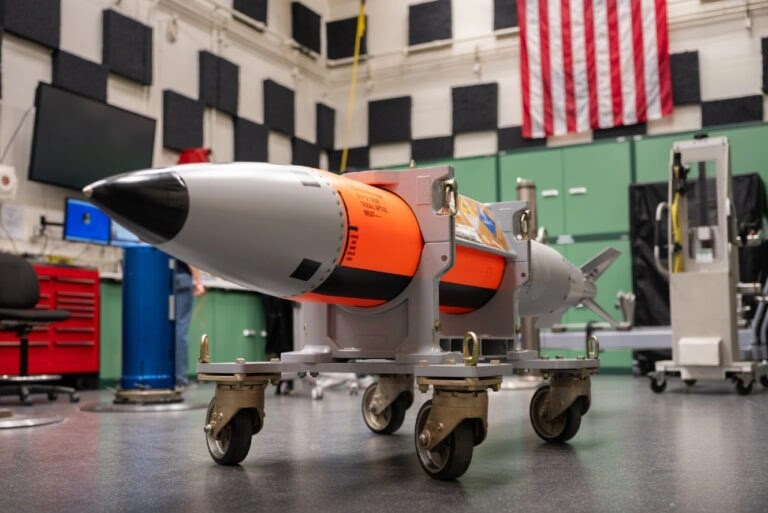
NATO is a nuclear alliance; member states make all their military capabilities available for joint use, including nuclear weapons (France’s situation is unique). For this purpose, U.S. B-61 atomic bombs stored in five European countries remain ready for use. Activated with the codes of the U.S. president and available for deployment by NATO air forces, these weapons are currently surrounded by uncertainty due to statements made by the Trump administration. Whether the notion of responding based on the degree and significance of an attack—outside previously defined scenarios—has altered the concept of the pact remains to be seen.

Moreover, the Strategic Arms Limitation Treaty (SALT) has expired. Thanks to this treaty, which limited each ballistic missile to a single nuclear warhead, the number of nuclear warheads—61,000 during the Cold War—was reduced to 16,000 today; however, the wind now appears to be shifting. As China moves to increase its arsenal from 350 nuclear warheads to 1,000 within the next five years, Russia is developing its tactical nuclear weapons and introducing new-generation advanced ballistic missiles into service. The United States, meanwhile, is modernizing its intercontinental ballistic missiles, renewing all its tactical weapons, and rapidly upgrading the B-61 munitions to be used by F-35 aircraft.

While the status of nuclear mines and torpedoes remains unknown for now, the current state of “micro” weapons is entirely uncertain. Particularly concerning is the possibility that these micro weapons may have been pre-positioned and kept ready in various NATO countries without the need for delivery vectors.

A New Roadmap for European and Pacific Defense

German Chancellor Friedrich Merz, in his statement at the Munich Security Conference (MSC), outlined a roadmap for European defense based on two pillars: rapidly increasing military equipment and ammunition, and creating an “autonomous” European component under the NATO umbrella that includes nuclear defense. UK Prime Minister Keir Starmer emphasized in his speech that his country’s nuclear firepower continues to contribute to NATO defense as it has in the past and highlighted the importance of “nuclear coordination,” while French President Emmanuel Macron signaled that France’s nuclear weapons could serve “EU defense.” These are steps aimed at balancing Russia’s nuclear power should the United States retreat into the background. NATO Secretary General Rutte’s statements that “Europe cannot defend itself without the U.S.” and references to a “nuclear alliance” are also part of this broader picture.

At this juncture, a general overview is necessary. In the corridors of Munich, discussions frequently arise about Europe’s need for an alternative balance guaranteed by nuclear deterrence. While France displays a one-step-forward, two-steps-back approach on this matter, the UK proposes coordinated action. On the other hand, the United Kingdom’s weapons and Trident missiles are U.S.-origin, and France would require constitutional amendments for a transformation of its nuclear defense policy. They may offer a short-term solution, but in the medium term, Germany, Italy, Poland, and Canada could turn toward developing their own nuclear weapons.

The situation in the Pacific is even more troubling. In response to China’s rapid armament, Japan and South Korea may, in the medium term, choose to acquire their own atomic bombs as symbols of sovereignty. If other capable countries join this competition in a chain reaction, how many nations will have added this weapon to their inventories by 2040 remains a major question mark. Provided raw materials can be secured and political will formed, acquiring an atomic bomb is not inherently difficult; while information about its chemistry is even accessible online, the crucial factors are technical expertise and trained specialists.

The Future of Global Proliferation and the 2040 Horizon

Approximately 50 countries across Europe, the Middle East, and the Pacific—Ukraine foremost among them—could possess this capability in the medium term. Transforming this capacity into an operational weapon in their inventories would pave the way for its use on the battlefield. We must remember the crisis atmosphere created by the Cuban blockade of November 1962 and avoid returning to those days.

The United States under President Trump has triggered a chain reaction that previous presidents would not have dared to initiate. Everyone attending the Munich Security Conference is uneasy about the situation, and halting the trajectory is becoming more difficult with each passing day. Although the U.S. officials we spoke with express confidence that economic and military sanctions will keep the situation under control, we will continue to monitor developments closely.

We must not forget the words emphasized by French philosopher Albert Camus after the detonation of two atomic bombs in Japan 80 years ago:

“Mechanical civilization has just reached its ultimate degree of savagery.”


SOURCE: C4Defence

Previous Post

BAE Systems Showcases Modular Electromagnetic Attack Capabilities

Next Post

KNDS Germany Introduces Boxer UxV CS Drone Command Module

Sami Atalan

Sami Atalan

Next Post
KNDS Germany Introduces Boxer UxV CS Drone Command Module

KNDS Germany Introduces Boxer UxV CS Drone Command Module

Most Popular

Raytheon RAIVEN akıllı sensör sistemi uçuş testi konsept görseli
Defence Industry Systems

Raytheon Completes First Flight Test of RAIVEN Sensor System

17 April 2026
MKE 76mm DENİZHAN Naval Gun on Turkish Navy ship during operation
Defence Industry Systems

MKE Launches $1.5 Billion Strategic Investment Initiative

16 April 2026
Close-up view of the Ghost Shark XL-UUV, an extra-large autonomous underwater vehicle for the Royal Australian Navy.
Defence Industry Systems

The Royal Australian Navy Officially Establishes the Maritime Autonomous Systems Unit

16 April 2026

Recommended

General Dynamics Land Systems ARV Gelişmiş Keşif Aracı amfibi deniz testleri sırasında.

$450 Million ARV Contract from General Dynamics

8 April 2026
Two Egyptian Air Force Dassault Rafale fighter jets flying over the Great Pyramids of Giza.

Egypt: A Suez-Centered Defense Strategy

26 February 2026
C4Defence

‎ ‎ ‎ ‎ ‎ ‎ ‎ ‎ ‎‎ Mildata Ltd. © 2026‎ ‎ ‎ ‎ ‎‎

Türkiye’nin ilk online savunma dergisi. Türkiye’s first online defence magazine.

  • Türkiye’s first online defence industry magazine.”

Bizi Takip Edin Follow Us

No Result
View All Result
  • Home Page
  • News
    • Agenda
    • Fair
  • Defence Industry
    • Turkish Defence Industry
    • Land Vehicles
    • Aircraft
    • Naval Vehicles
    • Projects
  • Modernization Programs
    • Turkish Armed Forced
    • Turkish SSB Projects
    • Turkish MoD Projects
    • Military Projects
    • Robotic Systems
    • Auxiliary and Subsystems
  • Articles
    • Sami Atalan
    • Prof. Dr. Mesut Hakkı Caşın
    • Prof. Dr. Mehmet Eryılmaz
  • About Us
    • Masthead
    • Privacy Notice
  • Menü ögesi
  • Menü ögesi
  • Türkçe
  • English

‎ ‎ ‎ ‎ ‎ ‎ ‎ ‎ ‎‎ Mildata Ltd. © 2026‎ ‎ ‎ ‎ ‎‎