







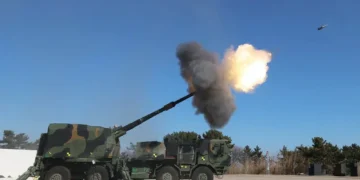










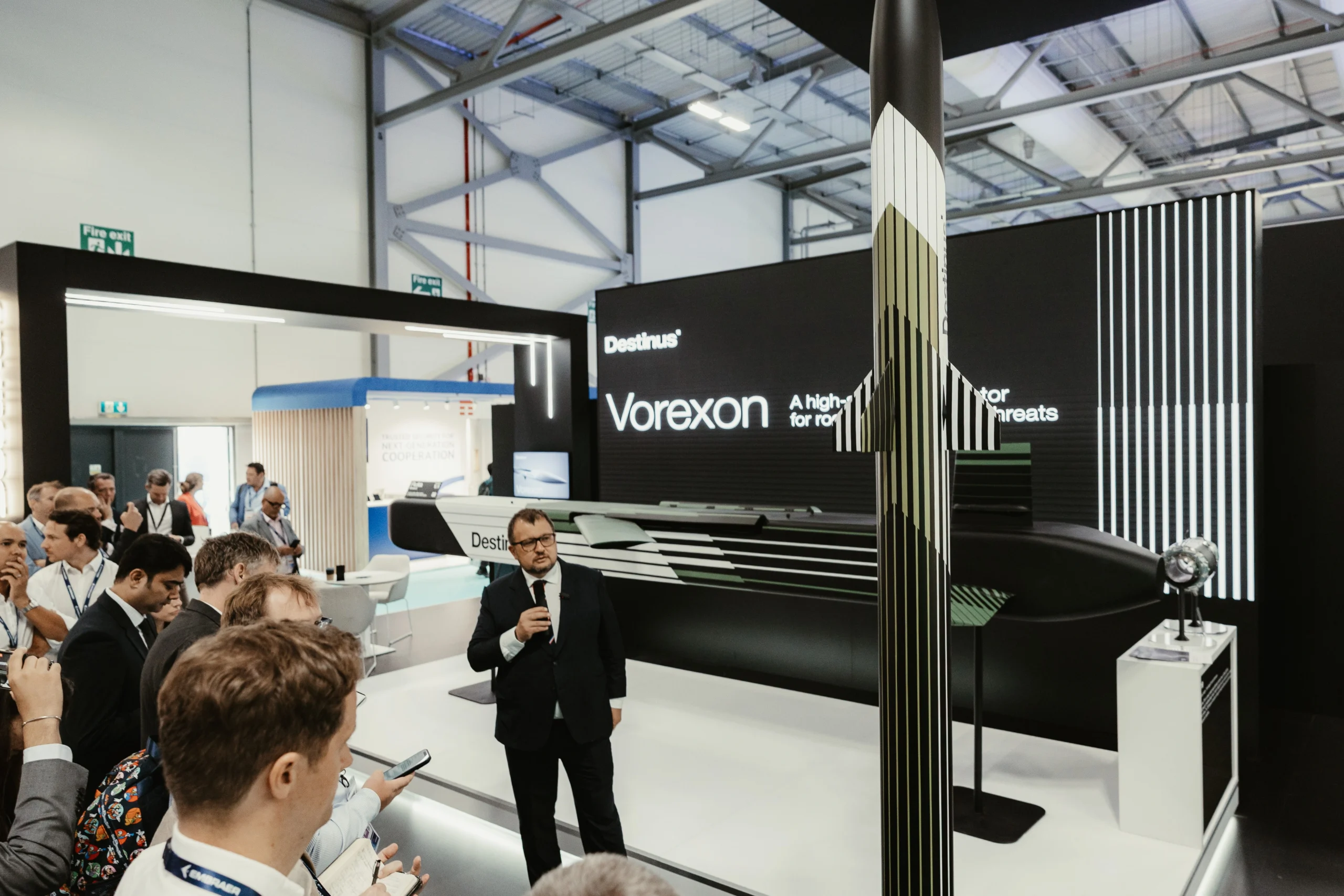
Is the era of spending millions on air defence missiles against a few thousand dollar artillery rockets coming to an end? European defence company Destinus has unveiled its new ground based interceptor system concept, Vorexon, at the Farnborough International Airshow. The system is designed to protect military facilities and infrastructure hubs against artillery rockets and certain artillery munitions.

The Defence Gap Exposed by the Ukraine War
The conflict in Ukraine has revealed the intensity of artillery warfare and the economic limits of current air defence systems. According to publicly available estimates, Russian forces were firing up to 20,000 rounds per day at certain periods of the war, while rocket artillery systems have been able to threaten critical facilities with very short warning times.
The high unit cost of current air defence missiles makes their use against cheap artillery rockets unsustainable, as the cost balance tips in favour of the attacker. Reversing this balance has become a priority for the defence industry. Destinus is promoting a “selective point defence” approach with the Vorexon concept, which only targets the area under threat rather than defending the entire front.
Vorexon’s Key Technical Features
Designed to be deployed around high value targets such as command centres, radars, ammunition depots, bridges and logistics hubs, Vorexon is intended to complement existing air defence and counter battery systems rather than replace them. According to Destinus, the system fills a largely missing layer in Europe’s integrated air defence: rapidly detecting and neutralising only those incoming munitions projected to hit the protected area.
The system’s key performance targets include a maximum speed above Mach 2 and an engagement range exceeding 20 kilometres. The interceptor will use a network centric guidance architecture supported by external radars. It will receive mid course updates after launch and then switch to an active radar seeker for the terminal phase. The firing decision will remain entirely under operator control.
Vorexon is planned for deployment on mobile or fixed platforms with multi round container launchers that will provide high ready round density and distributed protection. Combining the speed and agility needed against artillery rockets with a unit cost and production rate that favours the defender is one of the design’s core objectives. While the architecture remains optimised for artillery rockets and certain shells, it could also offer secondary capability against some threats such as subsonic cruise missiles and glide bombs.
From Concept to Production
Currently in the concept stage, Destinus aims to reach a significant development milestone in 2027. The targeted parameters, such as speeds above Mach 2 and ranges exceeding 20 kilometres, are presented as development goals subject to engineering validation and testing.
Destinus CEO Mikhail Kokorich commented on the matter. He said, “Ukraine has shown us that the goal cannot be to intercept every artillery round. The real objective is to detect and neutralise the few munitions projected to hit critical facilities. Vorexon is being designed precisely for this mission: a fast, scalable European point defence layer against artillery rockets and certain shells. It will protect radars, command centres, ammunition depots and logistics points so operations can continue when seconds matter. Point defence only works when commanders can protect every critical asset at a cost that does not lag behind the enemy’s production rate.”
You can check out our exclusive interview with Destinus CEO Mikhail Kokorich, which we featured in previous issues of C4Defence magazine, as well as the company’s strategic vision.
🔍 You may also like
Source: C4Defence- Destinus