






















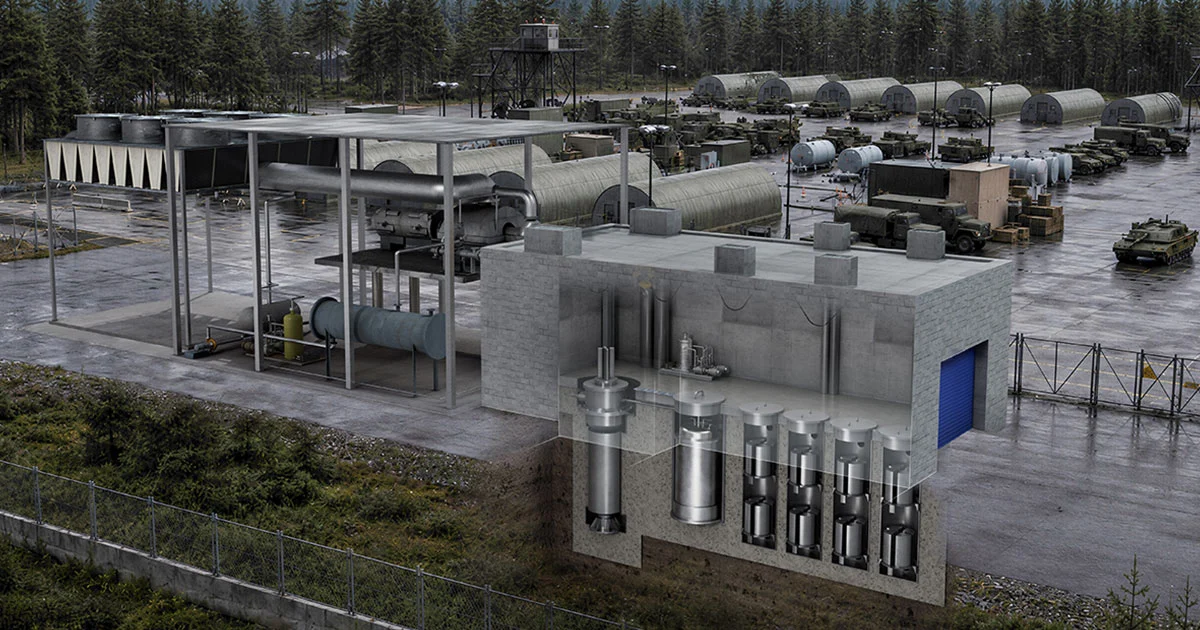
General Atomics Electromagnetic Systems (GA-EMS) has been selected by the U.S. Army as one of multiple industry partners for the Janus Program to advance its General Atomics Tactical Energy System (GA-TES) microreactor. The company announced on August 26 that it would move the system forward through its next development phase.

GA-TES is designed for remote, austere and strategically important locations. Built to deliver reliable power to sustain critical operations during grid disruptions, the system is being developed under the Janus Program, led by the Army in partnership with the Department of War Innovation Unit, which is working to accelerate commercially developed nuclear technologies into operational use. GA-EMS will carry out its work through an Other Transaction Authority-based agreement, with funding tied to milestone-based technical goals.
Built on Uranium-Zirconium Hydride Fuel
GA-TES draws on General Atomics’ work in uranium-zirconium hydride (UZrH) fuel technology and the safety and operating record of TRIGA reactors deployed worldwide. The system pairs self-regulating UZrH fuel with pump-free natural-circulation cooling, enhancing passive safety, simplifying operations and supplying power to defense infrastructure without relying on large cooling-water systems.
GA-EMS President Scott Forney said the company draws on more than 70 years of nuclear innovation to deliver microreactor technologies that provide safe, dependable and independent power for military installations. Forney said the company’s experience designing and deploying 68 reactors worldwide, along with supporting reactor technologies throughout their lifecycles, positions it to deliver energy solutions that strengthen operational resilience.
Dr. Jeff Waksman, principal deputy assistant secretary of the Army for Installations, Energy and Environment, said the Janus Program is about transitioning from designs and experiments to reliable commercial hardware that secures energy independence. Waksman said the selected teams, including GA-TES, are expected to work through the technical milestones agreed upon for their systems.
Technical Specifications of the GA-TES Microreactor
GA-TES is a liquid-metal-cooled microreactor with a baseline net output of approximately 5 megawatts electric (MWe) and an architecture scalable to about 20 MWe. Designed for off-grid and extreme environments, the plant has a 40-year design life. Its modular architecture allows transport and deployment by truck or rail, while natural-circulation primary coolant flow eliminates pumps and the mechanical complexity that comes with them.
Dr. Christina Back, vice president of GA-EMS Nuclear Technologies and Materials, said passive safety and operational simplicity are fundamental to the Tactical Energy System’s design. Back said self-protecting UZrH fuel and pump-free natural-circulation cooling reduce reliance on active systems and operator intervention while providing flexibility to meet evolving defense energy requirements.
Under the Janus Program, Fort Hood, Texas, will serve as the installation where GA-TES advances through development, testing and site-planning milestones toward potential deployment. The work supports the Army’s broader nuclear objectives.
🔍 You may also like
Source :C4Defence–General Atomics