











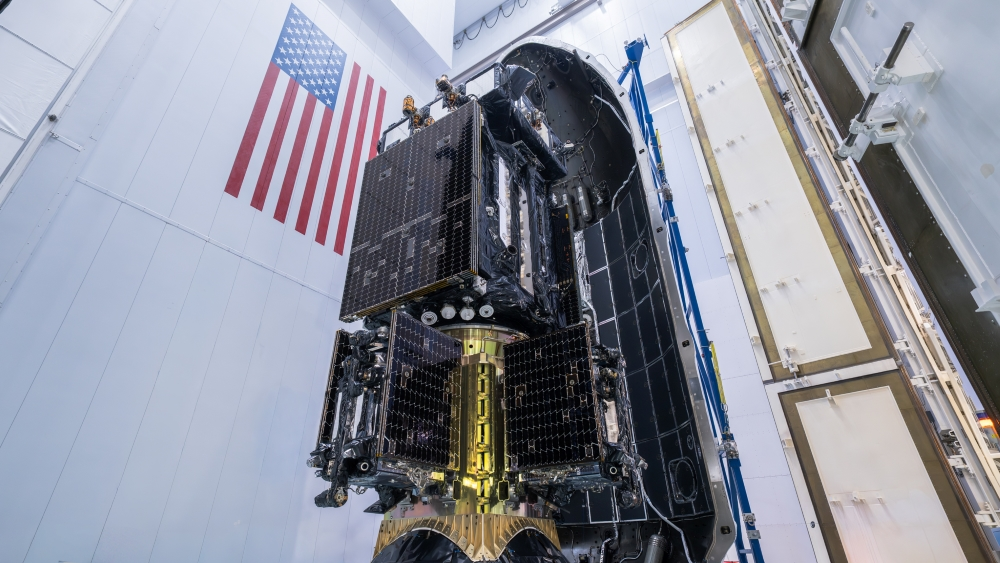
Northrop Grumman launched its Mission Robotic Vehicle (MRV) and three Mission Extension Pods (MEP) from Cape Canaveral on 22 July 2026, developed to provide autonomous satellite servicing capabilities. Described as the first of its kind, the MRV and MEP systems offer satellite servicing, mission life extension, and in-orbit refuelling capabilities.

Launch and System Architecture
The MRV was developed through Northrop Grumman’s investment and a partnership with DARPA (Defense Advanced Research Projects Agency). The vehicle is designed to support operations such as robotic satellite inspection, repositioning, repair, space debris removal, and in-orbit assembly.
The DARPA robotic payload carried by the MRV was developed by the US Naval Research Laboratory and consists of two fully articulated robotic arms along with specialised mission equipment. The MEP systems, which provide additional thrust to satellites, are designed to extend satellite operational life and enhance in-orbit manoeuvrability.
The vehicle was also launched with the Passive Refuelling Module (PRM)—a standard refuelling and docking interface approved by the US Space Force. This module is intended to enable the MRV to be refuelled in orbit and undertake long-duration missions. The system has also been equipped with processing capabilities to support future artificial intelligence-driven operations.
The Company’s Previous Experience
Northrop Grumman was the first company to extend the life of fuel-depleted commercial satellites with its first-generation satellite servicing vehicles, the Mission Extension Vehicles (MEV). The two MEVs in orbit have so far docked with three commercial communications satellites, providing a total of more than ten years of mission extension services. The MEP systems are built on this experience, offering a smaller, more rapidly deployable alternative.
Ryan Tintner, Vice President and General Manager of Northrop Grumman’s Space Superiority division, made the following statement after the launch: “MRV is a new class of autonomous space robotics that can learn and evolve to support our nation’s next-generation missions in space. These are not technology demonstrations. Our investments in this area are now making possible options in space that we simply could not offer before.”
🔍 You may also like
Source: C4Defence-Northrop Grumman