





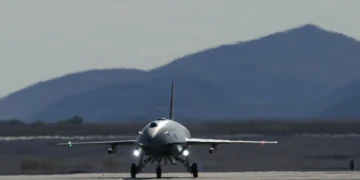











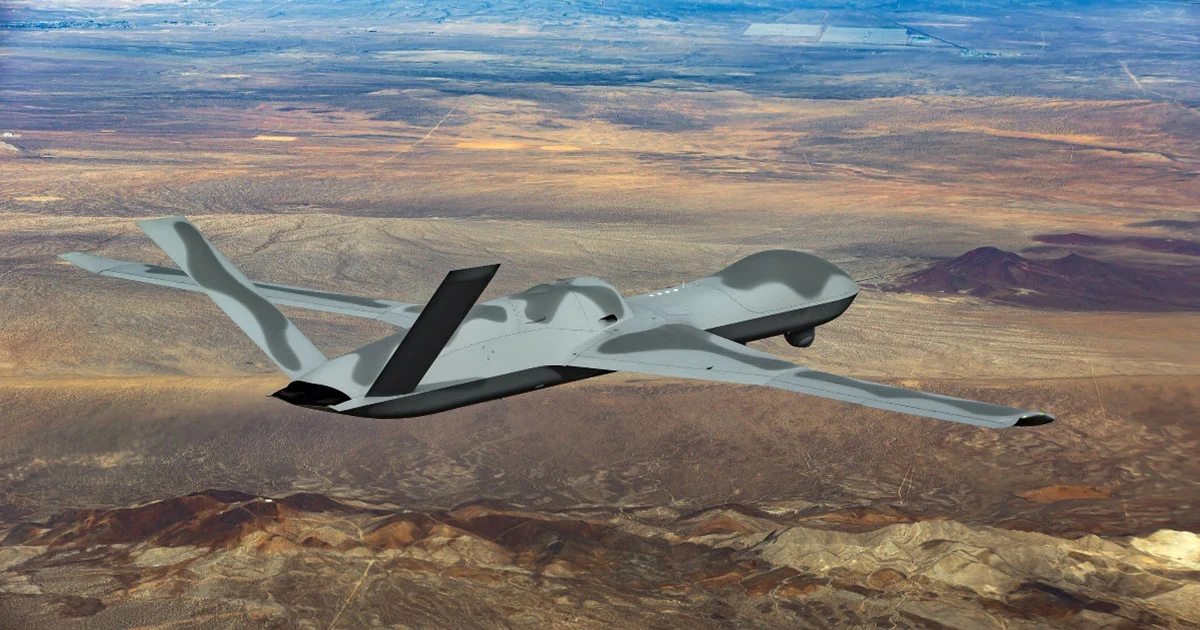
General Atomics Aeronautical Systems, Inc. (GA-ASI) and the U.S. Air Force (USAF) conducted an autonomy flight demonstration as part of the development of the Collaborative Combat Aircraft (CCA) concept. In the demonstration held on February 24, the MQ-20 Avenger® unmanned jet platform—equipped with the government’s latest Autonomy Starter Kit (ASK)—performed autonomous mission execution. Additionally, it provided collaborative targeting support.

Passive Targeting and the Sensor-to-Shooter Kill Chain
During the exercise, the MQ-20 utilized Single-Ship Ranging (SSR) and Infrared (IR) sensing capabilities to detect targets without emitting active radar signals. Additionally, GA-ASI’s TacACE® (Tactical Autonomy Core Ecosystem) software enabled fully passive geolocation of targets via Infrared Search and Track (IRST) sensors.
This technology allows unmanned platforms to detect targets without leaving any electromagnetic signature. As a result, it minimizes the risk of detection by enemy radar. Furthermore, it enables the establishment of a covert “sensor-to-shooter” kill chain. This is particularly critical in environments with intense electronic warfare activity and restricted communications. In these settings, these platforms can maintain operational capability and continue mission execution.
Data Link and Tactical Coordination
During the demonstration, the MQ-20 coordinated its autonomous behaviors using a proliferated Low Earth Orbit (LEO) data link within a large-force exercise framework. The engagement process also involved GA-ASI’s TacPad Pilot Vehicle Interface (PVI).
Mike Atwood, Vice President of Advanced Programs at GA-ASI, stated that the integration of SSR into TacACE’s modular capability library supports autonomous mission execution, collaborative targeting, and distributed kill chains. These capabilities further advance the role of autonomous aircraft in future air combat.
MQ-20 Avenger: A Leading Platform for CCA
Serving as a surrogate platform for the CCA concept for over five years, the MQ-20 Avenger continues to act as a testbed for the development of systems such as the XQ-67A Off-Board Sensing Station and the YFQ-42A CCA jets. This latest test provided valuable data on the use of autonomous jets as sensor platforms in air combat.
Read more defence news
Source: C4Defence-GA-ASI