







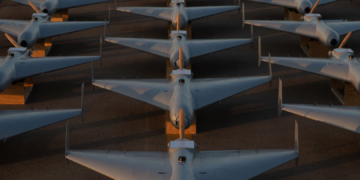








Aiming to transform electronic warfare-protected strike capability into mass production across Europe, Destinus has accelerated the launch of its new long-range precision strike system, the RUTA Block 3 program, in the 2,000 km range class. At a time when conventional missile stockpiles are proving insufficient in munitions-intensive conflicts, this new system, featuring an ISO container-based launch architecture, is planned to begin flight tests in 2027.

Shaped by operational lessons learned from the war in Ukraine, the program aims to move allied nations’ missile inventories away from the limited-stock logic and toward sustainable industrial production.
Triple-Industry Structure from Design to Serial Production
Rather than being designed from scratch, the Block 3 project will be built upon the existing, field-validated RUTA architecture and will be realized through a distributed production model across the continent. Additionally, Destinus, as the project’s main engineering authority, handles the design and large-scale serial production of the current RUTA family at its facilities in the Netherlands. The company is already conducting serial production of RUTA Block 1 missiles from this center.
Ukraine plays a critical role in the system’s operational development and testing processes. While RUTA Block 2, developed with support from Ukraine’s Brave1 program and currently undergoing testing, is targeted to enter serial production in 2026, Ukraine will serve both as an operational test range and a production hub for key components for the new Block 3 project.
🔍 You may be interested in: Rheinmetall and Destinus Establish Europe’s New Missile Production Base
On the German front, a strategic partnership will come into play to scale up industrial output. The Rheinmetall Destinus Strike Systems joint venture, planned to be established by the end of this year, will provide high-volume production capacity for the Bundeswehr and other European customers. Production at Rheinmetall’s Unterlüß facility is expected to begin with Block 1 and Block 2 in the 2026-2027 period, followed by Block 3 after completing certification processes.
“The Issue is not a Sophisticated Missile, but Industrial Depth”
The RUTA Block 3 being developed under the program will have a technical infrastructure capable of striking targets in the 2,000 km range class. Planned to be equipped with a 250 kg-class warhead for significant operational impact, the missile will derive its propulsion system from the larger Destinus T220 turbojet engine, currently in the design phase. Configured specifically for contested mission environments, the system will operate with advanced autonomous navigation capabilities in environments where GNSS navigation signals are degraded or completely jammed. It will combine this capability with a terminal sensing and guidance architecture currently under development. The launch system, which ensures the missile’s logistical and operational flexibility, will be based on a standard ISO container architecture compatible with land, sea, and fixed deployment options.
Electronic Warfare Protection and Container-Based Deployment
Powered by the larger Destinus T220 turbojet engine (currently in the design phase), RUTA Block 3 will carry a 250 kg-class warhead. Designed specifically to operate in contested environments with intense electronic warfare where GNSS signals are jammed or degraded, the missile will feature advanced autonomous navigation systems.
Another notable feature is the system’s logistical flexibility. RUTA Block 3 will utilize a standard ISO container-based launch architecture that allows launch from land, sea, and fixed platforms. This enables the system to be easily camouflaged and transported to the operational area, even via civilian-looking logistics routes.
Latest Defence News
Defence Industry Systems |Air Platforms
Source: C4Defence-Destinus