

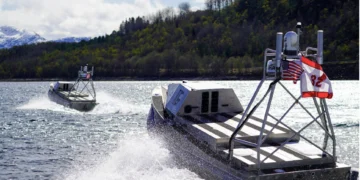
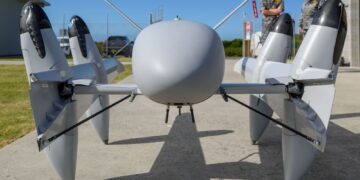










A game changing technology has just made its mark in the freezing waters of the Arctic and sub zero operational environments. The GARC autonomous surface vessel, equipped with advanced artificial intelligence algorithms, is fundamentally changing asymmetric capabilities for allied forces in naval operations.

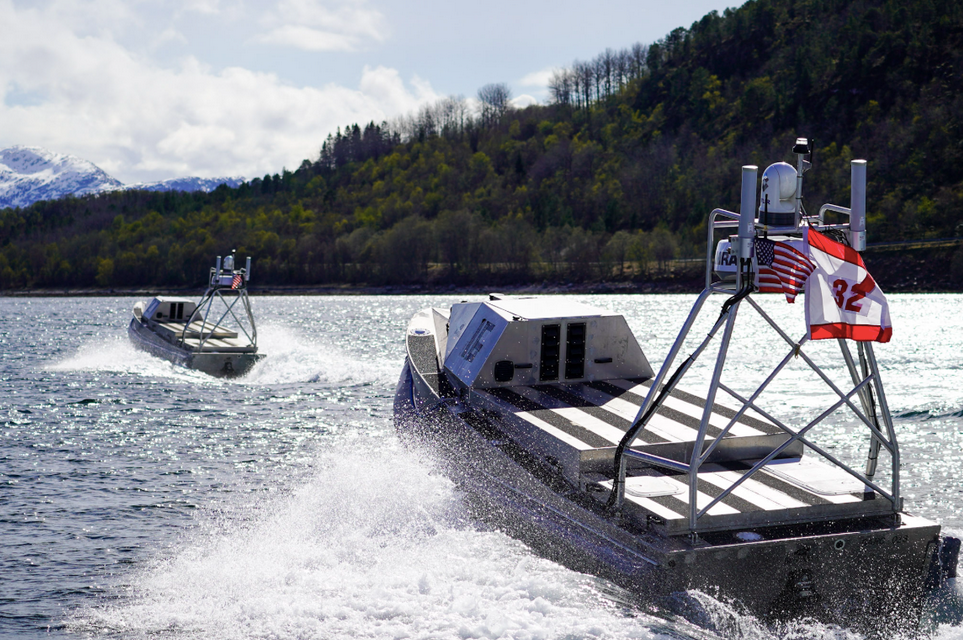
The platform was tested near Ramsund, Norway as part of Arctic Sentry 2026, an exercise NATO launched to strengthen its deterrent posture in the Arctic region. The tests shed light on the future of distributed maritime concepts. The unmanned system, developed by US based BlackSea Technologies, has managed to draw global defence attention with its autonomous navigation and operational integration capability in freezing open sea conditions.
Full Integration with US and Norwegian Navies
The operations were carried out in partnership with the US Sixth Fleet, US Unmanned Surface Vessel Squadron 3 (USVRON 3) and the Royal Norwegian Navy. Together they pushed the tactical limits of unmanned maritime technologies. The platform, which company engineers designed with a hull built to withstand harsh climate conditions and a modular payload architecture, proved that its situational awareness sensors and autonomous routing software can work reliably even at very low temperatures. The exercise also provided critical field experience for next generation naval personnel training alongside unmanned and AI enabled systems.
Lunsford Schock, Mission Director at BlackSea Technologies, offered a technical assessment of the exercise’s operational outcomes. He said, “Arctic Sentry demonstrated first hand how effectively our platform can operate in the dynamic, contested and unpredictable maritime environments north of the Arctic Circle. This activity has strengthened our tactical partnerships with our European allies while reflecting our commitment to preserving freedom of manoeuvre at sea with scalable and smart solutions.”
Multi Domaint hreat Perception on the Northern Front
Arctic Sentry, which aims to reinforce the Alliance’s posture in the Arctic and High North region, was built on a multi domain operational approach. The strategic move brings allied platforms, sensors and command and control capabilities together under a single roof. The exercise was directed by Joint Force Command Norfolk, while overall strategic guidance was provided by Allied Command Operations.
Recent tactical footage officially released by the US Navy on 15 May also proved the operational presence of unmanned systems in the field. The shared footage shows a GARC autonomous surface vessel assigned to Commander, Task Force 66 elements operating with high stability in the tactically critical waters of Breivika Bay. Navy sources also stressed that these live tests conducted near Ramsund, Norway play a decisive role in sea control and sea denial strategies in the High North.
The Autonomous Era in Distributed Maritime Operations
The platform’s tough test inside the Arctic Circle is feeding directly into the Distributed Maritime Operations (DMO) doctrine being worked on by the Pentagon and NATO allies. Small, low cost autonomous surface systems with the potential to operate in swarms can carry out intelligence, surveillance and reconnaissance (ISR) missions without risking manned mother platforms. These autonomous solutions, which stand out for their advanced endurance, communications infrastructure that works even in heavy jamming environments, and modular architecture, are positioning themselves as asymmetric force multipliers in the Arctic, a region that has become the new centre of global power competition.
Latest Defence News
Defence Industry Systems |Naval Platforms
Source: C4Defence-BlackSea Technologies