

















In the defence industry, coating systems play a direct and decisive role in system reliability, operational continuity, and service life, all in line with military standards and NATO criteria. These technologies range from traditional metallic and conversion coatings to PVD, CVD, and self-healing nanotech systems. They are strategic engineering elements that combine high temperature, corrosion, and wear resistance with environmental regulatory compliance.

The selection of coating systems in the defence industry is not limited to just surface protection. It’s carried out according to military standards (MIL-STD, MIL-DTL) and NATO’s STANAG criteria, directly impacting system reliability, operational continuity, and service life. Components used on land, sea, and air platforms are exposed to high mechanical loads, temperature and pressure fluctuations, friction, moisture, saltwater, and chemical effects. These conditions lead to various damage mechanisms such as wear, oxidation, cracking, and pitting corrosion. Therefore, coating selection is made by considering performance criteria like hardness, friction coefficient, corrosion resistance, and thermal stability.
Commonly used coating systems in the defence industry include metallic coatings, conversion coatings, ceramic and high-performance coatings, polymer-based systems, and specialised functional coatings. Hard chrome coatings provide high wear resistance, while PVD (Physical Vapour Deposition) and DLC (Diamond-Like Carbon) coatings offer low friction and high surface hardness, minimising performance loss in moving parts. Ceramic and thermal barrier coatings are preferred in applications requiring high-temperature tolerance, whereas radar-absorbing and IR-suppressing coatings provide both protective and tactical advantages.
1- Metallic Coatings
- Zinc and Zinc Alloys
- Nickel (Electrolytic / Electroless Nickel) Coating
- Chrome Plating
- Cadmium Plating
- Aluminium Coating
2- Conversion Coatings
- Phosphate Coating (Zn, Mn Phosphate)
- Chromate / Passivation
- Anodising (Aluminium)
3- Ceramic and High-Performance Coatings
- Thermal Barrier Coatings (TBC)
- PVD / CVD Coatings
- DLC (Diamond-Like Carbon)
4- Polymer and Organic Coatings
- Epoxy/Polyurethane Paints
- CARC (Chemical Agent Resistant Coating)
- IR Suppressing Coatings
5- Special Purpose Coatings
- Radar Absorbing Coatings
- Silane / Sol-Gel Coatings
Current trends in the literature focus on nanotech coatings, electromagnetic wave-absorbing (stealth) systems, plasma electrolytic oxidation (PEO), and self-healing coating structures. Nanoscale coatings, in particular, offer improved corrosion and wear resistance, while carbon-based nanomaterials play a significant role in reducing radar visibility. However, environmental aging conditions and production costs remain active research topics. On the other hand, although conventional coatings containing hexavalent chromium offer superior performance, their use is being restricted due to toxic effects. The REACH regulations enacted within the European Union have accelerated the shift toward environmentally friendly and sustainable coating technologies in the defence industry. In this context, coating systems have become strategic engineering elements where high performance requirements and environmental compliance are evaluated together.
New Technology Coatings
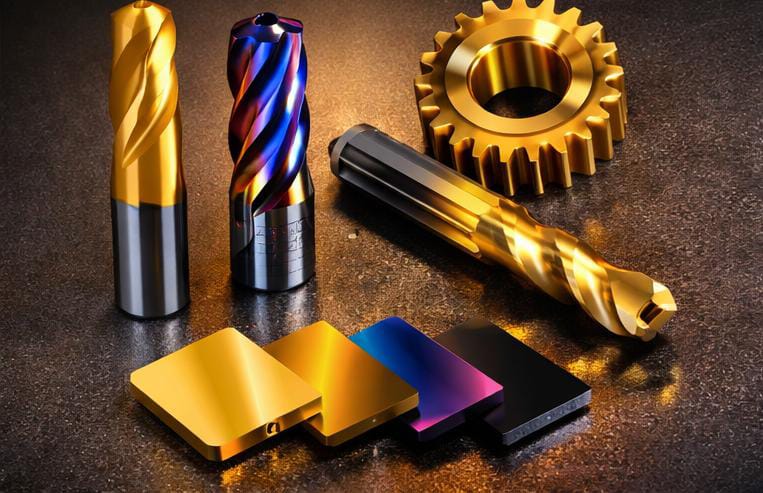
PVD (Physical Vapour Deposition) Coatings
PVD coatings are produced by physically vaporising a target material under vacuum and depositing it onto the substrate surface. This method is preferred especially in applications requiring high hardness and wear resistance. Titanium nitride (TiN) coatings have a hardness of around 2000 HV and, aside from their gold colour and decorative properties, are used to increase wear resistance on cutting tools and medical instruments. Titanium carbonitride (TiCN) coatings stand out in mould and high-wear applications due to their higher hardness and lower friction coefficient compared to TiN. Titanium aluminium nitride (TiAlN) coatings are characterised by high temperature resistance and are used in cutting tools and defence industry parts requiring oxidation resistance up to 800–900°C. Chromium nitride (CrN) coatings are common in automotive, marine, and defence applications as an environmentally friendly alternative with high corrosion resistance and no Cr⁶⁺. Finally, diamond-like carbon (DLC) coatings are preferred in mechanical moving systems, particularly weapon mechanisms, for their low friction coefficient and high wear resistance.
Working Principle: The PVD process consists of three main stages: vaporisation of the material, transport of atoms in a vacuum environment, and condensation on the substrate surface to form a thin film layer. Vacuum pressure typically ranges between 10⁻³ and 10⁻⁶ mbar.
PVD Methods:
- Arc Vaporisation (Arc PVD): The target material is vaporised using a high-current arc. Dense, hard coatings are achieved, but micro-droplet formation is a drawback.
- Magnetron Sputtering: Plasma is generated using a magnetic field, providing more uniform coatings.
- Electron Beam (E-beam): The target is locally heated with an electron beam, allowing the production of high-purity coatings.
Coating Types and Applications:
- TiN (Titanium Nitride): High hardness; cutting tools.
- TiCN (Titanium Carbonitride): Enhanced wear resistance; mould and tool applications.
- TiAlN (Titanium Aluminium Nitride): High temperature resistance; defence and aerospace components.
- CrN (Chromium Nitride): High corrosion resistance; eco-friendly alternative.
- DLC (Diamond-Like Carbon): Low friction coefficient, high wear resistance; ideal for weapon mechanisms and moving parts.
Advantages: High hardness, low friction, thin and uniform coating, environmentally friendly.
Disadvantages: High equipment cost, difficult application on complex geometries, high vacuum requirement, limitations in producing thick coatings.
In the defence industry, PVD coatings play a critical role on gun barrels, mechanical friction parts, aerospace fasteners, and surfaces designed to reduce IR signatures and radar visibility.
CVD (Chemical Vapour Deposition) Coatings
CVD coatings are produced by chemical reactions of gas-phase reactants on the substrate surface to form a solid film. They typically produce thicker coatings (5–20 µm) with higher temperature resistance compared to PVD. Titanium carbide (TiC) coatings stand out in cutting tool and mould applications due to their high hardness and wear resistance. Silicon carbide (SiC) coatings are suitable for turbine blades and defence applications requiring high temperature and thermal resistance. Alumina (Al₂O₃) coatings are used on turbine parts and radomes for their thermal barrier and electrical insulation properties. TiN coatings produced via CVD exhibit similar properties to PVD but offer advantages in thicker film structure and higher adhesion. Additionally, DLC coatings produced at low temperatures using PECVD provide friction-reducing solutions for precision mechanical parts.
Working Mechanism: Reactive gases are fed into the reactor, transported to the substrate surface, undergo a chemical reaction to form a solid film, and by-product gases are removed.
Example reaction:
TiCl₄ + CH₄ + H₂ → TiC + 4HCl
Types of CVD: Thermal CVD, LPCVD (Low Pressure CVD), PECVD (Plasma Enhanced CVD), MOCVD (Metal Organic CVD).
Produced Coatings and Applications:
- TiC: High hardness; cutting tools.
- TiN: Wear resistance; mould industry.
- Al₂O₃: Thermal barrier; turbine parts.
- SiC: High temperature resistance; aerospace.
- DLC (PECVD): Low friction; mechanical systems.
Advantages: Thick and dense coating, superior adhesion, high temperature performance, suitable for complex geometries.
Disadvantages: High processing temperature, risk of substrate deformation, use of corrosive gases, high energy consumption.
Use in the Defence Industry: CVD coatings are preferred for turbine blades, ballistic protection systems, high-temperature valve components, missile systems, and radome coatings. They are critically important for systems exposed to high temperatures and extreme wear conditions.
Comparison of CVD and PVD: CVD provides higher temperature tolerance and coating thickness, penetrates complex geometries better, and offers superior adhesion strength. PVD, on the other hand, operates at lower temperatures, is cleaner in terms of environmental risks, and has advantages in producing thin, uniform coatings.
Water-Based and Low-VOC Paints: New Technology in the Defence Industry
Traditionally, solvent-based paints used in the industry contain high amounts of volatile organic compounds (VOCs), posing risks to both human health and the environment. This created a need for greener, safer alternatives, especially in the defence and aerospace sectors. That’s where water-based and low-VOC paints come into play.
The main difference with water-based paints is the use of water as the solvent while keeping organic solvents to a minimum. Low VOC levels not only protect worker health but also make it easier to comply with environmental regulations. These systems typically use acrylic, epoxy, or polyurethane resins, providing both mechanical strength and corrosion resistance.
Technically, water-based paints offer the advantages of fast drying and applicability at low temperatures. Their solid content ranges from 35% to 55%, and high adhesion values can be achieved according to ASTM or ISO standards. However, high-temperature tolerance and wear performance are still not as high as solvent-based paints. That’s why hybrid systems are often used in the defence industry. For example, a water-based primer is applied over a metal substrate that has been pretreated with phosphating, followed by a PVD or CVD coating to enhance wear and friction resistance.
In defence, these paints are used particularly on armoured vehicle bodies, helicopter and UAV bodies, naval platforms, and radomes. If low friction and wear resistance are also required for moving mechanical parts, water-based topcoats are supplemented with DLC or PVD coatings.
In short, water-based and low-VOC paints offer major environmental and health benefits. While they still have some limitations in high-temperature and wear resistance, these issues can be overcome with hybrid systems. For this reason, they are considered a new, innovative technology in the defence industry.
Self-Healing Coatings: Mechanisms, Technologies, and Applications
Self-healing coatings are coating systems that can repair themselves when cracking or damage occurs on the surface. This preserves both corrosion and wear resistance. These types of coatings have gained serious attention in recent years, especially in high-performance fields like defence, aerospace, and automotive.
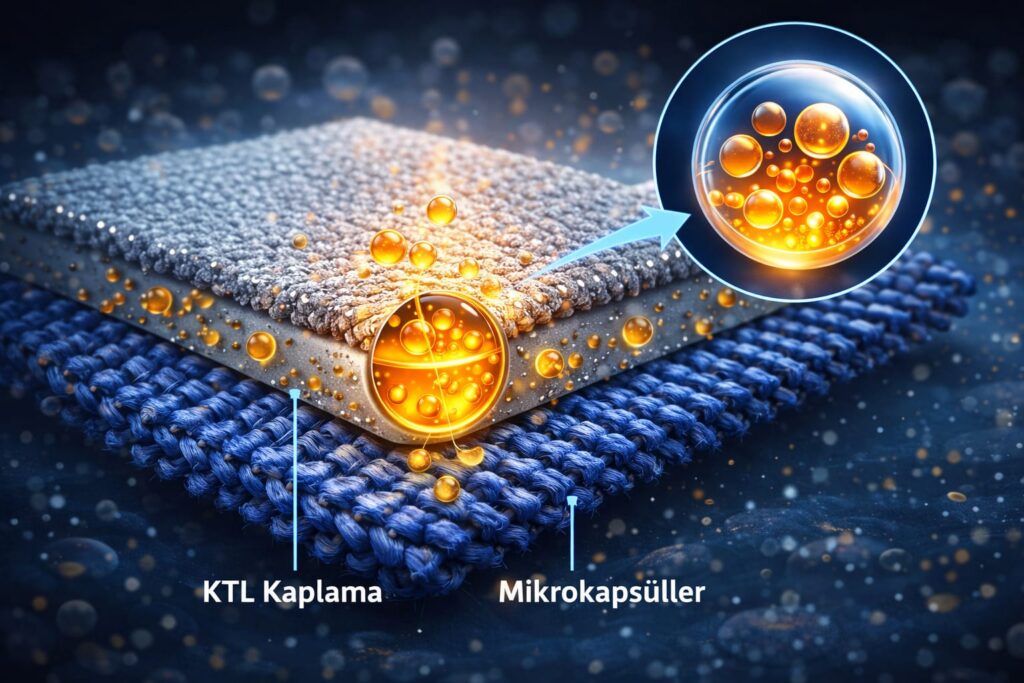
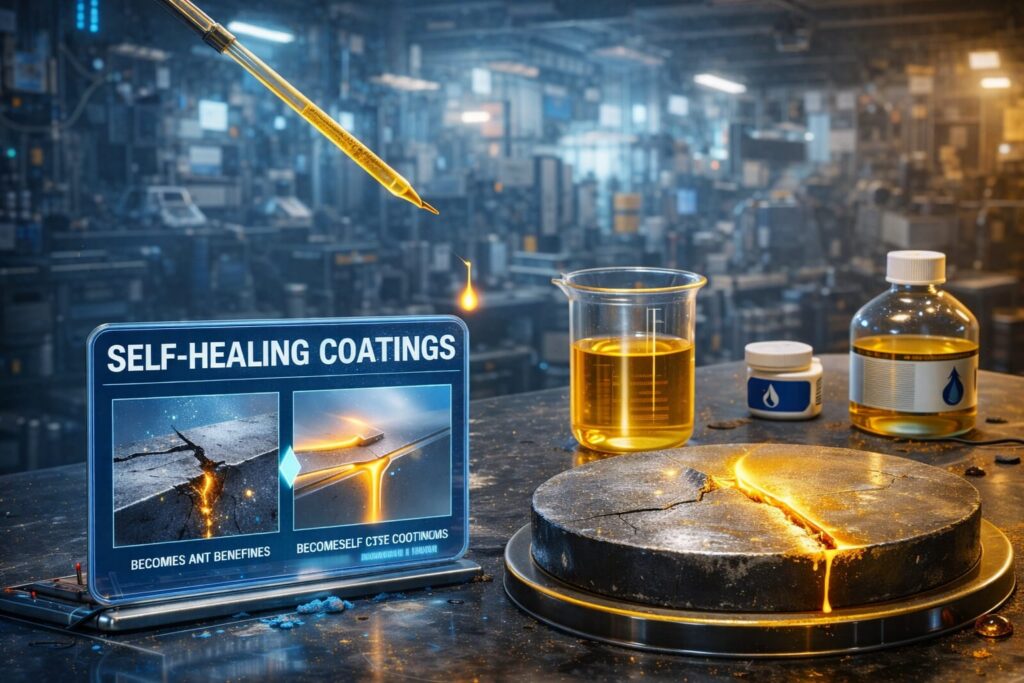
These coatings basically work through different mechanisms. The first is the microcapsule method: small capsules embedded in the coating rupture when a crack forms, releasing a healing agent that fills the crack. The second involves polymer chains re-bonding on their own, for example, through temperature or chemical triggers that close microcracks. There are also metal- or ceramic-based hybrid systems where nano- or micro-particles form a new oxide layer in the damaged area to protect the surface.
Different material systems exist as well. Polymer-based coatings contain epoxy, polyurethane, or acrylic, and are easy to apply because they’re flexible. But their performance is limited under high temperatures or heavy mechanical loads. Metal- or ceramic-based coatings, on the other hand, can be applied to titanium, aluminium, or stainless steel surfaces, providing high temperature and wear resistance in defence and aerospace. When hybrid systems like polymer + PVD/CVD are built on top of these, both mechanical strength and self-healing ability increase.
The advantages are clear: corrosion and wear resistance are maintained even after damage occurs, maintenance costs drop, and safety improves, especially on critical defence components. Applications are generally limited to high-cost systems that are difficult to maintain, such as armoured vehicles, weapon mechanisms, aircraft parts, and radar surfaces.
Of course, there are still some limitations. If the number and distribution of microcapsules isn’t sufficient, the self-healing effect diminishes. Polymer-based systems don’t perform well under high temperatures or heavy mechanical loads, and the costs are high. But when nano- and micro-scale hybrid systems are integrated with PVD/CVD coatings, these problems can be largely solved.
In short, self-healing coatings are seen as a future technology—especially for critical defence and aerospace components—enhancing both durability and ease of maintenance.
Technical Analysis by KARAKAYA86 R&D Team
This article was originally prepared in Turkish for the 156th issue of C4Defence Magazine.
REFERENCES
Aytaç, A. & Malayoğlu, E. (2018). PVD ve CVD Kaplamaların Endüstrideki Uygulamaları ve Performansları. DergiPark.
DEKAP Endüstri. Savunma Sanayi İçin PVD Kaplama.
Kimetsan Kimya. Savunma Sanayine Yönelik Su Bazlı Boyalar ve Kaplamalar.
Polymex. Savunma Sanayi Kaplama Sistemleri ve Su Bazlı Boyalar.
Yıldız, T. & Arkadaşlar (2022). Korozyona Dayanıklı, Kendini İyileştiren Kaplamalar: Nano Yapılar ve Uygulama Alanları. ResearchGate.
Kimetsan Kimya. Savunma Sanayi Kaplamaları ve Teknolojileri.
Wikipedia (Türkçe). Chemical Agent Resistant Coating (CARC).
A. Matthews & Leyland, A. (1998). “On the significance of the H/E ratio in wear control: a nanocomposite coating approach.” Surface and Coatings Technology, 108–109, 1–9.
Musil, J. (2000). “Hard and superhard nanocomposite coatings.” Surface and Coatings Technology, 125, 322–330.
Holleck, H. (1986). “Material selection for hard coatings.” Journal of Vacuum Science & Technology A, 4(6), 2661–2669.
TMMOB Metalurji ve Malzeme Mühendisleri Odası. Yüzey İşlemleri ve Kaplama Teknolojileri Seminer Notları.
Korozyon Derneği Yayınları. Korozyon ve Önleme Yöntemleri, İstanbul.
Source:C4Defence