

























BAE Systems announced that, as part of test activities conducted in partnership with the U.S. Air Force and related institutions, it has successfully demonstrated its modular and scalable electromagnetic attack (EA) capabilities. According to the statement made on February 23, 2026, the tests were carried out using a weapon pod integrated onto a test aircraft representing Group 4 or Group 5 unmanned aerial vehicles (UAVs). This achievement highlights BAE Systems EA Capabilities.

High Performance for Small Platforms
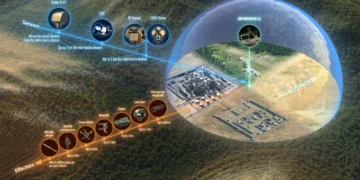
With this modular architecture, developed using core components of its existing high-power airborne EA systems, BAE Systems aims to establish a low-cost and distributed EA network. The system’s integration directly showcases EA Capabilities of BAE Systems.
The system offers a flexible structure that can be customized according to operational requirements and the size, weight, and power constraints of platforms. In this context, the modular EA solution is configured to be integrated into collaborative combat aircraft, unmanned aerial vehicles (UAVs), rotary-wing platforms, ground vehicles, surface ships, and various weapon stations. Moreover, with BAE Systems EA Capabilities, these platforms gain adaptable electromagnetic attack functionality.
Open Architecture and Operational Compatibility
Rory Duddy, Program Director for Modular Electromagnetic Attack at BAE Systems, stated: “We are demonstrating that we can miniaturize our high-performance EA equipment for the armed forces and reallocate it across smaller nodes on the network. We are innovating to deliver a mix of affordable capabilities that create a disruptive effect on the battlefield.” Both operational compatibility and the open architecture are key features of BAE Systems EA Capabilities.
The next-generation system can operate independently or serve as a complementary element to the U.S. Air Force’s full-spectrum EA-37B electromagnetic attack aircraft. The architecture of the system, which runs the “Counter-C5ISRT” software, has been developed in full compliance with Big Iron standards and the Software Open Systems Architecture (SOSA). This open architecture enables rapid hardware and software updates in response to emerging threats, as well as the integration of third-party applications that maximize EA Capabilities at BAE Systems.
SOURCE: C4Defence / BAE Systems