














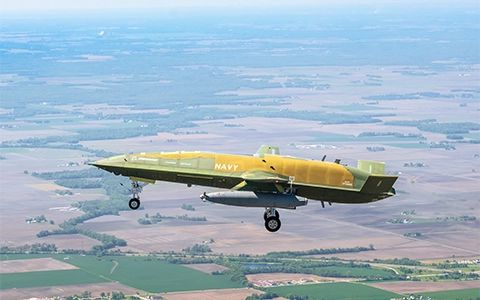
The U.S. Navy has reached a new milestone in the MQ-25A Stingray program by completing the platform’s first two-hour autonomous flight, powered by the Rolls-Royce AE 3007N engine. Conducted in collaboration between Boeing and Rolls-Royce, the tests operationally validated the unmanned tanker aircraft’s ability to take off, maneuver, and land in accordance with a digital mission plan.

Optimized Performance with the AE 3007N
With the flight carried out on April 25, Rolls-Royce obtained a critical dataset for system integration within the MQ-25A program. At the core of the platform, the AE 3007N engine features a high-bypass ratio of 5:1, enabling low specific fuel consumption (SFC). This allows the unmanned aircraft to effectively support both aerial refueling missions and long-endurance intelligence, surveillance, and reconnaissance (ISR) operations.
During the two-hour test flight, the MQ-25A also demonstrated autonomous taxiing, takeoff, and landing, while proving data link compatibility with the MD-5 ground control station. The flight confirmed the engine’s aerodynamic and software integration with the aircraft under operational conditions.
🔍 Related News: :US Navy Selects V-BAT for ISR Missions
Strategic Range and Operational Security
Aerial refueling—the MQ-25A’s primary mission—will enable Carrier Strike Groups (CSGs) to conduct operations from safer distances without exposure to enemy air defense systems. Meagan Rater, Director of Defense Advanced Programs at Rolls-Royce North America, noted that the high performance of the AE engine family enhances personnel safety while directly supporting the National Defense Strategy’s maritime domain awareness objectives.
Delivery Timeline
Rolls-Royce aims to deliver four additional AE 3007N engines to Boeing in 2026 to support production reserves for the MQ-25A program, which is planned to cover a total of 76 aircraft. With over 90 million flight hours globally under its belt, the AE engine family has further strengthened its technical dominance in the unmanned systems market through this project. The company continues to support domestic production and industrial resilience goals with a $1.5 billion investment in its U.S. manufacturing facilities over the past decade.
Latest Defence News
Defence Industry Systems | Air Platforms
Source: C4Defence-Rolls-Royce