





















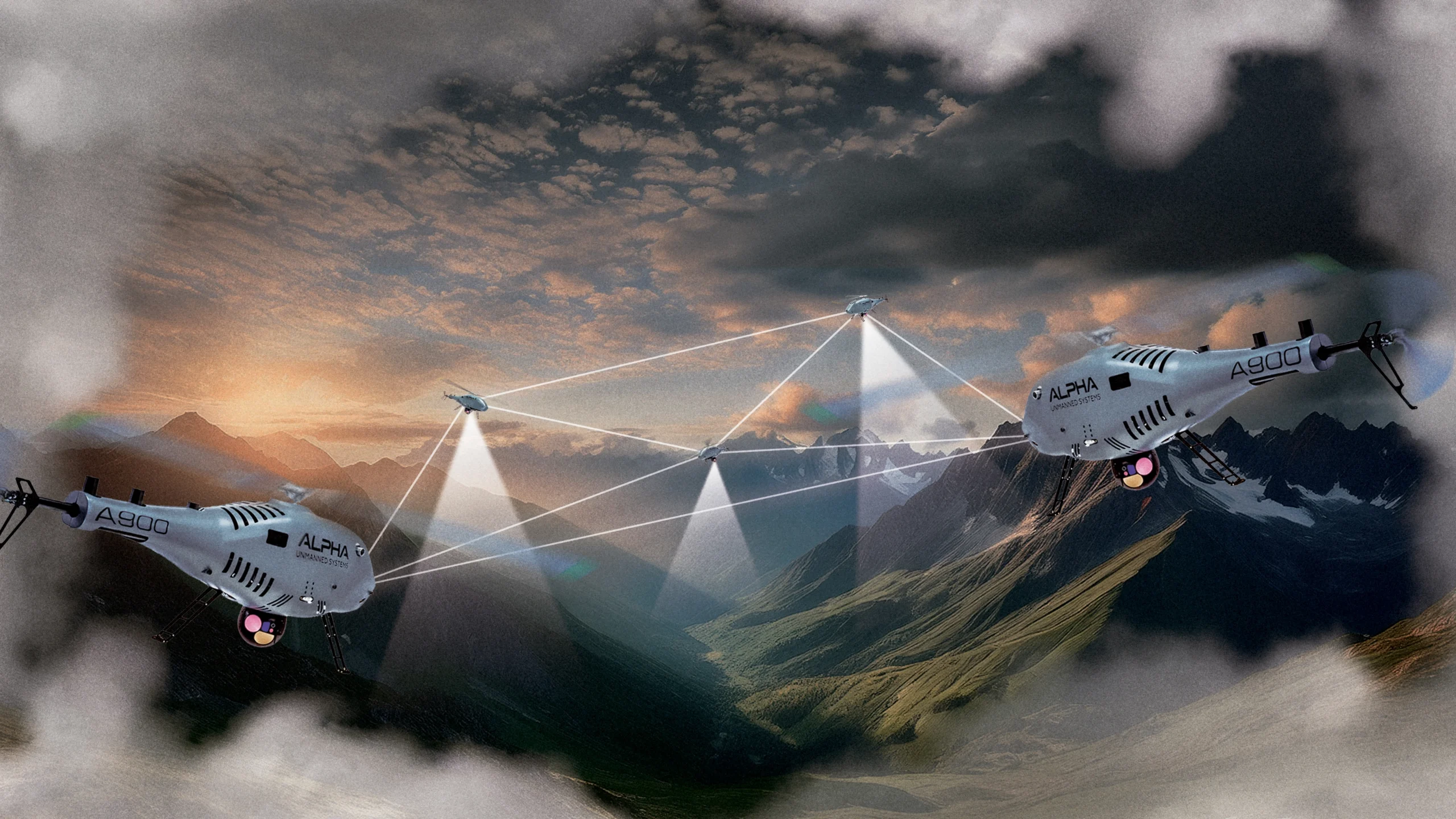
The FENIX project, launched under the Spanish Ministry of Defence’s COINCIDENTE programme, brings to the field a “heterogeneous swarm” technology that allows different types of unmanned aerial vehicles (UAVs) to operate in a coordinated manner as a single entity. With flight control systems and advanced navigation solutions forming the technical backbone of the project, UAV Navigation‑Grupo Oesía enables different platforms to autonomously cooperate in complex and high‑risk mission scenarios.

Heterogeneous Swarm and Operational Flexibility
While traditional swarm technologies usually focus on the coordinated flight of similar platforms, the FENIX project allows UAVs with different specialisations – such as reconnaissance, surveillance and target tracking – to work in a complementary way. Led by Alpha Unmanned Systems, with contributions from institutions such as FADA‑CATEC and AICIA, this effort increases the system’s flexibility and resilience, taking situational awareness in the field to the highest level. Moreover, thanks to its heterogeneous swarm architecture, the FENIX project offers genuine operational flexibility.
Key Technological Capabilities
🔍 Related news: Shield AI’s New UAV LUCAS – The Autonomous Era in Kamikaze Drone Technology
The systems developed under the FENIX project are not limited to flight mechanics; they focus on enhancing the operational intelligence of UAVs in the field. The real‑time communication network established between the UAVs allows the data collected to be instantly shared and processed by the entire swarm. (You may also want to check out the details of UAV Navigation’s Tiche Project, which is closely related to this topic.) In addition, thanks to autonomous mission allocation capability, the swarm can automatically redistribute tasks among itself in response to dynamically changing threats on the battlefield. Advanced swarm coordination algorithms that minimise the risk of collision in complex airspace aim to maintain connectivity and ensure mission continuity even in challenging electronic warfare environments such as enemy jamming or spoofing. In these technologies, the FENIX project holds a special place.
Autonomous Mission Management Through a Single Interface
One of the most important features that sets the FENIX project apart from other efforts is user experience and operational efficiency. The system operator manages the entire process through a single human‑machine interface, defining only the mission to be carried out. The system then automatically breaks the mission down into simpler sub‑tasks, distributes them optimally according to the capabilities of each UAV, and generates the safest and most efficient trajectories for each vehicle while taking physical constraints into account. In this regard, the FENIX project offers innovative solutions in its field.
As C4Defence, we will continue to closely monitor the developments in the FENIX project which is poised to redefine the balance in the European defence industry as well as the operational implications of this technology in the field.
🔍 You may also like: For the latest developments in Türkiye’s autonomous swarm operations, check out the relevant post on our X account.
Source: C4Defence-UAV Navigation-Grupo Oesía