


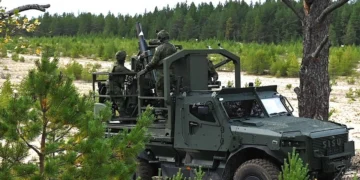




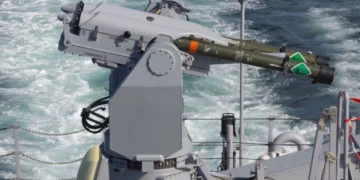




















The US Army is moving towards a new technology that could reshape air defence strategy on NATO’s eastern flank. Developed by DZYNE Technologies, the IonStrike counter‑drone system features a kinetic interceptor that can be retasked in flight. Unlike traditional “fire‑and‑forget” missiles, this gives operators tactical flexibility against swarming kamikaze drones.

Tests conducted by the 52nd Air Defence Artillery Brigade (52d ADA BDE) are measuring the system’s operational capability, which integrates directly with the Army’s existing command‑and‑control infrastructure. Fully compatible with Forward Area Air Defence (FAAD) and Integrated Battle Command System Maneuver (IBCS‑M) networks, IonStrike’s radar‑independent architecture allows target detection and engagement through current systems without adding extra training burdens on personnel. These efforts are part of a new combat concept under the Eastern Flank Deterrence Initiative (EFDI), supported by US Army Europe and Africa (USAREUR‑AF) and NATO Allied Land Command (LANDCOM), aimed at developing faster decision‑making processes against intense drone attacks.
Flexible engagement Capability and Economic Sustainability
The US Army’s interest in autonomous systems is advancing rapidly across different platforms including autonomous helicopter projects alongside air defence solutions. The key difference that sets IonStrike apart from traditional air defence missiles is that it gives the operator in‑flight control over the missile. Unlike classic systems that operate on a “fire‑and‑forget” principle, this technology enhances situational awareness on the ground. If the target is re‑identified as a friendly asset while the missile is airborne, the operator can immediately cancel the attack. Similarly, if a threat changes direction, the missile can lock onto a new target. This “retaskability” feature is especially valuable against swarming kamikaze drones, providing ground operators with significant flexibility compared to their adversaries. Another critical advantage is the system’s lower cost relative to the targets it neutralises, offering economic sustainability across defence layers.
Meanwhile, the US continues to modernise its existing ground forces, recently approving a major order for Paladin self‑propelled howitzers. Currently being tested in a four‑round launcher configuration, the IonStrike system is also being developed in a 12‑round launcher layout for higher‑intensity attack scenarios. In its terminal phase, the system uses an infrared seeker and a proximity fuze, aiming to be effective against various drone threats day or night. During operational evaluations scheduled for the summer, the system’s performance will be analysed in detail – including network integration, radar cueing, reload procedures, and real‑world engagement against realistic threats.,
🔍 You may also like
Source: C4Defence-US Army