






















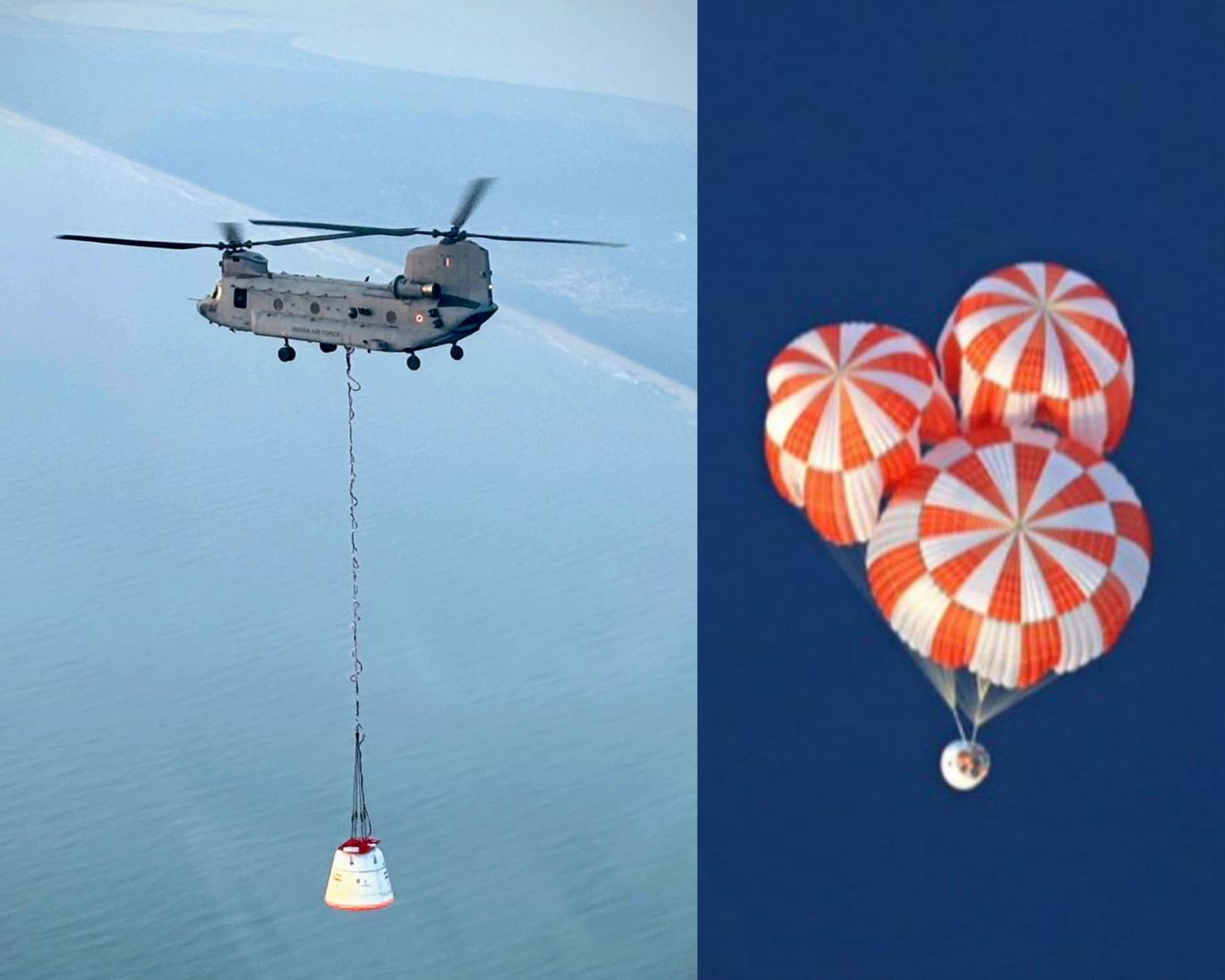
The Indian Air Force (IAF) has successfully completed the second Integrated Air Drop Test of the Crew Module as part of the Gaganyaan space mission. During the test, carried out using a Chinook helicopter, the parachute-based deceleration system designed to ensure a safe landing was validated. The Gaganyaan Crew Module also played a critical role in this test.

The Indian Air Force (IAF) has successfully carried out the second Integrated Air Drop Test (IADT) of the Crew Module, a key milestone in India’s human spaceflight program. Conducted on behalf of the Indian Space Research Organisation (ISRO), this activity represents a significant step forward in the country’s indigenous space efforts.
As part of the test process, a Chinook helicopter from the IAF inventory was used. The Crew Module was released from a designated altitude, and the parachute-based deceleration system responsible for ensuring a safe landing was verified. The successful completion of the test was also recorded as a demonstration of effective inter-agency coordination between the IAF, the Indian Navy, ISRO, and the Defence Research and Development Organisation (DRDO).
What is the Gaganyaan Space Mission?
The Gaganyaan mission is India’s first human spaceflight program, led by the Indian Space Research Organisation (ISRO). The primary objective of this program is to send a three-member crew to Low Earth Orbit (LEO) at an altitude of approximately 400 kilometers, where they will conduct a three-day mission. Following this, the crew will be safely returned to Earth, landing in Indian waters. With this mission, India aims to become the fourth country in the world—after the United States, Russia, and China—to independently send humans into space.
Read more defence news
Source:C4Defence-IAF