

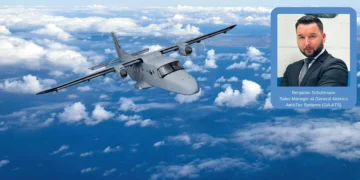















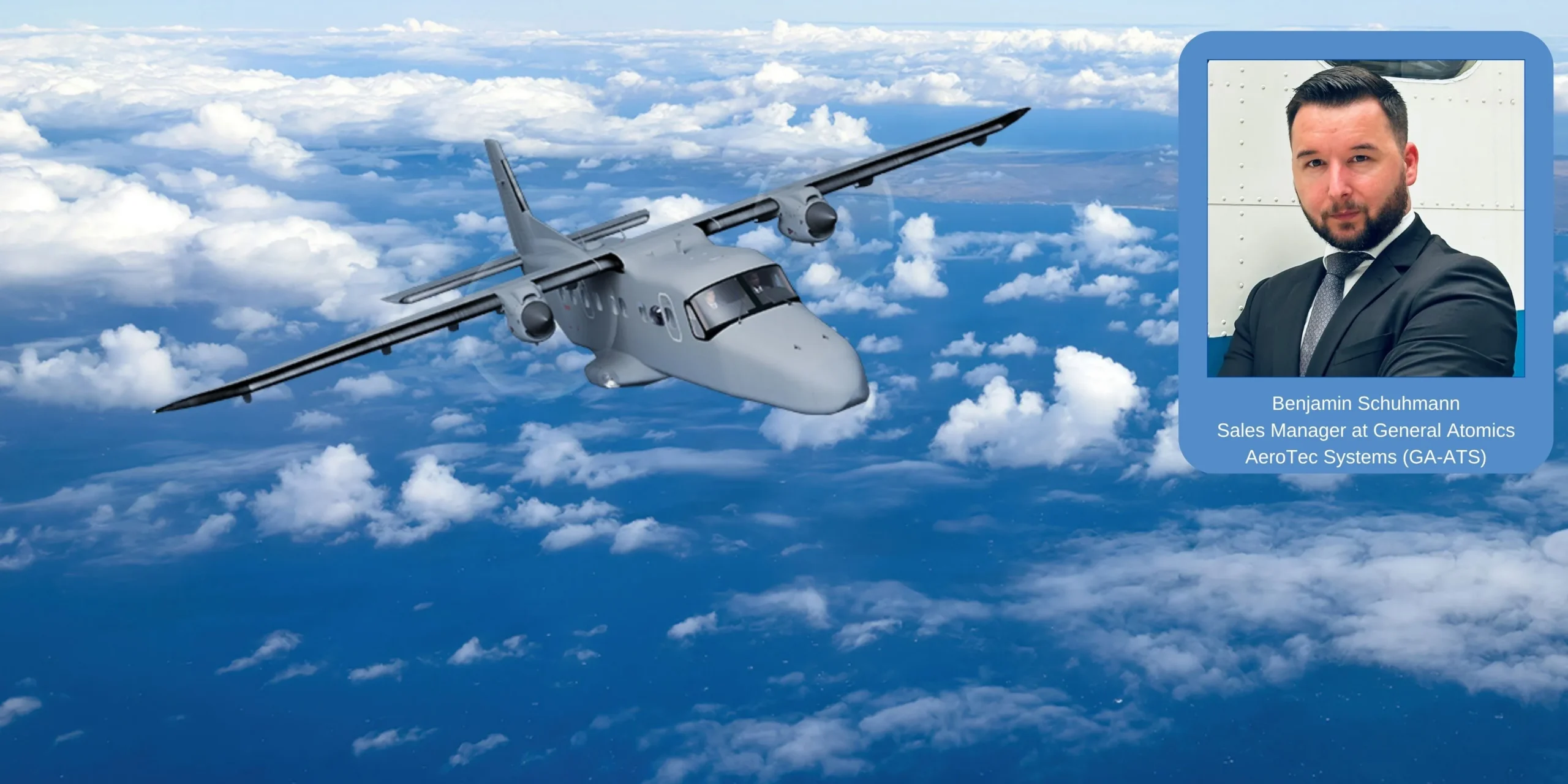
The Unmatched Power of Short-Takeoff-and-Landing Aircraft, now on the Ground Through Digital Transformation! The Do228 NXT is redefining standards in special mission aviation by combining legendary STOL capabilities with modern sensor fusion and network-centric operational capabilities. Benjamin Schuhmann, Sales Manager at General Atomics AeroTec Systems (GA-ATS), who blends German engineering heritage with a global vision, discussed the platform’s modular solutions against asymmetric threats and its strategic future goals with C4Defence.

C4Defence: How would you define General Atomics AeroTec Systems’ (GA-ATS) strategic position in the European defense and aerospace market, and what are your long-term objectives as a Germany-based OEM (Original Equipment Manufacturer)?
Benjamin Schuhmann, Sales Manager at General Atomics AeroTec Systems: General Atomics AeroTec Systems (GA-ATS) occupies a unique strategic position in the European aerospace and defense landscape as a Germany- based OEM combining sovereign industrial capability with the backing of a strong international group. Our roots in Europe ensure compliance with stringent European certification, safety, and defense requirements, while our global footprint enables access to advanced technologies, long-term investment security, and international program experience.
Our long-term objective is to strengthen our role as a trusted provider of fixed-wing special mission aircraft, system integration, and lifecycle support—focused onreadiness, adaptability, and long-term operational relevance for government and military operators.
C4Defence: How do you foresee the future of the global aerospace market? What are your expectations, and how are you preparing accordingly?
Benjamin Schuhmann: The global aerospace market is increasingly shaped by geopolitical uncertainty, asymmetric threats, and the growing importance of persistent situational awareness. We see a clear trend toward multi-role platforms that can be rapidly adapted to changing mission profiles, rather than highly specialized, single-purpose solutions.

In parallel, operators are placing greater emphasis on lifecycle costs, availability, digitalization, and sustainability. GA-ATS is preparing for this environment by investing in modular aircraft architectures, open mission systems, and digital engineering capabilities. This allows us to integrate new sensors, communications, and effectors over time while minimizing downtime and cost. Our focus is on platforms that remain operationally relevant for decades, not just at entry into service.
C4Defence: You have modernized the legendary Do228 platform with the “NXT” version. What are your objectives for this platform, particularly in the Middle East and Asian markets? Which types of needs are being addressed, and through which platforms are partnership solutions being considered?
Benjamin Schuhmann: The Do228 NXT is designed to meet the growing need for persistent surveillance, maritime patrol, and intelligence missions in regions characterized by vast coastlines, remote areas, and harsh environmental conditions.
In the Middle East and Asia, we address requirements such as Maritime Patrol Aircraft (MPA), ISR, SIGINT, disaster response, and border security. Our approach includes close cooperation with regional partners for mission systems, local industrial participation, and in-country MRO solutions.

C4Defence: What are the most critical technical and operational features that distinguish the Do228 NXT from other similar special-mission aircraft? Specifically, how do the aircraft’s renowned STOL (Short Take-Off and Landing) capability and flight characteristics provide operational advantages in modern missions?
Benjamin Schuhmann: The Do228 NXT stands out through a combination of performance, robustness, and mission adaptability. Its exceptional STOL capability enables operations from runways that are inaccessible to many comparable aircraft, significantly expanding the number of usable operating locations. This is a decisive advantage for missions conducted in remote areas, island regions, or forward operating bases.
Equally important are the aircraft’s flight characteristics and excellent low-speed handling as well as a top speed of 260 KTS, which are critical for surveillance, ISR, and maritime patrol missions. The TNT high wing configuration provides outstanding downward visibility and four hardpoints for Special Mission Equipment, while the aircraft’s stability reduces crew workload and enhances mission effectiveness during long on-station times.
C4Defence:What are the main sensors and mission systems integrated into the Do228 NXT? How do the platform’s digital cockpit and networked operations capabilities provide operational advantages to users?
Benjamin Schuhmann: The Do228 NXT is designed as an open, modular special mission platform. It can integrate a wide range of sensors, including maritime and ground surveillance radars, EO/IR systems, SIGINT/ELINT/COMINT payloads, EW Suites, and mission management systems. Operator consoles can be configured according to mission needs, allowing efficient sensor fusion and real-time decision-making.
The digital cockpit architecture improves situational awareness, reduces pilot workload, and enables seamless integration with mission systems. Networked operations allow the aircraft to act as an information node, sharing data in real time with ground stations, command centers, and other airborne assets. This significantly enhances mission effectiveness, particularly in joint and multi-domain operations.
C4Defence: How do you assess the potential of the Do228 NXT as a testbed for sustainable technologies, such as hydrogen or electric propulsion? What operational and maintenance (MRO) advantages could these approaches offer?
Benjamin Schuhmann:The Do228 NXT offers significant potential as a testbed for sustainable aviation technologies due to its robust airframe, generous payload margins, and flexible systems architecture. These characteristics make it well suited for the evaluation of alternative propulsion concepts, including hybrid-electric or hydrogen-based solutions, particularly in the regional and special mission context.
From an operational and MRO perspective, such technologies could offer reduced fuel dependency, lower operating costs in specific mission profiles, and simplified maintenance concepts over time. While these technologies are still evolving, GA-ATS views the Do228 NXT as an ideal platform to support future experimentation and gradual introduction of sustainable solutions without compromising operational reliability.
Source: C4Defence