






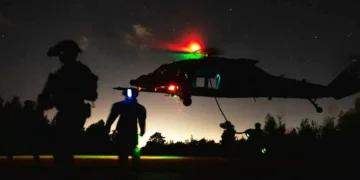
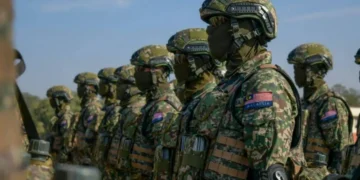





We are not satisfied with the forms of negotiation. They cannot possess nuclear weapons. I would never want to use the U.S. military to attack Iran, but sometimes you are compelled to do so.” “We have begun large-scale attack operations in Iran.
President of the United States Donald Trump [1]
History has accelerated in the Persian Gulf. The United States and Israel pressed the war button against Iran and struck Iranian targets. Donald Trump called on Iranians to overthrow their government after the United States and Israel launched airstrikes that he described as “a major and ongoing operation” against the Islamic regime. Shortly after the start of the attack, which the Pentagon named “Operation Epic Rage,” Israel announced that it had detected missiles launched from Iran toward its own territory. [2]

Stating that the United States would destroy Iran’s missiles and level its missile industry, Trump said, “A short while ago, the U.S. military launched a major war operation in Iran. Our objective is to protect the American people by eliminating the urgent threats posed by the Iranian regime. This terrorist regime can never possess a nuclear weapon. I repeat. They can never possess a nuclear weapon. They are a savage group composed of very ruthless, terrible people. These threatening activities directly endanger the United States, our troops, our overseas bases, and our allies around the world. We will completely destroy their navy. Americans may lose their lives and the United States may suffer casualties.”
Addressing the Iranian people, Trump stated, “When we are finished, take over your government. It will be yours from now on. Your time for freedom is approaching. This will probably be the only chance you will have for generations to come,” clearly revealing that regime change is among the primary objectives. [3]
Emphasizing that Iran must not possess nuclear weapons, Donald Trump said, “Iran can never have a nuclear weapon. For this reason, as part of the ‘Operation Midnight Hammer’ carried out last June, we destroyed the regime’s nuclear program in Fordow, Natanz, and Isfahan.” Israeli Defense Minister Yisrael Katz announced that they had launched a “preemptive strike” against Iran. [4] The U.S. President also stated that they had “tried again and again to reach an agreement” with Iran, saying, “We will destroy their missiles and level their missile industries. We will also destroy their navy. We will destroy it completely.” He added, “We will ensure that the ‘terrorist’ proxy forces in the region can no longer destabilize the region or the world. This regime will very soon learn that no one should challenge the power and might of the United States Armed Forces.” [5]
The Israel Defense Forces stated that Iran had responded with a “rain of missiles” and that they were working to intercept them. Israel closed its airspace. Explosions were heard in Iran’s capital, Tehran, and in many other cities, and smoke was rising into the sky. Iran closed its airspace. Trump, telling Iranian citizens “The hour of your freedom is approaching,” called on them to “take over your government” when the operation ends. Iran’s religious leader Ali Khamenei is not in Tehran and has been transferred to a secure location. [6]
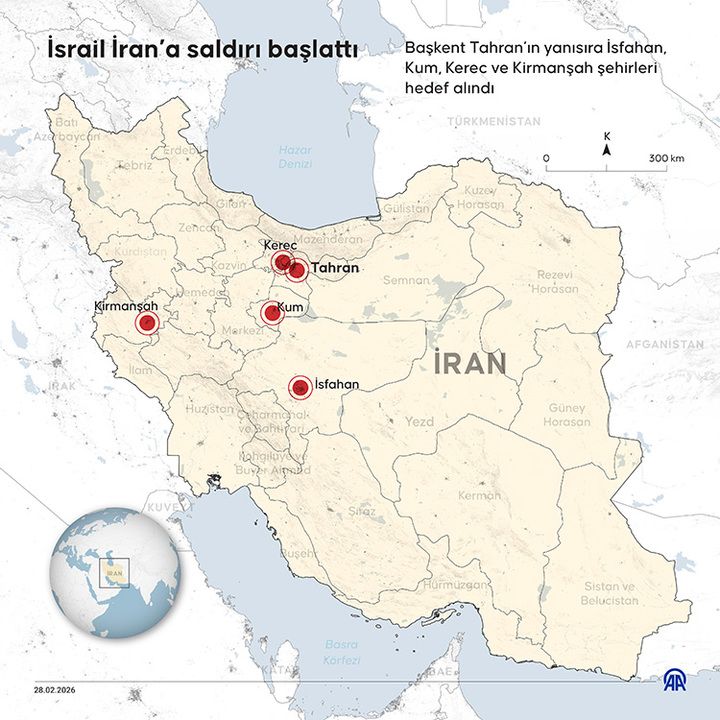
In the U.S.–Israel attacks on Iran, critical cities such as Tehran, Isfahan, Qom, and Karaj were targeted, while Iran, in response to the attacks, fired dozens of ballistic missiles at Israel. [7]
The U.S. bases targeted by Iran in the region are as follows: Qatar: Al Udeid Air Base; Kuwait: Al Salem Air Base; UAE: Al Dhafra Air Base; Bahrain: Naval Support Activity Bahrain (U.S. 5th Fleet Base); Jordan: Muwaffaq Salti Air Base.
In his first statement regarding the operation, Israeli Prime Minister Benjamin Netanyahu said, “The United States and Israel have launched an operation to eliminate the existential threat posed by the Iranian regime.” Netanyahu stated, “The operation will create the conditions for the Iranian people to take their destiny into their own hands,” and emphasized that Iran would not be allowed to acquire nuclear weapons. [8] He also said, “A short while ago, Israel and the United States began an operation to eliminate the existential threat posed by the terrorist regime in Iran.” Thanking Trump for his “historic leadership,” Netanyahu declared, “For 47 years, the Ayatollah regime has chanted ‘Death to Israel,’ ‘Death to America.’ They shed our blood, killed many Americans, and massacred their own people.” [9] Netanyahu expressed that the aim of the operation they initiated was “to eliminate the existential threat.” [10]
Iran fired dozens of ballistic missiles at Israel in response to the U.S. and Israeli attacks. Iran retaliated with an attack that its government said involved the launch of hundreds of missiles against Israel. U.S. officials at the time stated that the United States had helped Israel intercept Iranian missiles during this attack. Tehran declared, “In response to the hostile and criminal aggression against the Islamic Republic of Iran, the first large-scale missile and unmanned aerial vehicle attacks of the Islamic Republic of Iran against the occupied territories have begun.” [11]
Yes, the war has begun, and it can be expected that Iran may carry out attacks on U.S. bases in the Gulf with its proxy forces in the region and its other capabilities. Indeed, Iran attacked the U.S. naval base in Bahrain with ballistic missiles in retaliation for the joint U.S.–Israel military operation. Iranian missiles struck the headquarters of the U.S. Navy’s Fifth Fleet. A Qatari official confirmed that Qatar intercepted two Iranian missiles over its territory. Meanwhile, explosions were reported in Abu Dhabi, the capital of the United Arab Emirates, while sirens sounded in Jordan and Bahrain. [12] These developments demonstrate that the war will continue for a long time with new tactical and strategic attacks between missiles and air power. The aim of the joint operation is to neutralize Iran’s initial missile strike and weaken its air defenses; Hezbollah’s previous attacks in Lebanon had aimed to disable warning systems prior to the Israel–U.S. strike.
Iran’s Ministry of Foreign Affairs stated that they would make the aggressors “regret what they have done,” adding that U.S. bases were now legitimate targets. In its first statement following the U.S. and Israeli attack on the country in the early morning hours, the ministry said: “The renewed military aggression of the United States and the Zionist regime against Iran is a violation of international law and the principles of the United Nations Charter… The Iranian nation has always shown patience and restraint to prevent escalation and preserve regional stability.” With this statement, it conveyed the message that the war could expand. [13] As there are concerns about the further spread of the war in the West Asia/Middle East region, airspace has been closed in many countries. The primary targets in a possible Iranian retaliation could be U.S. or Israeli military bases.
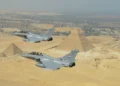
This image has an empty alt attribute; file name: ABD_ucak.jpg
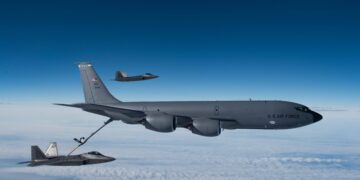
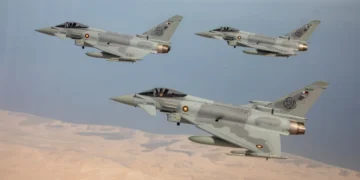
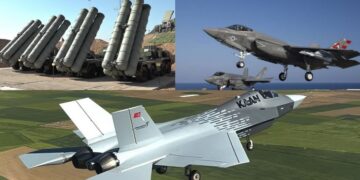
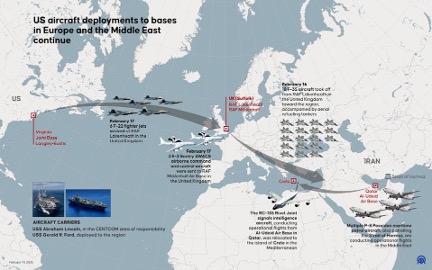
It is observed that the United States aims to establish an effective air defense shield and umbrella against Iranian missile attacks by deploying a large air force to the region via the United Kingdom and Greece. This force structure indicates that it will implement a different shock attack strategy compared to the 1991 Gulf War and the 2003 Iraq Operation. However, after the initial strike, the possibility that Iran’s retaliatory missile attacks, carried out in coordination with Israel, could lead to a longer war presents a potential surprise scenario. In essence, while the United States tests Iran, it can be said that it is highly probable that China and Russia—who are closely monitoring the region—may also obtain classified information regarding the U.S. military’s strategic concept.
Critical Political–Military Developments Before the War
International society, as the drumbeats of a possible war between the United States and Iran intensify, is discussing the background to such a conflict moving from potential to reality. From a big-picture perspective in terms of critical timing, the massive U.S. military buildup in the region appears to be burning the last grains of the hourglass for launching a large-scale attack on Iran, much like the Venezuela operation example.
Indeed, after major powers such as Russia, China, the United Kingdom, and Japan withdrew their citizens and diplomatic representatives from the region, the most recent development has been that the United States, amid threats of an attack on Iran, called on its citizens to immediately leave Israel. [14]
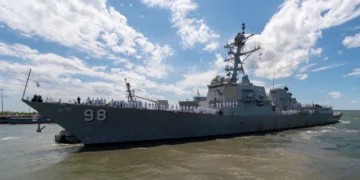
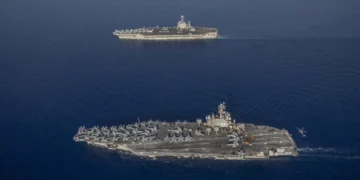
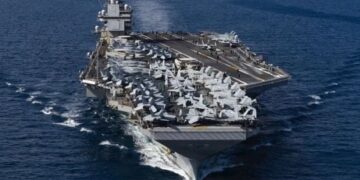
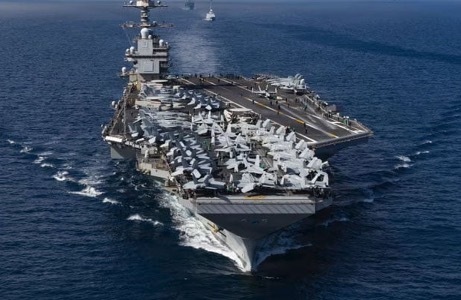
The world’s largest and most advanced nuclear-powered aircraft carrier, the USS Gerald R. Ford, arrived off the coast north of Israel near Haifa on Friday, 27 February 2026. The ship reached the Israeli coast after transiting from the NATO naval base at Souda Bay in Crete where it had been stationed. Its arrival and the landing of several U.S. refueling aircraft in Tel Aviv beforehand were seen as signs of an intensified American military presence in the region. This deployment marks a significant escalation in U.S. military presence in the Middle East and, together with the presence of the USS Abraham Lincoln, constitutes one of the largest concentrations of U.S. naval and air power in the region in recent decades. President Trump sent the Ford-class aircraft carrier to the region as an “open signal” of deterrence while evaluating possible military attacks on Iran if meaningful progress could not be reached in the Geneva nuclear negotiations. [15]
Many countries, including China, India, and Canada, have called on their citizens to leave Iran as quickly as possible due to potential conflicts. Germany issued an “urgent” warning against traveling to Israel, and France repeated the same advisory. [16]
U.S. President Donald Trump stated that he is “not happy” with ongoing negotiations with Iran. Regarding a possible operation, Trump said, “I don’t want to do this, but sometimes you have to.” [17] Trump also took the opportunity to outline U.S. targets in Iran during a national address. Today, Donald Trump is steering the United States toward war with Iran, yet Washington has offered no clear justification for why it must strike or whether Iran poses a military threat sufficient to warrant intervention against Americans. Trump has ordered the largest U.S. military buildup in the Middle East since the 2003 Iraq invasion. Naturally, Trump has broadly expressed his concerns regarding the so-called nuclear threat. However, unlike the lead-up to the Iraq War—when the Bush administration spent months arguing to Congress based on the false claim that Iraq was developing weapons of mass destruction—Trump and his senior aides have not taken the trouble to clarify why they could bomb Iran or precisely what the United States hopes to achieve. [18]
In this way, we have reached the edge of a precipice: a series of events and choices that leave very little room for maneuver for Washington or Tehran, occurring almost inadvertently. [19] With the United States conducting a massive military buildup in the Middle East and the likelihood of a diplomatic breakthrough appearing quite low, the prospect of an American operation against Iran is now imminent. [20]
It must be remembered, however, that if tensions in the Persian Gulf between the U.S. and Iran escalate into an actual war, this would not be the first time. In a potential Persian Gulf war, attacks on oil and gas tankers and prolonged disruptions to maritime trade routes would severely shake economies dependent on energy producers and their exports. Developments in Iran—internal unrest, visible security measures on university campuses, and renewed diplomatic maneuvers—are converging at a sensitive geopolitical turning point, attracting increased attention in the Middle East and global energy markets. Structurally, Iran holds a critical position for global energy markets.
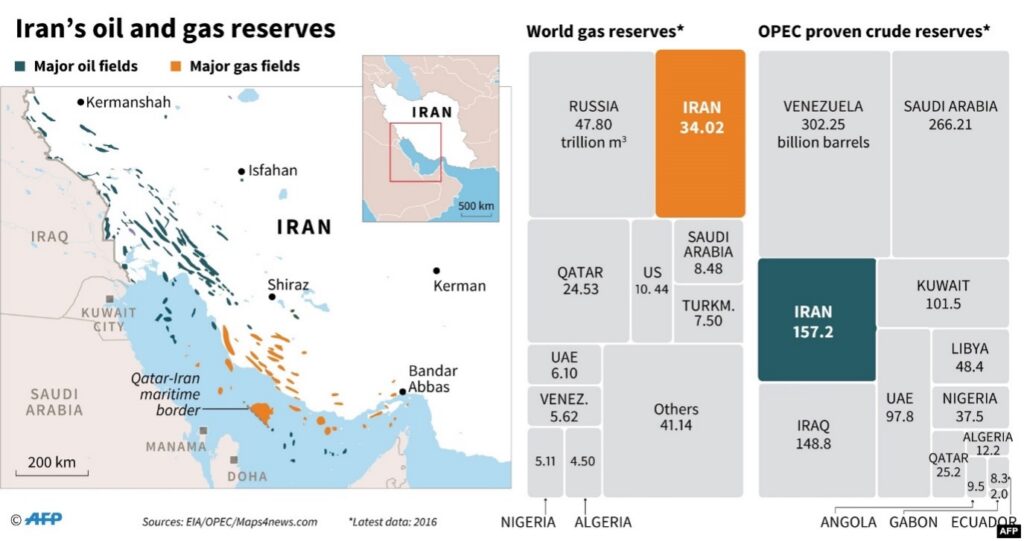
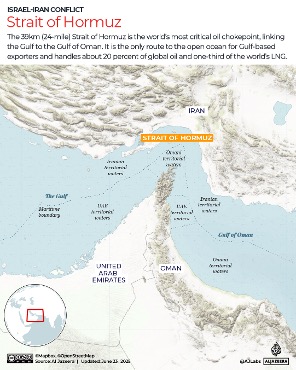
The country holds approximately nine percent of the world’s proven oil reserves and ranks second globally in natural gas reserves. The Strait of Hormuz lies at the center of this calculation. About one-fifth of global oil consumption passes through this narrow maritime corridor connecting the Persian Gulf to international markets. Iran’s coastline is on the northern side of the strait, placing the country in a critical position in maritime security dynamics. Although Tehran has repeatedly stated that it supports safe navigation, periodic tensions between Iran and Western naval forces have historically raised insurance costs and freight rates. Renewed internal instability, combined with visible military signals in the region, could heighten market sensitivity regarding this chokepoint. [21]
Between 15–20 February, oil exports from Kharg Island reached approximately 20.1 million barrels. This is nearly three times the amount loaded during the same period in January and far above Tehran’s normal daily rate, amounting to more than 3 million barrels per day. This surge coincides with the United States assembling the largest military force in the Middle East since the second Gulf War in 2003. [22] In our view, Iran’s rapid recent loading of oil onto tankers, as reported, may signal preparations for a potential U.S. strike.
Additionally, during live-fire exercises, Iran temporarily closed certain sections of the strait, describing the move as a security measure. This could be interpreted as a sign that Iran might attempt counterattacks or mine operations against the U.S. Navy to block the Gulf. It should be noted, however, that the Strait of Hormuz is not ideal for mine warfare. The currents in the strait push mines to the bottom or cause anchoring cables to snap. Similarly, the passage is far deeper than what is needed for bottom mines to be effective. In the past, Iran has not possessed mines of the type known as “rising mines,” which are needed for such a waterway. However, there is a possibility that Iran may have acquired these types of mines in the intervening period.
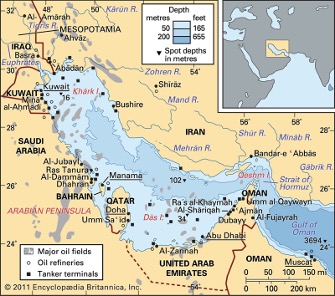
Additionally, the U.S. Navy has placed its regional operations on alert, deploying mine-clearing ships, unmanned maritime vehicles, and maritime patrol intelligence aircraft. The strait connecting the Persian Gulf to the Arabian Sea has two shipping lanes, each approximately two miles wide and separated by a buffer zone, and is used by about 3,000 ships every month.
Roughly one-quarter of seaborne oil and one-fifth of global LNG shipments pass through this corridor—mostly from Gulf producers to Asia—and most Gulf suppliers have no alternative maritime route for exports. “The LNG risk is even more serious,” analysts note. “Qatar, the world’s second-largest LNG exporter, ships all of its LNG through the Strait of Hormuz with no alternative route. Any disruption would quickly tighten supply both in Asia and globally, as buyers compete for available cargoes.” [23]
Some analysts believe that if Iran comes under severe pressure, it could close the strait as a last resort. If successful, this could cut oil supplies to economies such as China, India, and Europe, potentially driving oil prices above $120 per barrel. Other analysts argue that Iran is unlikely to close the strait, as doing so would harm both its enemies and its allies. [24]
Strategic Analysis of the U.S. Military Force Structure Before Intervention in Iran with a Different Military Strategy
Only eight months after the “Operation Midnight Hammer” carried out in June 2025, the United States is once again preparing to strike Iran. At that time, Trump described the attacks as a “magnificent military success” and claimed that Iran’s key uranium-enrichment facilities were “completely and utterly destroyed.” [25]
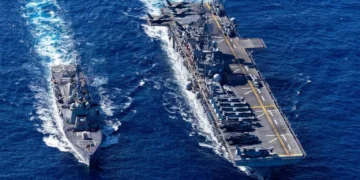
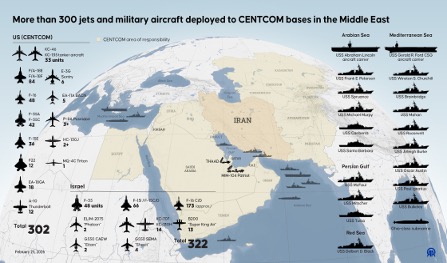
Analyzing the current strategic situation, the naval “armada” in the Middle East and Eastern Mediterranean—with 2 aircraft carriers and 16 surface warships—is the largest fleet in the region since the five-carrier battle group assembled at the start of the 2003 Operation Iraqi Freedom. This force is capable of conducting punitive strikes against Iran and protecting U.S. allies and partners in the region.
Today, the U.S. Navy consists of 292 warships, of which 233 are commissioned warships (USS) and 59 are support ships (USNS). Most are in port, under maintenance, or engaged in training, with less than one-fifth of the force at sea for operations. A total of 49 Navy ships are conducting operations, 20 of which are in or around the Middle East (18 USS and 2 USNS). In summary, 41% of Navy ships ready for military operations are in the Middle East. [26]
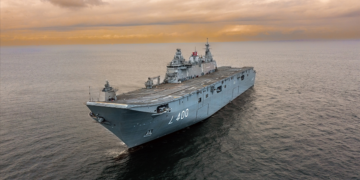
The world’s largest aircraft carrier, USS Gerald R. Ford, reached the coast of Israel while continuing its voyage in the Mediterranean. As part of the military buildup against Iran, numerous refueling aircraft have also been deployed to the region. The simultaneous deployment of two aircraft carriers in the same area has drawn particular attention. [27]
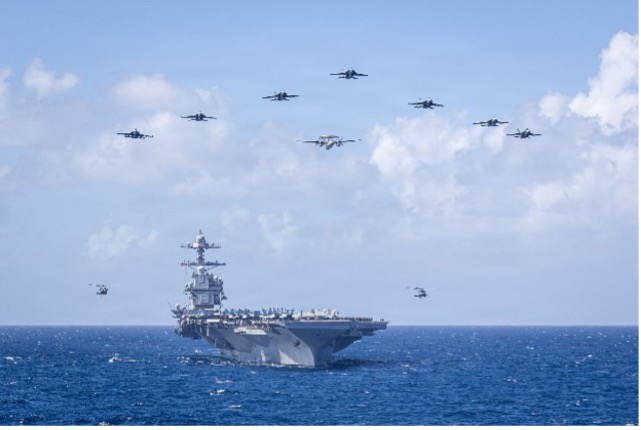
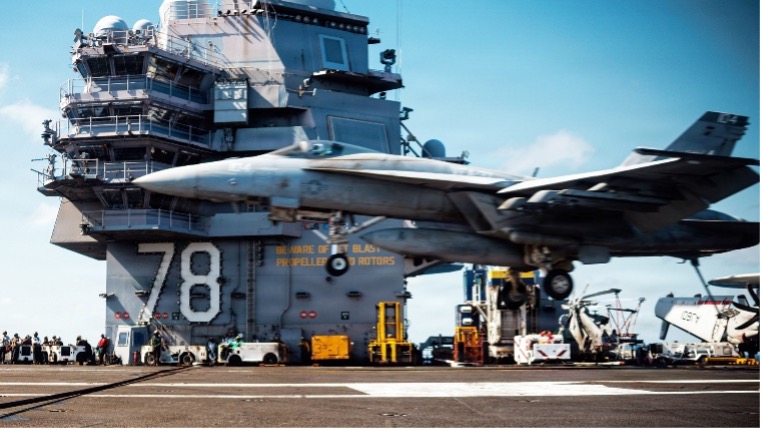
The U.S. Navy has increased its buildup in the Eastern Mediterranean and the Gulf region and intensified its planned exercises in preparation for an attack.
Experts say that Trump would likely have a range of military options, including precision strikes against Iran’s air defenses or attacks targeting Supreme Leader Ayatollah Ali Khamenei. However, they warn that Iran could retaliate in ways it did not after last year’s U.S. or Israeli strikes, which could endanger American lives and potentially trigger a regional war. [28] If we are talking about something that would last relatively briefly, like the 12-day conflict that took place last June, the answer would be that the U.S. could carry it out without substantial assistance from other countries in the region. The country most likely to join the U.S. would be Israel. [29] In an extraordinary development, the United States has deployed up to 12 F-22 fighter jets this week to Ovda Air Base in southern Israel.
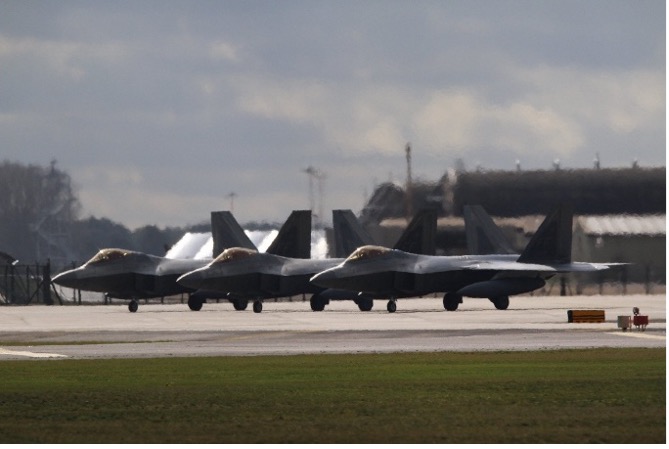
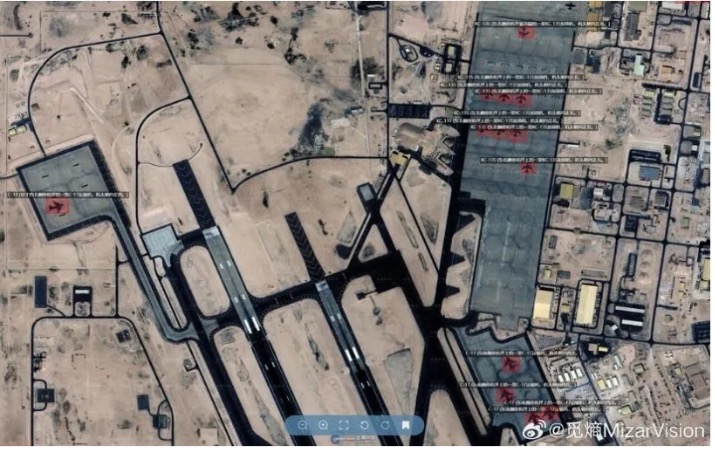
The U.S. Navy has increased its buildup in the Eastern Mediterranean and the Gulf region, intensifying planned exercises in preparation for an attack.
However, some of these partners—including Jordan, Saudi Arabia, Qatar, and the United Arab Emirates—have indicated or implied that they would not allow the U.S. to use their airspace or bases for attacks on Iran. Some of these statements came after high-level meetings with Iranian officials, and the decisions of Arab partners could complicate U.S. military planning and operations.
In modern history, few military operations have been announced as loudly and persistently in advance as the June 2025 strikes by Israel and the U.S. on Iran’s nuclear program. For over thirty years, leaders in Tel Aviv and Washington have issued stern warnings about the Islamic Republic’s nuclear ambitions and activities, and five U.S. presidents have pledged to prevent Tehran from achieving nuclear weapons capability. [30]
For the U.S., scenarios range from a limited, targeted strike to an intensive bombardment lasting weeks. Iran, on the other hand, might prefer a controlled and carefully planned response, similar to the preannounced reactions to U.S. attacks on its nuclear facilities during the 12-day Israel-Iran conflict last June. Alternatively, if Iranian leadership feels the regime faces an existential threat, it could decide to “set the region on fire.” Such an extreme scenario could include attacks on other U.S. allies in the region, including Israel and Saudi Arabia, strikes on oil and gas fields, and the closure of the Strait of Hormuz—a doomsday scenario.
Approximately 20 million barrels of crude oil and refined products pass daily through this narrow waterway between Iran and Oman, accounting for nearly a fifth of global consumption. Of course, if Iran disrupts passage through the Strait of Hormuz, it would also halt its own oil exports, depriving Tehran of vital revenue. This is likely one reason the Strait has never been fully closed. Moreover, the U.S. Navy is well-prepared for any intervention, which suggests that any disruption could be resolved within hours or days rather than weeks. [31]
Can the U.S. and China Manage an Oil Crisis?
Global energy markets increasingly operate within a framework where regional security dynamics can trigger intercontinental chain reactions with economic consequences. The complex relationship between geopolitical stability and energy supply chains has evolved into a system where a single bottleneck can affect everything from inflation rates to currency values. This interconnected reality becomes particularly evident when examining how a potential U.S.-Iran military conflict and oil prices interact within the broader context of global energy security.
The International Energy Agency (IEA) requires its members to maintain enough oil in their strategic reserves to cover at least 90 days of net crude oil and refined product imports. IEA members last released oil from strategic reserves in early 2022, following Russia’s full-scale invasion of Ukraine. This included the largest draw from the U.S. Strategic Petroleum Reserve in six months, averaging about one million barrels per day. The U.S. Strategic Petroleum Reserve, with a capacity of 714 million barrels, is the world’s largest emergency oil stockpile. Although Washington has been gradually replenishing its reserves since mid-2023, according to the U.S. Energy Information Administration, stocks were around 415 million barrels as of mid-February—well below capacity.
China’s crude oil purchasing behavior is also likely to play a central role in any supply disruption scenario. Consuming about 17 million barrels per day in 2025, China is particularly vulnerable to instability in the Middle East. According to the analytics firm Kpler, the region accounted for roughly half of China’s 10.4 million barrels per day of crude oil imports last year.
At the same time, according to ROI calculations, China has absorbed a large portion of the global supply surplus in recent years, adding an estimated 800,000 barrels per day of storage capacity in 2025 alone. China does not publish official data on its crude oil stocks, but analysts estimate that reserves could reach up to 1.3 billion barrels, covering more than four months of imports, with additional storage capacity also available. The commercial dynamics behind China’s storage policy remain uncertain, but historically, crude oil purchases have slowed during periods of relatively high oil prices. Beijing could ease pressure on global supply by slowing purchases if prices spike sharply. China may also choose to release some of its stocks to relieve pressure on domestic refineries. In 2022, China officially released strategic petroleum reserves (SPR) only once, and even then in a limited quantity.
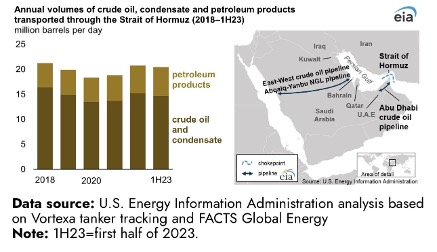
It is impossible to know exactly how the conflict between Washington and Tehran will unfold, but any escalation would likely drive oil prices even higher, and a serious disruption in Middle East oil supply could trigger one of the largest energy crises of the past decades. As a result, the world’s two largest oil consumers, the U.S. and China, hold the key to managing such a shock. [32]
Saudi Arabia and the UAE have some infrastructure that can bypass the Strait of Hormuz, which could partially mitigate disruptions in passage through the strait. These pipelines generally do not operate at full capacity, and our estimates suggest that in the event of a supply disruption, about 2.6 million barrels per day could be redirected through Saudi and UAE pipelines to bypass the Strait of Hormuz.
Saudi Aramco operates the East-West crude oil pipeline, which runs from the Abqaiq oil processing center near the Persian Gulf to the Red Sea port of Yanbu, with a capacity of 5 million barrels per day. In 2019, when Aramco converted some natural gas liquids pipelines to carry crude oil, the pipeline’s capacity temporarily increased to 7 million barrels per day. In 2024, Saudi Arabia pumped additional crude through the East-West pipeline to avoid transportation disruptions around the Bab el-Mandeb Strait.
The United Arab Emirates also operates a pipeline that bypasses the Strait of Hormuz. This pipeline, with a capacity of 1.8 million barrels per day, connects onshore oil fields to the Fujairah export terminal on the Gulf of Oman.
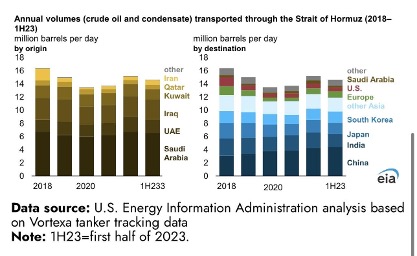
In 2024, volumes of crude oil and condensate originating from the UAE and passing through the Strait of Hormuz were 0.4 million barrels per day lower than in 2022, due to refinery upgrades that allowed more heavy crude to be processed domestically. These improvements also enabled the UAE to increase exports of lighter crude grades and led to higher utilization of the pipeline to the Fujairah export terminal. The increased daily use of the pipeline has limited the available spare capacity for redirecting additional volumes to bypass the Strait of Hormuz. [33]
Thirty years later, the pressing question remains: how can countries dependent on trade from the Persian Gulf protect the region from potential Iranian threats and attacks? One of the most important issues to address is the international nature of global shipping. According to the 2018 United Nations Review of Maritime Transport, half of the world’s commercial fleet is registered in the Marshall Islands, Liberia, Hong Kong, Singapore, and Malta. It is highly unlikely that the major navies—except China, which covers ships registered in Hong Kong—would provide escort services for vessels registered in these countries.
The post-World War II practice of open registries or “flags of convenience” has become widespread. Even in the case of the seized Stena Impero, which sailed under the British flag, no British nationals were employed on the ship. This raises the first question: do world navies, such as that of the United States, have a responsibility to assume an escort role? The U.S. did not take such action until attacks occurred on ships flying the American flag during the Tanker War.
If navies assume a protective role, the next question is: what advantage does registering a vessel under one’s national flag provide? Considering the number of ships passing through the Persian Gulf, a patrol operation resembling a maritime police function seems likely. Iran’s use of lighter, more mobile units—rather than larger assets such as frigates, submarines, or aircraft—would allow destroyers, frigates, and corvettes to patrol the relevant areas and maintain a greater presence in regions of heightened conflict. Support for the Special Response Team (SRT) would come from air assets deployed on land or at sea. [34]
Conclusion and Potential Developments
The U.S. and Israel have launched a major military operation against Iran in the early hours. The U.S. military has named the operation “Operation Epic Fury,” which Trump described as the United States conducting “a large and ongoing operation to prevent this very bad, radical dictatorship from threatening America and our core national security interests.” Trump has called on Iranian military forces to lay down their arms and for Iranian civilians to rise up and “take over their government,” but how Iran will respond remains unclear. Nevertheless, a new war has begun, reshaping regional and global balances.
Oil markets are currently experiencing significant price increases, with Brent crude rising above $71 per barrel, reaching a seven-month high. This upward movement is linked to escalating tensions between the U.S. and Iran, adding a risk premium of several dollars per barrel to U.S. crude. Market volatility stems from fears of potential military intervention and associated supply disruptions, while broader concerns about the global oil surplus continue.
Analysts warn that if rhetoric turns into concrete action, prices could rise even further. One analysis suggests that if the U.S. targets military or government leadership but avoids damaging Iran’s oil infrastructure, prices could reach around $80 per barrel. A separate assessment forecasts a temporary $10–$15 per barrel increase in the event of a broader, short-lived conflict that does not trigger major supply disruptions. More severe scenarios involve potential attacks on Iran’s production fields or export terminals, which some estimates suggest could push prices up to $100 per barrel. Last year’s previous worst-case scenario projected that if Iran were to blockade critical maritime chokepoints, prices could rise as high as $130 per barrel. [35]
Finally, striking Iran’s oil and gas fields, refineries, and nuclear infrastructure could lead to an environmental disaster comparable to the 1991 Gulf War.
SOURCE: C4Defence
Kaynakça
[1] https://www.cnbc.com/2026/02/27/trump-iran-war.html
[2] https://www.ft.com/content/2fb3447b-7ff7-4f9a-9068-05cfb4bf4138
[3] https://www.hurriyet.com.tr/dunya/live-son-dakika-iran-savasi-basladi-israil-tahrani-vurdu-43118343#post-2
[4] https://www.aa.com.tr/tr/dunya/abd-ve-israil-iran-a-saldiri-baslatti/3842503
[5] https://tr.euronews.com/2026/02/28/abd-ordusu-israilin-irana-baslattigi-saldiriya-katiliyor
[6] https://www.theguardian.com/world/2026/feb/28/us-israel-launch-strikes-attack-iran-what-we-know-so-far-latest
[7] https://www.trthaber.com/haber/dunya/abd-ve-israil-irana-saldiri-baslatti-935807.html
[8] https://www.ntv.com.tr/dunya/abd-destekli-israil-iran-savasi-iranda-hedefler-vuruldu-tahran-israile-fuze-saldirisi-baslatti-1713899
[9] https://www.bbc.com/turkce/articles/c70njd4e485o
[10] https://www.hurriyet.com.tr/dunya/israilde-ohal-kurmaylari-ile-siginakta-bulusan-netanyahudan-ilk-aciklama-operasyonun-adini-da-duyurdu-43118444?utm_source=webpush
[11] https://www.nbcnews.com/world/iran/live-blog/israel-iran-live-updates-rcna261099
[12] https://www.turkiyetoday.com/region/iran-strikes-us-naval-base-in-bahrain-as-retaliatory-missiles-hit-across-persian-gulf-3215284
[13] https://www.hindustantimes.com/world-news/israelus-attack-on-iran-spreads-to-wider-middle-east-us-bases-in-uae-bahrain-kuwait-qatar-become-targets-101772270192009.html
[14] https://www.theguardian.com/world/2026/feb/27/us-urges-citizens-leave-israel-threat-strike-iran
[15] https://www.facebook.com/techtimespage/posts/the-uss-gerald-r-ford-the-worlds-largest-and-most-advanced-nuclear-powered-aircr/903274602508279/
[16] https://www.bbc.com/news/articles/c309vz0z893o
[17] https://www.ntv.com.tr/dunya/trumptan-irana-operasyon-aciklamasi-bunu-yapmak-istemiyorum-ama-1713859
[18] https://www.theguardian.com/commentisfree/2026/feb/27/trump-iran-war-iraq-invasion
[19] https://edition.cnn.com/2026/02/23/politics/military-trump-iran-us-strike-mcgurk
[20] https://www.timesofisrael.com/despite-overwhelming-military-might-us-faces-complex-challenges-in-iran-campaign/
[21] https://bitumenmag.com/News/escalating-security-measures-in-iran-recast-regional-stability-calculations
[22] https://english.alarabiya.net/business/energy/2026/02/26/iran-ramps-up-oil-tanker-loadings-as-us-amasses-military-force
[23] https://www.independent.co.uk/news/world/middle-east/iran-us-strait-of-hormuz-asia-energy-threat-israel-b2925545.html
[24] https://en.majalla.com/node/326087/business-economy/what-would-happen-if-iran-closed-strait-hormuz
[25] https://www.nbcnews.com/world/iran/trump-said-obliterated-irans-nuclear-program-now-says-us-may-bomb-iran-rcna260383
[26] https://www.csis.org/analysis/us-military-middle-east-numbers-behind-trumps-threats-against-iran
[27] https://www.ntv.com.tr/dunya/abd-donanmasindan-dikkat-ceken-adim-ayni-anda-iki-gemi-bolgede-ve-dunyanin-en-buyuk-ucak-gemisi-israile-yanasti-1713810
[28] https://www.militarytimes.com/news/your-military/2026/02/26/us-military-assembles-largest-force-of-warships-aircraft-in-middle-east-in-decades/
[29] https://www.npr.org/2026/02/27/nx-s1-5727652/how-u-s-allies-are-bracing-for-trumps-potential-military-action-against-iran
[30] https://www.foreignaffairs.com/iran/irans-dangerous-desperation
[31] https://thearabweekly.com/us-and-china-hold-keys-containing-oil-shock-war-iran
[32] https://thearabweekly.com/us-and-china-hold-keys-containing-oil-shock-war-iran
[33] https://www.eia.gov/todayinenergy/detail.php?id=65504
[34] https://navalinstitute.com.au/escorting-in-the-persian-gulf/
[35] https://www.indexbox.io/blog/opec-considers-2026-production-hike-as-iran-tensions-drive-oil-prices-higher/