


























Thales Alenia Space has signed a strategic contract with OHB System AG, the prime contractor for the European Space Agency’s (ESA) LISA mission, which will study gravitational waves. The initial value of the contract, signed to provide the propulsion subsystem for the LISA (Laser Interferometer Space Antenna) mission, was announced as €16.5 million. The project, to be carried out by Thales Alenia Space—a joint venture of Thales (67%) and Leonardo (33%)—is expected to reach a total volume of €89.5 million as it progresses through subsequent phases.

Technological Subsystems and Task Allocation
Thales Alenia Space’s facilities in the United Kingdom will assume full responsibility for the propulsion subsystem, from design and manufacturing to system assembly, integration, and testing processes. Leonardo, meanwhile, will supply the micro-propulsion units that precisely control the satellite’s attitude. The company will also provide flight computers, control software, and telecommunications systems, as well as DFACS (Drag-Free and Attitude Control System) units that enable the satellites to maintain a “free-fall” state without being affected by external forces.
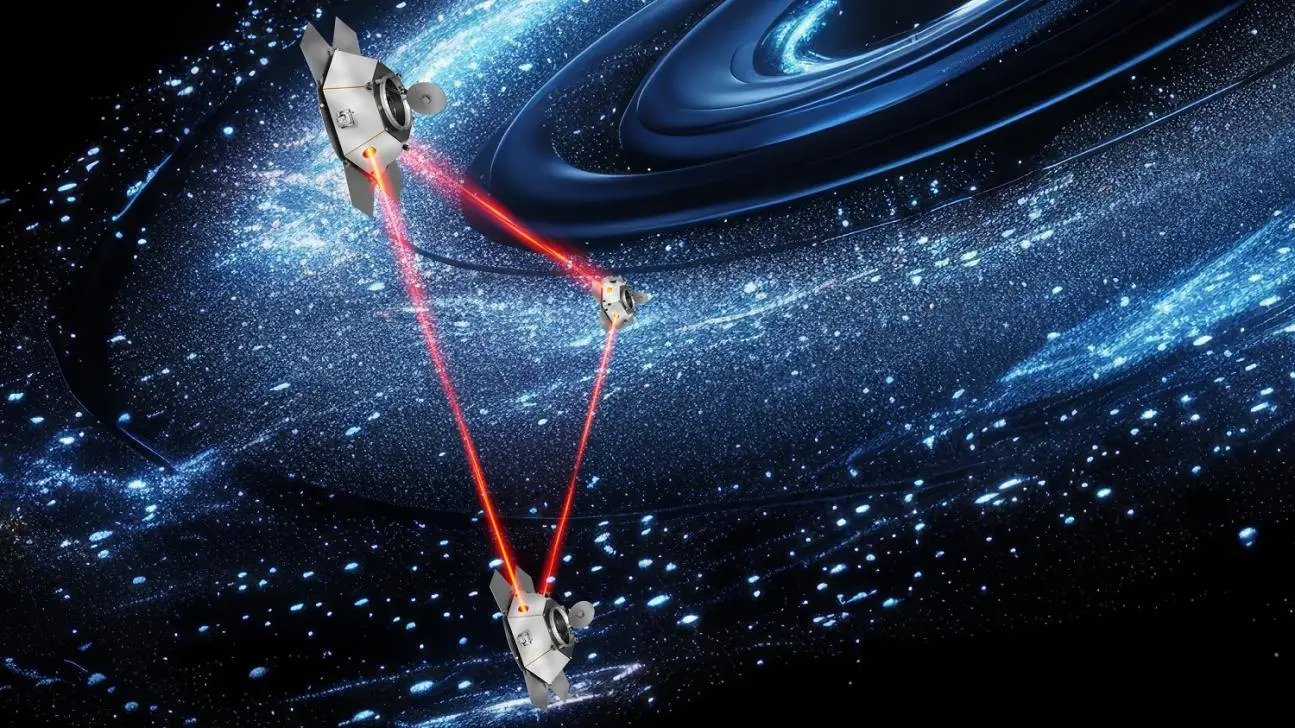
Planned to be launched in 2035 aboard an Ariane 6 rocket, LISA will form a triangular constellation of three satellites positioned 2.5 million kilometers apart in space. This system will become the first space-based observatory to test Einstein’s general theory of relativity through space-based observations by measuring spacetime fluctuations with a precision smaller than the diameter of an atom.
Source: C4Defence / Thales