


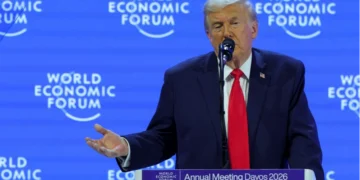




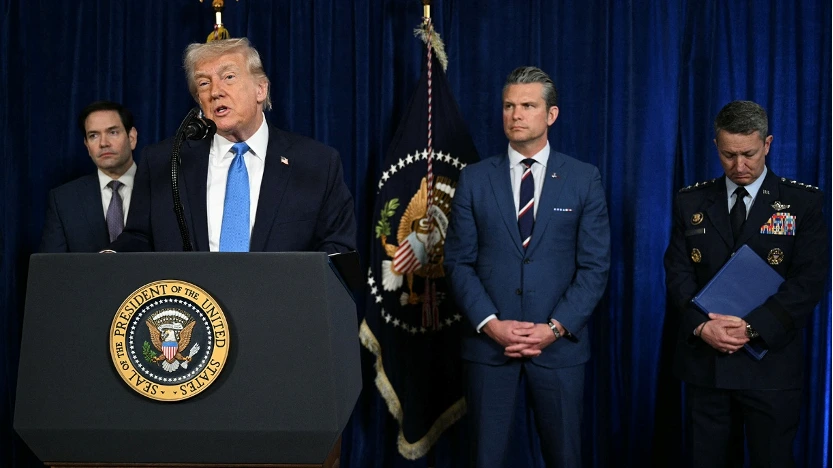
“All of these actions were a serious violation of the fundamental principles of American foreign policy that date back more than two centuries.” “It goes all the way back to the Monroe doctrines. The Monroe Doctrine is a very important thing, but we went far—really far—beyond it. Now they call it the Donroe Doctrine. In a way, we forgot it.” “It was very important, but we forgot it. We are not forgetting it anymore. Under our new national security strategy, American sovereignty in the Western Hemisphere will never be questioned again.”
Donald Trump [1]
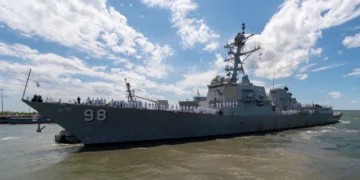
The United States carried out a “large-scale attack” against Venezuela. U.S. President Donald Trump said, “We are reasserting American power.” [2] The operation began with an attack package launched by the United States Armed Forces under the code name “Absolute Resolve Operation,” starting with strikes on military and civilian strategic targets in northern Venezuela. Maduro and his wife Cilia Flores were taken from their residence on a military base, placed aboard a U.S. warship to be taken to New York, and subsequently brought to New York to face charges of narco-terrorism. In the indictment, they were accused of playing a role in a narco-terrorism conspiracy. The defendants are charged with conspiring to commit narco-terrorism and import cocaine, possessing machine guns and destructive devices, and conspiring to possess machine guns and destructive devices against the United States. [3] The Venezuelan government described this as an “imperialist attack” and called on its citizens to take to the streets. [4] President Trump first announced the operation with the statement: “The United States has successfully carried out a large-scale operation against Venezuela and its leader President Nicolas Maduro. Maduro and his wife have been captured and removed from the country.” [5] U.S. President Donald Trump claimed that Venezuela would be “administered” by Washington until a “safe” transition process was completed. Russia, Iran, Brazil, and other countries condemned the attack, stating that it was a “violation of international law.” UN Secretary-General Antonio Guterres stated that the attack set a “dangerous precedent.” Germany, the EU, the United Kingdom, and others welcomed the overthrow of Maduro and, while calling for elections, also called for respect for international law. [6]

In our view, the Trump administration’s removal of Maduro from power in Venezuela is the de facto pulling of the trigger of the “Trump Addendum” to the Monroe Doctrine, clearly set out in the U.S. 2025 National Security Strategy; in order to reestablish overwhelming strategic superiority in the United States’ backyard in Central and South America, it constitutes an open challenge not only to Cuba–Colombia–Mexico, but rather to Beijing and Moscow. Indeed, in line with this assessment, Trump, stating that Venezuela had acquired “offensive weapons” and that these weapons were used, argued that these actions violated U.S. foreign policy principles dating back to the “Monroe Doctrine.” Regarding the “Monroe Doctrine,” Trump said, “With our new national security strategy, we will no longer forget this. America’s dominance in the Western Hemisphere will never be questioned again.” Targeting Colombian President Gustavo Petro as well, Trump reiterated his previous statements, repeating the claim that the country sends cocaine to the United States. Trump stated, “(Petro) has factories that produce cocaine, he produces the cocaine and sends it to the U.S. He needs to be careful.” Trump also said that the military operation was a warning to others who could threaten American “sovereignty” or American lives in Venezuela. [7] Donald Trump, by targeting Colombia, Mexico, and Cuba, signaled that these countries could face a similar fate. Expressing his discomfort regarding security at the Mexican border and the flow of drugs, Trump did not give a clear confirmation as to whether the Venezuela raid was a warning, but used the phrase “something needs to be done.” [8] In his statement, Trump threatened Colombian President Gustavo by saying, “He has factories that produce cocaine, he produces the cocaine and sends it to the U.S.” Trump also sent a message to Cuba, saying, “Cuba is a collapsing country and we want to help its people. I think Cuba will also be one of the countries we will talk about.” [9] Chilean President Gabriel Boric raised concerns with the statement: “Today Venezuela, tomorrow it could be any other country.” [10]
Analysis of the Military Operation
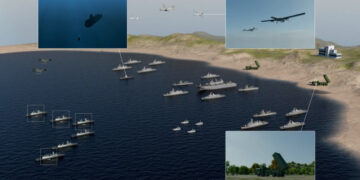
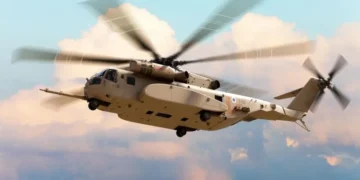
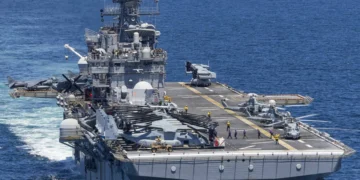
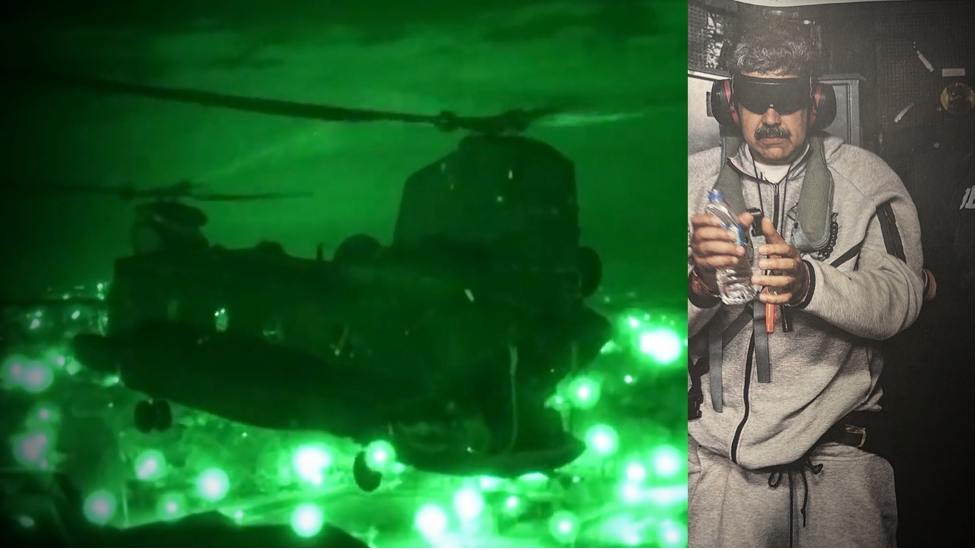
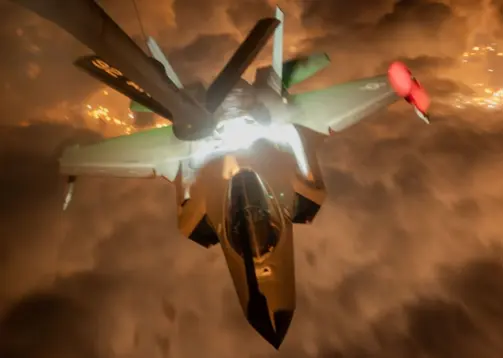
The United States has been increasing its military capacity in the region for several months. The most significant development was initiated in mid-November with the deployment of the USS Gerald Ford aircraft carrier strike group and numerous other warships to the Caribbean. U.S. Chairman of the Joint Chiefs of Staff General Dan Caine stated that Operation Absolute Resolve required months of planning and exercises, and that the forces waited for suitable weather conditions. General Dan Caine said, “As night fell, helicopters took off with the extraction force, which included law enforcement personnel, and began flying toward Venezuela at 100 feet above sea level.” As the helicopters approached the coast, they were protected by other aircraft, including unmanned aerial vehicles, bombers, and fighter jets. Caine stated, “These forces were protected by aircraft belonging to the United States Marine Corps, the United States Navy, the United States Air Force, and the Air National Guard.” The protective force included F-22s, F-35s, F/A-18 E/A aircraft, B-2s, B-1s, and “numerous remotely piloted unmanned aerial vehicles, as well as other support aircraft,” he said. [11]
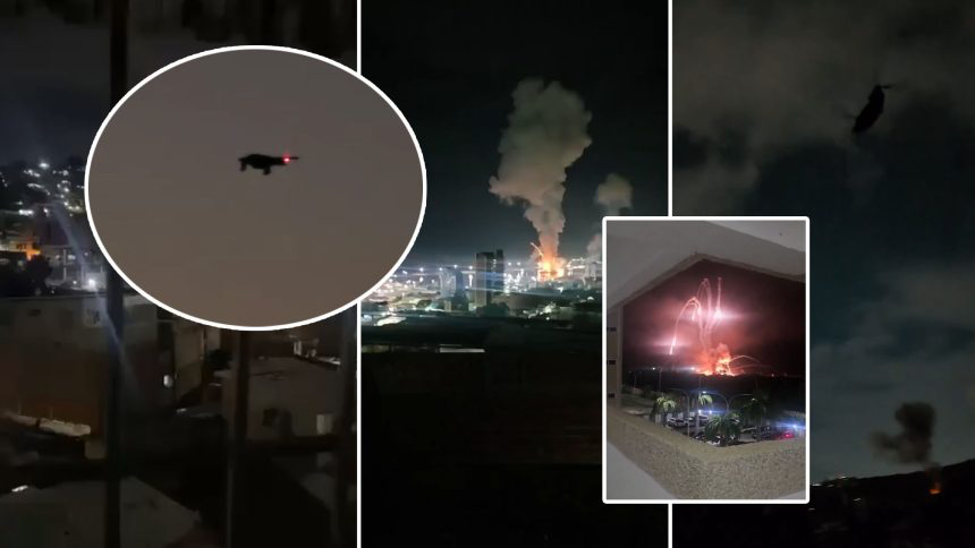
According to Caine, as the helicopters approached Caracas, the United States dismantled and disabled Venezuela’s air defense systems and also deployed weapons “to ensure the helicopters’ safe passage to the target area.” According to Caine’s account, after the helicopters reached the compound, they came under fire but continued operating. According to Caine, U.S. forces and the FBI eventually entered the compound, and Maduro and his wife “surrendered” and were taken into custody. Trump said that Maduro tried to flee during his capture. “He was trying to get into a safe place,” Mr. Trump told reporters. “The safe place was made entirely of steel, and because our guys were very fast, he couldn’t reach the door,” he stated. [12]
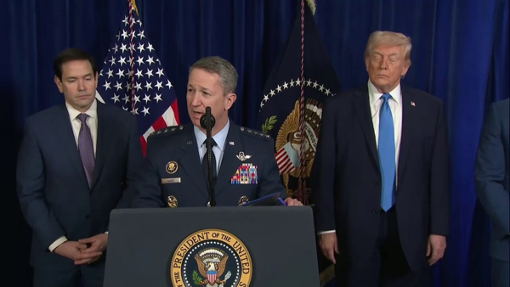
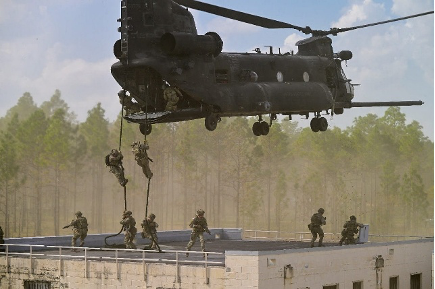
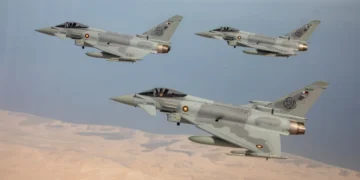
Caine, while describing the details of the operation, left the door open to the argument that other operations could be carried out with the statement, “There is always the possibility that we may undertake such a mission again.” [13] More than 150 aircraft were used to deliver the extraction team to the capital. The official added that no U.S. soldiers were killed in the operation and that there were “very few” wounded, stating that he watched the operation live. Maduro and his wife were first placed on a ship and then onto an aircraft, which later landed at Stewart Air National Guard Base in New York State, approximately 97 km north of Manhattan.
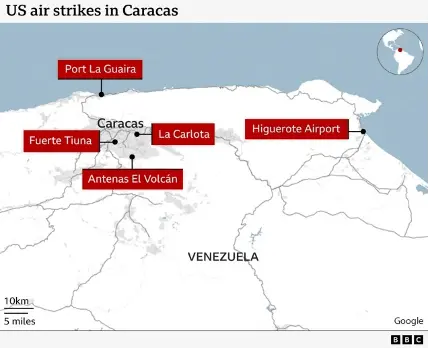
The U.S. strike force concentrated on five targets: Generalissimo Francisco de Miranda Air Base; an airport known as La Carlota; Fuerte Tiuna, a major military facility in Caracas; the Port of La Guaira, Caracas’s main gateway to the Caribbean Sea; and Higuerote Airport, which is also located in Miranda state, just east of Caracas. Antenas El Volcán targeted a telecommunications tower on Cerro El Volcán, a high peak in Miranda state. [14] The dawn raid carried out by elite Delta Force commandos was the riskiest military operation of its kind since U.S. Navy SEAL Team 6 members killed Osama bin Laden at a safe house in Pakistan in 2011. [15] According to Chairman of the Joint Chiefs of Staff Air Force General Dan Caine, the military also established an extensive network with many U.S. intelligence agencies. Secretary of War Pete Hegseth stated, “This is America First; this is peace through strength; and the United States Department of War is proud to help make it happen.” [16] Secretary of Defense Pete Hegseth stated that the U.S. intervention in Venezuela and the capture of Nicolás Maduro were the “opposite” of the U.S. invasion of Iraq. Hegseth said, “We spent decades shedding blood and got nothing economically in return, and President Trump has reversed that.” Hegseth stated that through strategic actions the United States could “gain access to additional wealth and resources and allow a country to release them without spilling American blood.” [17]
The Theoretical and Strategic Background of the United States’ New Monroe Doctrine and Its Challenge to China and Russia
Missile Crisis and launch a military attack on Venezuela? The “Trump Addendum” to the Monroe Doctrine, outlined in the 2025 National Security Strategy, has officially entered into force. Just days after reports that the Chinese People’s Liberation Army conducted warfighting simulations in the Western Hemisphere, and after China’s new official strategy toward Latin America refused to recognize the region as being of special importance to U.S. security, Washington demonstrated a long-awaited commitment to hemispheric security. The Trump administration’s removal of Maduro from power in Venezuela is not only a message to hostile regimes in the hemisphere such as Cuba and Nicaragua; it is also an attempt to reestablish global deterrence that will be seen in Beijing and Moscow as a clear sign of the Trump administration’s commitment to a security order aligned with American interests. [18]
The core principles of the doctrine continued to evolve through subsequent administrations. In 1904, President Theodore Roosevelt added the “Roosevelt Corollary,” which stated that the United States had the right to intervene in the Americas under certain conditions. This principle declared that the U.S. government could use “international police power” to end what Roosevelt called “chronic wrongdoing or impotence” in the Western Hemisphere. Trump’s statements on January 3 were not the first time he had expressed a desire to return to a foreign policy position inspired by this centuries-old doctrine. In November, the administration published an updated national security strategy, explicitly shaping its posture toward the Western Hemisphere in accordance with the Monroe Doctrine and stating that it would “reassert and reinforce” the doctrine in order to “reestablish American supremacy.” [19]
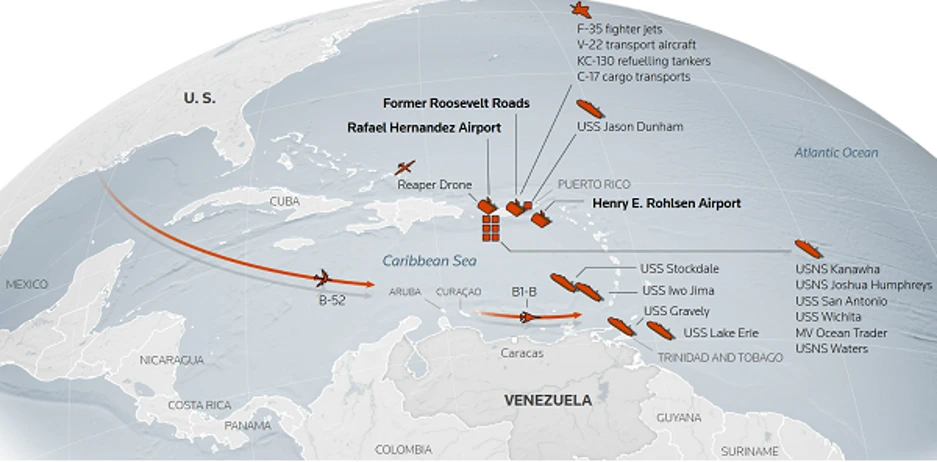
The United States had, in fact, already revealed its strategic shift in Central America. Indeed, three U.S. military officials and three maritime experts said that the new construction in Puerto Rico and the Virgin Islands indicated preparations that could enable the U.S. military to conduct operations inside Venezuela. Venezuelan President Nicolás Maduro explicitly signaled that the United States was aiming to remove him from power. Construction work at the former Roosevelt Roads naval base in Puerto Rico, which had been closed by the U.S. Navy more than 20 years ago, began on September 17, and crews cleared and repaved the taxiways leading to the runway. Until the Navy withdrew from the facility in 2004, Roosevelt Roads was one of the largest U.S. naval bases in the world. The military buildup in the region is the largest unrelated to disaster relief since the United States sent two aircraft carriers and more than 20,000 troops to Haiti in 1994 as part of “Operation Uphold Democracy.” Since early September, the United States has carried out dozens of strikes in the Caribbean and the Pacific against vessels allegedly carrying drugs. [20]
Analysis of the Operation from the Perspective of International Law and U.S. Law
The counterargument to Trump’s attacks on Venezuela is that the operation violates international law. [21] The United States’ recent actions set a troubling precedent for the region. The UN Secretary-General, the UN High Commissioner for Human Rights, and many governments around the world have raised alarms about actions by the Trump administration that could further increase regional polarization and instability. [22] The theory of state sovereignty is one of the core principles of international law. Has the rule that heads of state enjoy jurisdictional immunity under international law been violated? The principle of non-intervention in the internal affairs of states, set out in Article 2 of the UN Charter, is comprehensive and encompasses the concepts of the “prohibition of intervention” and “non-interference.” The prohibition of intervention includes elements such as direct armed conflict and war, while non-interference has a lighter character, covering forms of involvement that do not amount to war or direct intervention. [23]
Trump argued that the attack was a military operation unprecedented since World War II and that its purpose was “to bring the dictator Maduro to justice,” asserting that the “partnership” between the United States and Venezuela would make Venezuela “rich, free, and secure,” and claimed that “the long-suffering of the Venezuelan people will come to an end.” Trump stated that he did not want anyone else to become involved in Venezuela or for the situation that had persisted for many years to be repeated, saying, “We will continue to administer the country until such time as we can carry out a safe, proper, and reasonable transition.” Stating that the embargo imposed on Venezuelan oil would remain fully in force, Trump said that the U.S. Navy would maintain its position there and that this would continue until U.S. demands were fully met. [24] U.S. President Trump defended the legal legitimacy of the operation by saying, “…This was an operation against a heavily fortified military stronghold in the heart of Caracas to bring the lawless dictator Nicolás Maduro to justice.” Republican Senator Susan Collins of Maine said that the Trump administration should have informed Congress in advance about the operation and that lawmakers should be involved in the process as the situation developed. [25]
The legal and constitutional basis of the Venezuelan military operation carried out by the U.S. Army—specifically, the capture and prosecution of the head of a sovereign state—remains legally controversial. Under domestic law, it was also unclear whether U.S. President Trump consulted the U.S. Congress prior to the operation. As is known, under the U.S. Constitution, before the country’s armed forces are deployed against an overseas adversary state and prior to a declaration of war, the presidency is required to notify Congress. On the matter, U.S. Attorney General Pam Bondi stated that the couple would face criminal charges and be tried in the United States based on an indictment filed in New York in 2020. In a social media post, she said, “They will soon face the full wrath of American justice on American soil, in American courts.” United Nations Special Rapporteur on Human Rights and Counter-Terrorism Ben Saul said that Trump should be investigated because of this operation. Saul stated, “I condemn the United States’ illegal attack against Venezuela and the illegal abduction of its leader and his wife. Every Venezuelan life lost is a violation of the right to life.” [26]
France, Russia, China, and the EU, as well as the European Commission, have argued that Washington violated international law following the operation carried out by U.S. forces. Brazilian President Luiz Inácio Lula da Silva said that the United States’ actions had “crossed an unacceptable line,” likening them to “the darkest moments of [U.S.] intervention in Latin America and the Caribbean,” an explicit reference to the dozens of U.S. military interventions in the region over the past two centuries. China’s Ministry of Foreign Affairs condemned the United States’ “hegemonic behavior,” stating that it threatened peace and security in Latin America and the Caribbean. In its statement, China said, “China, deeply shocked by the United States’ use of force against a sovereign country and its president, strongly condemns this.” [27] Cuban President Díaz-Canel stated, “Cuba condemns the criminal attack by the United States against Venezuela and calls on the international community for an urgent response.” UK Prime Minister Keir Starmer, meanwhile, stated that his country had long supported a change of power in Venezuela, saying, “We regarded (Venezuelan President) Nicolás Maduro as an illegitimate president, and we feel no regret at the end of his regime.” Recalling that the United Kingdom reiterated its support for international law following the U.S. intervention in Venezuela, Starmer said, “The UK government will discuss the evolving situation with U.S. counterparts in the coming days in order to ensure a safe and peaceful transition to a legitimate government that reflects the will of the Venezuelan people.” [28]
References
[1] https://www.usatoday.com/story/news/politics/2026/01/03/trump-on-monroe-doctrine-the-donroe-doctrine-after-venezuela-raid/88008767007/
[2] https://www.atlanticcouncil.org/dispatches/us-just-captured-maduro-whats-next-for-venezuela-and-the-region/
[3] https://www.bbc.com/news/articles/crmlz7r0zrxo
[4] https://www.pbs.org/newshour/world/a-timeline-of-u-s-military-escalation-against-venezuela-leading-to-maduros-capture
[5] https://taskandpurpose.com/news/us-strikes-venezuela-caracas/
[6] https://www.dw.com/en/explosions-in-caracas-venezuela/live-75373644
[7] https://breakingdefense.com/2026/01/us-military-attacks-venezuela-captures-maduro-trump-says/?utm_medium=email&_hsenc=p2ANqtz-_HKT9OsuUXkQIZl05k1gC-UymzL-M_NBknPY5KiPWfvoB4rjdUqsBGSS3zgpzjzhQK-O4_dmkCeFGRfiSmksJS5f4j1u5rYYH4urBN5LcKKBNYzxI&_hsmi=396826082&utm_content=396826082&utm_source=hs_email
[8] https://gdh.digital/haber/trump-venezuelanin-ardindan-3-ulkeyi-daha-tehdit-etti-siradaki-onlar-olabilir-d0qn8a2z0k
[9] https://www.milliyet.com.tr/dunya/trump-canli-yayinda-iki-ulkeyi-tehdit-etti-dikkat-etmelerini-oneriyorum-7514913
[10] https://x.com/CNNChile/status/2007528427323097478
[11] https://breakingdefense.com/2026/01/venezuela-150-aircraft-cyber-effects-maduro-operation-how-it-happened-caine/
[12] https://www.cbsnews.com/live-updates/venezuela-us-military-strikes-maduro-trump/
[13] https://breakingdefense.com/2026/01/venezuela-150-aircraft-cyber-effects-maduro-operation-how-it-happened-caine/
[14] https://www.bbc.com/news/articles/crmlz7r0zrxo
[15] https://www.nytimes.com/2026/01/03/us/politics/trump-capture-maduro-venezuela.html
[16] https://www.war.gov/News/News-Stories/Article/Article/4370431/trump-announces-us-militarys-capture-of-maduro/
[17] https://www.cbsnews.com/live-updates/venezuela-us-military-strikes-maduro-trump/
[18] https://www.atlanticcouncil.org/dispatches/us-just-captured-maduro-whats-next-for-venezuela-and-the-region/#gray
[19] https://www.usatoday.com/story/news/politics/2026/01/03/trump-on-monroe-doctrine-the-donroe-doctrine-after-venezuela-raid/88008767007/
[20] https://repeatingislands.com/2025/11/07/how-the-us-is-preparing-a-military-staging-ground-near-venezuela/
[21] https://www.nytimes.com/2026/01/03/opinion/venezuela-attack-trump-us.html
[22] https://www.wola.org/2026/01/military-action-venezuela-united-states-maduro-trump/
[23] Mesut Hakkı Caşın: ‘’Uluslararası Hukukun Temel Esasları’’, İstanbul, 2022.
[24] Hürriyet Gazetesi. https://www.hurriyet.com.tr/dunya/live-son-dakika-abdye-goturulen-madurodan-yeni-goruntuler-elleri-kelepceli-ayaginda-terlik-43076383
[25] https://www.cbsnews.com/live-updates/venezuela-us-military-strikes-maduro-trump/
[26] https://www.theguardian.com/world/2026/jan/03/explosions-reported-venezuela-caracas
[27] https://www.theguardian.com/world/2026/jan/03/colombia-sends-armed-forces-venezuela-border-concern-refugee-influx
[28] https://www.haberturk.com/kuba-venezuela-ya-yonelik-saldirilar-nedeniyle-abd-yi-kinadi-3850687?page=3